
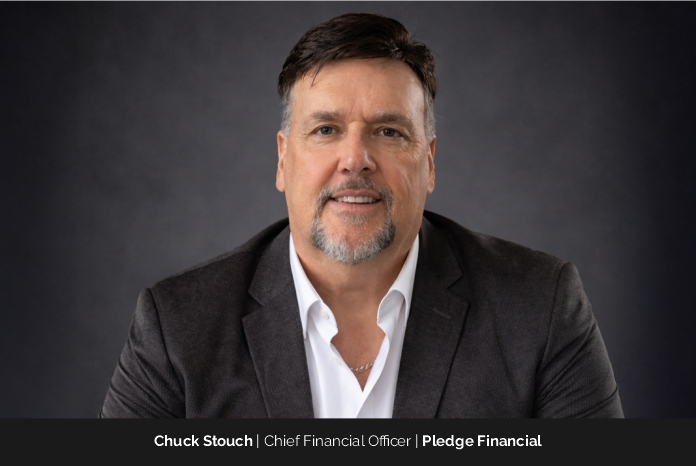
Chuck Stouch, Chief Financial Officer at Pledge Financial, has built his reputation on discipline, accountability, and an internal drive to be successful. His journey begins not with boardrooms or international acquisitions, but with a simple truth learned early: if you want something, you work hard for it. “I grew up a blue‑collared kid in a row home on the outskirts of Philadelphia… Dad was a truck driver and a veteran, and we didn’t have much so I learned to hustle at a young age,” he recalls. From shoveling snow to mowing lawns to scalping tickets to pay for college, he learned that nothing in life was handed to you—you earned it. Those experiences formed the grit and determination that would shape everything that followed in his future.
Chuck has built his reputation as someone who breaks through barriers and gets things done, always pushing to exceed expectations. As a young and hungry accountant at a regional CPA firm, he worked 65–70‑hour weeks, often the first in and last out. Worried he was falling behind his peers due to an overwhelming workload, he sought insight from a partner—who delivered a statement that would stay with him forever: “The reward for a job well done is the opportunity to do more.” Chuck did more—and he’s been doing more ever since.
Beyond the spreadsheets and strategic plans, there’s a side of Chuck most don’t see: the adventurer. He’s traveled the world seeking experiences that match the boldness he brings to his career. He’s swum with sharks off the coast of South Africa, he’s run with the bulls in Spain and toasted with friends at Octoberfest in Germany. He believes that stepping into discomfort—whether in business or halfway around the world—is the fastest way to grow.
The through-line in Chuck’s life is simple: challenge everything, work relentlessly, push boundaries, try to make it fun and never forget where you came from. .
A Systems Mindset And Ownership Lens
Chuck recants that he left public accounting because whenever he told a joke, no one laughed, and he knew he was funnier than that! But he also knew partnership in a CPA firm was not his path. The discipline of auditing shaped Chuck’s foundation, joining Digital Systems Group, which built proprietary accounting software for government agencies, pushing him into new technical complexity. He learned fund accounting, mastered the software logic, translated customer needs into technical specifications and presented the system to prospective customers from the Pentagon to major Naval bases across the country.
Across organizations, industries, and continents, Chuck Stouch found his calling not just in analyzing numbers but in building systems, teams, and scalable futures. His time at Pledge Financial is a master class in operational architecture. When he arrived, the company had 12 stores, no real back office, and no infrastructure. Within three months, he built everything—banking structure, payables processing, general ledger architecture, and an entire reporting ecosystem—“all scalable,” as he notes with pride. His joy? Creating order from chaos. His fuel? High standards, strong teams, and the challenge of building something from scratch turning complexity into clarity.
Becoming a co-owner did not change Chuck’s approach to spending; it reinforced it. He’s always treated every dollar as if it were his own and believes accountability starts with personal example. His coworkers tease him the way he scrutinizes expenses and for flying discount airlines to save a few dollars, but he believes that discipline in small choices builds trust in larger ones.
A Career Without Borders
Chuck has had an amazing career holding executive positions across the U.S., Canada, and Europe, but his most meaningful accomplishment came while working for Dollar Financial Group outside Philadelphia. After gaining M&A experience and serving as VP Finance for a newly acquired subsidiary, he was asked to step into Canada to oversee North American back-office operations during a leadership transition.
Suddenly, 73 people reported to him, a moment that felt “both exciting and intimidating” but he has never been one to back down from a challenge. By listening closely, addressing long-standing issues, and implementing systems that made work easier, Chuck quickly earned the team’s trust. Within a month, the management team advocated to keep him permanently, and he relocated to Victoria, British Columbia, as one of the company’s first expats.
Abroad, he learned that leadership travels—but it must adapt to local cultures. One of his most challenging assignments came while he was living and working in London. He was brought in to help a struggling acquisition in Madrid, Spain. It was an eight-store acquisition where every customer transaction was handwritten in a ledger, transferred at month end to a home office where the data was typed into spreadsheets, and reported in company consolidation a month in arrears. He modernized the entire process—while navigating cultural curveballs like siestas and tapas invitations that tested his patience and broadened his perspective. “Leadership should make people better, not just busier,” he observes.
A Blueprint for Exceptional Teams
Chuck believes the difference between a good finance team and a truly exceptional one comes down to people. He surrounds himself with managers who push back thoughtfully, listen to alternatives, and put the best ideas forward regardless of where they come from. He builds teams on example and accountability, supporting those doing the toughest work, passing along praise, and taking responsibility when things go wrong.
He also looks for hidden strengths beyond job titles and invests time walking the floor, talking with his team, and understanding their challenges. “When goals are clear, and people see how their work contributes, alignment follows, and alignment creates excellence. When people feel supported and understood, their best work shows up,” he reflects.
Chuck believes that exceptional teams thrive when managers are empowered to challenge and contribute. He insists culture matters just as much as skill, creating traditions that bring people together and make the office environment enjoyable. As an executive leader in Canada, he created and DJ’d an annual company-wide “Wing Bowl” celebration with employee prepared foods, whacky costume contests, and a five-minute wing-eating competition, building camaraderie across all levels of employees and departments.
“You’re nothing without the individuals who support you, challenge you, and grow alongside you,” he notes. For him, exceptional teams are defined by trust, shared purpose, accountability, and genuine connection. “When people feel valued, challenged, and united, you can build something truly world-class,” he reflects, we had that in Canada.
Scaling Pledge with Discipline
Pledge has grown to 51 stores through 19 acquisitions in a little over three years. The hardest challenge has been building one unified culture. Every acquisition comes with its own processes, performance pay scale and systems. Molding all this into one culture that all team members buy into is a struggle and not everybody makes it.
Most recently, Pledge closed six separate deals—adding 16 stores across three states—right before and after the Christmas holiday. Each acquisition requires a full physical audit, with three people assigned per store. That level of staffing means pulling team members from existing locations, which can strain operations during an already demanding season. Seeing the entire organization come together—across functions, regions, and time zones—to complete all of this within a single month reinforces the importance of communication, trust, and leading from the front. It was a reminder that leadership isn’t just about directing the process; it’s about showing up, setting the tone, and ensuring people feel valued while tackling the hard work.
On the operational side, technology has transformed the way we analyze and manage the business. Advanced data collection and performance metrics now give us clearer insights into what items sell best at each location, how inventory should be moved to maximize sales, and where opportunities exist to improve yields. These tools allow us to run more efficiently, make smarter lending decisions, and manage multi‑unit operations with far greater precision than ever before. while the essence of pawn remains the same, the industry is becoming more data‑driven, more customer‑centric, and more technologically enabled. Operators who embrace these changes—without losing sight of the relationship‑driven nature of pawn—will be best positioned to thrive in the years ahead.
“Rapid growth only works when people, process, and discipline stay aligned.”
Shaping Future CFOs And Lasting Impact
Technology is central to Chuck’s philosophy. He recalls that when he began in public accounting, he had a number 2 pencil, a ten-key calculator, and green bar ledger paper, carrying audit binders and doing everything manually. Having seen the shift from ledger paper to fully digital systems, he believes finance now stands at the edge of another transformation with artificial intelligence.
Chuck sees the CFO role evolving into a technologist, strategist, and data architect as AI reshapes data analysis, risk modeling, and decision making. He encourages emerging leaders to embrace technology early, master the fundamentals, become fluent in it, experiment with it, question assumptions, and use AI to enhance judgment rather than replace it.
“The leaders who embrace this shift early will shape the future of the industry,” he explains, adding, ““Those who leverage data and technology without compromising trust will excel.”
“The best CFOs will blend timeless discipline with modern analytical capability.”
A Legacy Measured in People
Chuck Stouch built his career the way he built his first accounting systems—piece by piece, with determination, intensity, and a refusal to settle for “good enough.” He’s a builder, a problem‑solver, a mentor, and a leader who knows that humor, tenacity, and high standards can coexist.
For all the systems he’s built and all the companies he’s helped grow and even taking one public, Chuck says his greatest achievements aren’t the metrics or milestones. They’re the people. The colleagues who still reach out years later to tell him he was the best leader they ever had. The friendships built across borders. The teams whose confidence he strengthened, whose careers he helped shape.
A kid from humble beginnings with a relentless drive grew into a finance executive who shaped companies, transformed systems, and left people better than he found them.
And if you ever forget the principle behind that rise, he’ll remind you—with a grin:
“Don’t complain about the results you didn’t get from the work you didn’t put in.”