

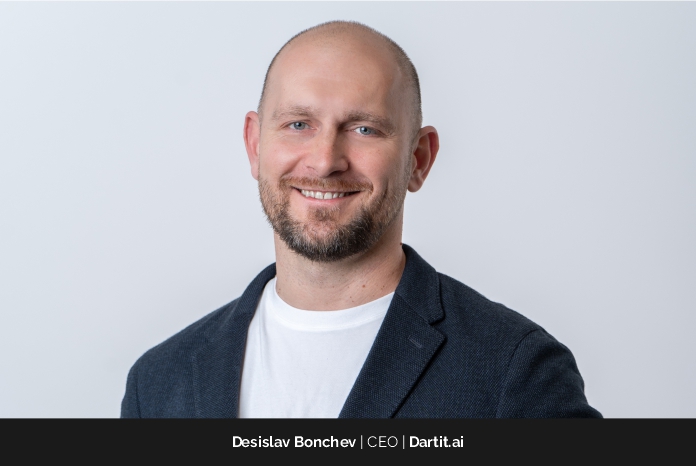
Desislav Bonchev, Founder and CEO of Dartit.ai, has built his career on turning technological complexity into practical business value. Working at the intersection of artificial intelligence, enterprise architecture, and business transformation, he is developing a platform designed to bring structure, speed, and trust to complex B2B supply chain workflows.
With a Master’s degree in Artificial Intelligence from Johns Hopkins University and a Bachelor’s degree in Economics, Bonchev believes technology creates value when it helps organizations make better decisions and operate with greater confidence.
Before founding Dartit.ai, Bonchev spent four years at Microsoft as a Senior Cloud Solution Architect and AI Champion for Central and Eastern Europe, helping organizations modernize cloud architectures and adopt data and AI capabilities across 24 countries. Earlier, he held CTO and senior solutions architecture roles leading complex technology initiatives.
A Founder-Funded Path to Supply Chain Transformation
“Software should augment human capability, not work against it.” This principle has shaped Bonchev’s work in enterprise technology for over two decades. Through this lens, he recognized a systemic failure in the B2B supply chain sector — one that directly contradicts this idea. Despite significant investments in software, professionals remain trapped in manual, fragmented processes.
An operator might spend an entire afternoon searching for certificates or digging through disconnected systems, storage silos, specifications, and scattered records to evaluate one quote. Keeping a deal moving forward often meant weeks of jumping between different SDS/MSDS, CoA, certificates, emails, chats, calls, portals, and internal tools. This led to the creation of Dartit.ai. A system engineered to absorb this complexity. By structuring this data, the goal is to give professionals the clarity, speed, and trust they need to work with confidence.
Staying Independent of the Hype
The initial strategy for Dartit.ai followed a deliberate path. Desislav Bonchev and his team chose to keep the venture founder-funded during its early phase to ensure the business earned relevance through measurable business impact rather than fundraising optics. This decision kept the platform rooted in direct operational experience.
The ambition was to build an organization that stands on its own merits, prioritizing customer value over the next financing round. This independence allowed the team to bypass hypothetical market positioning and work directly with partners on tangible supply chain challenges. Consequently, the company culture emphasizes architectural discipline and execution over industry trends.
Bonchev is direct about the fact that the company does not optimize for vanity metrics. In practice, the work centers on whether the platform reduces friction and helps companies operate more effectively in real commercial environments.
Managing AI Uncertainty
High expectations can often lead to a hard fall when it comes to new technology. Hence, Desislav Bonchev maintains a pragmatic view of Artificial Intelligence, distinguishing native AI systems from conventional, deterministic software. While standard programs follow fixed rules, AI operates on probabilities. It explores possibilities and, by its nature, may occasionally produce an unexpected result.
For enterprise AI, Bonchev believes this reality must be embraced. This exploratory capability allows models to surface opportunities in environments where the problem space is not fully defined. Rather than forcing AI into a rigid framework, Dartit.ai is designed to operate within this probabilistic nature. The platform structures knowledge and preserves the provenance of information. By implementing these internal safeguards, the system can validate results, recover from errors, and ensure the human operator remains in control of critical decisions. Acknowledging these limitations allows organizations to manage the volatility of real-world business with greater reliability.
Setting the Record Straight
A common misconception is that Dartit.ai is just another marketplace. However, Bonchev is precise in his differentiation between the two. He sees traditional listing platforms as incomplete because they fail to address the complex post-transaction process. He believes that to truly fix the industry, one must change the perspective entirely. “You can never solve a problem on the level on which it was created,” Albert Einstein famously noted. And this principle is baked into the platform’s architecture.
Instead, he defines Dartit.ai as a functional layer positioned between raw knowledge and a company’s final objectives. The system is designed to transform fragmented supply chain tasks into a single, structured execution pipeline. Beyond surface-level requests or quotes, the platform interprets the evidence behind these interactions, linking them to commercial intents and streamlining collaboration across the entire chain. This integration facilitates both human-to-human coordination and cross-system interoperability. Desislav Bonchev describes the distinction by saying, “The real value proposition is not simply visibility of offers or requests. It is the ability to connect objectives, evidence, people, and systems into one operating flow that makes supply-chain work faster, clearer, and more executable.”
The Blueprint of Proximity
Scaling across European markets required a particular approach to network density. In B2B supply chains, where specialization and trust are paramount, an imbalance between supply and demand is more than an inefficiency. It is a risk to the platform’s credibility. “We are building the network by traversing real commercial relationships rather than by broadcasting generic invitations,” Bonchev notes.
This targeted strategy concentrates on the strategic onboarding of established commercial alliances. When a key seller is folded into the platform, the team simultaneously maps and incorporates that seller’s specific buyer web. By analyzing the recurring needs within these clusters, the relevant supply side is then identified and integrated. This ensures that every new participant enters an environment of immediate relevance, turning the platform into a structured extension of proven business ecosystems.
Regulatory Frameworks as Operational Tools
While many people view European regulations as a bureaucratic burden, the leadership at Dartit.ai treats compliance as a primary value proposition. Rather than treating rules as external constraints, the platform incorporates them as tools to give partners operational confidence in a complex legal sector. This perspective has fundamentally redefined the company’s product plan.
CEO Desislav Bonchev conveys that they are currently integrating capabilities that allow partners to map product specifications and supporting evidence directly to relevant EU mandates.
This approach aims to surface compliance issues at the start of the process rather than during final verification. By providing these early signals, the system helps organizations avoid operational blockers. It also significantly reduces the manual labor traditionally required for regulatory vetting. Bonchev believes this creates a more predictable environment, where “evolving EU regulation pushes us to build with stronger traceability, better evidence handling, and a clearer connection between product data and operational decisions.”
The Measure of Success
We ask this technopreneur about measurable customer outcomes, and the answer centers on the physical passage of time. He evaluates success through “cycle compression”. It is the ability to drastically shorten the sourcing and procurement process. In most traditional supply chain environments, teams are bogged down by the volume of documentation required for a single transaction. Days are consumed by a “digital scavenger hunt” through safety data sheets (SDS/MSDS), certificates of analysis (CoA), and disconnected email threads.
Dartit.ai is purpose-built to consolidate this fragmented evidence and internal data into a single, unified thread. This transformation turns manual discovery and evaluation into an instant match-and-gap analysis process. Tasks such as offer assembly, which typically span several days, are reduced to minutes. When stakeholders collaborate within a consolidated, evidence-backed system, the entire deal cycle moves from weeks to hours. Bonchev considers this the clearest measure of impact because it removes the burden of non-value work, enables faster execution, and significantly lowers operational risk.
The Foundation of Shared History
Efficiency in high-stakes environments is rarely a product of technical skill alone. At Dartit.ai, the primary cultural advantage is a level of trust cultivated over many years. Numerous members of the leadership and engineering teams have worked together across previous ventures. Such history has provided a profound understanding of individual working styles and professional standards, creating a level of execution quality that is difficult to manufacture in a newly assembled group.
This foundation enables the team to operate with minimal friction and rapid alignment. The edge comes from being more than a group assembled around an opportunity. They are, as Desislav Bonchev notes, people who genuinely believe in what they are building. A long-standing connection allows for a natural sense of accountability and a commitment to mission-critical solutions, not just what is commercially convenient.
The Greedy Algorithm for Focus
“My way of handling a fast-scaling environment is not through intensity for its own sake,” Bonchev states. Leading a company through a surge in demand is a test of disciplined attention rather than raw energy. This industry veteran is candid that Dartit.ai is not yet in a hypergrowth phase. But his experience with large-scale cloud products taught him how to handle extreme pace. He saw how quickly execution can accelerate. In such environments, the primary risk is not the workload. It is the sudden influx of distractions and competing expectations.
To stay grounded, he uses a method similar to a greedy algorithm. He ignores the surrounding noise and narrows his focus to just two things. Bonchev looks at the long-term strategic goal Dartit.ai has committed to. Second, he pinpoints the single highest-value action that moves them closer to it. By executing that one task and then moving to the next immediately, he keeps his energy focused and his presence much more stable. To him, staying firmly on the next immediate step is the only way to protect his energy and keep the team moving in the right direction.
A Seat at the Table
While success is typically an accumulation of incremental wins, certain milestones serve to validate the entire strategic course. Desislav Bonchev upholds a disciplined perspective on product-market fit, valuing operational precision over premature celebration. That consistency is now beginning to be reflected externally. He was recently named one of “Europe’s Most Influential CEOs Driving Innovation and Growth, 2026.”
Alongside this personal recognition, a significant turning point occurred when Dartit.ai received a Microsoft ISV Partner recognition.
Beyond cloud sponsorship, the partnership signaled that the company’s vision resonated within one of the world’s most influential enterprise technology ecosystems. It marked a shift from conceptual curiosity to genuine industry credibility. Coupled with active enterprise rollouts, the news confirmed that Dartit.ai’s structured, AI-native execution model is both necessary and viable. For Bonchev, it represented a clear transition from a visionary idea to a platform backed by major market players.
The New Frontier of Flow
Desislav Bonchev believes the European B2B supply chain is the ideal setting for AI-native workflows. This space is currently defined by fragmentation. Professionals are forced to jump between scattered systems, documents, and disconnected communication channels. These activities are conducted merely to execute standard commercial and operational tasks. This is where he feels technology can step in. It can manage complexity, structure information, and reduce non-value work while restoring people’s confidence.
However, there is a catch. Bonchev has observed that many AI projects fail because the product discipline behind them is too weak. The execution is not rigorous enough. Durable value requires embedding technology into reliable workflow-ready systems that can handle uncertainty and function consistently within enterprise settings. For that, such solutions need to be developed by teams with a deep understanding of how enterprise software is designed, delivered, and governed.
For this prescient executive, the next wave of value will not come from generic experiments. It will come from deeply integrated products. Solutions that augment execution quality in high-complexity industries.
The Transition Toward Interdisciplinary Talent
The era of the “pure coder” is giving way to something more nuanced. The evolution of the talent sector suggests that building AI-native products now requires more than software development proficiency alone. Bonchev identifies interdisciplinary thinking as the key differentiator. The future belongs to “explorers” and “thinkers.” Professionals who can synthesize engineering with business context, knowledge modeling, and a structural understanding of real-world systems. They must have a way of thinking that uses technology to make it more capable.
He asserts that AI is making software development less labor-intensive. Yet, it significantly raises the threshold for excellence. Real innovation happens when the person writing the code has enough domain expertise to recognize exactly where a process is failing.
This perspective drives the recruitment philosophy at Dartit.ai. He actively seeks talent from non-traditional backgrounds, prioritizing the capacity to ask the right questions over standard credentials. By creating space for these minds, he ensures the company is built on real insight and the power to connect technology with the intricacy of the world it is meant to serve.
Foundations Over Fireworks
Building a lasting company in the AI space means going back to basics. Desislav Bonchev advises aspiring CEOs to resist the urge to use AI for its own sake. He recommends starting with a structural grasp of the challenge at hand, using that clarity to filter for tools that provide genuine leverage.
However, he acknowledges that even the most disciplined strategy has limits. It cannot eliminate the inherent uncertainty of innovation. Once the base is set, progress requires grit. Kurt Vonnegut’s words best capture this reality: “We have to continually be jumping off cliffs and developing our wings on the way down.” Ultimately, success depends on learning the ropes as you go.
This C-suite executive believes the strongest AI products will be built by teams who truly comprehend their industry. These are the domain builders who know how to translate that understanding into usable, reliable, and valuable systems. To find a durable advantage, founders must focus on system integrity. They should review whether it is explainable, trustworthy, resilient, scalable, and aligned with how real organizations operate. Desislav Bonchev concludes with a clear message: “Do not build around AI first. Build around the problem, the domain, and the quality of the system you want to create. AI should strengthen that foundation, not replace it.”