
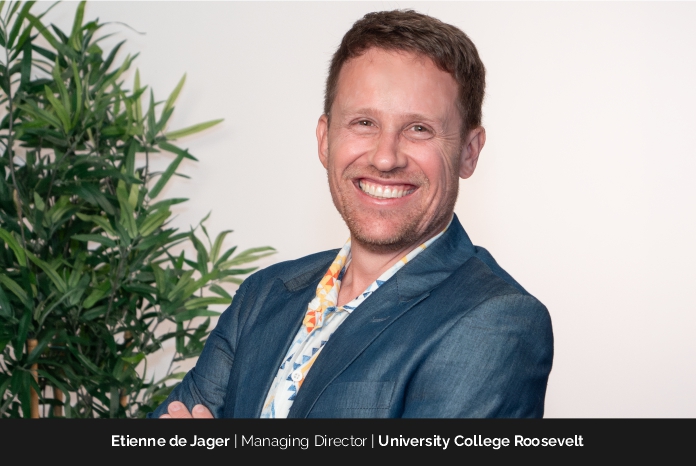
It is the fearless leader who steps up when storms are raging and steers the organisation through a period of uncertainty. Etienne de Jager, Managing Director at University College Roosevelt (UCR), Middelburg, The Netherlands, is such a leader. Unflappable under pressure, he is not afraid to make hard decisions and call a spade a spade. He faces the toughest challenges with aplomb, and despite bleak prospects, he works with his team to turn around a situation. And throughout it all, he is honest with his people about possible failure.
Once a crafter of destination marketing strategies in the tourism space, Etienne, who has an academic background in communications, digital technologies, and education, moved to the education sector and made institutions he served more visible and attractive to prospective students, which resulted in increased recruitment. About four years ago, he stepped into the role of Managing Director at UCR. Etienne’s career trajectory has been unconventional in every sense of the word, but those who trust their gut and are not afraid to be themselves are known to achieve greater things.
Switching to Organisational Management
Etienne is a marketing professional through and through. For most of his career, he focused on the marketing aspects of communication. Initially, in the education industry, his marketing function involved business development, recruitment, and student growth. In 2022, he transitioned to organisational management, a natural progression to manage the fallout from the previous Dutch government policies affecting the recruitment of international students.
The government made higher education less welcoming for international students. “They became stricter on who can come and study in the country,” Etienne says. The Dutch government also dissuaded higher education institutions from using English as a medium of instruction. The new policies impacted marketing and recruitment, which ultimately became the question of survival for many institutions, including UCR.
During this time, Etienne found himself at the “intersection of leading that department.” UCR was not immune to the challenges stemming from the lower recruitment of international students, especially the decline in funding. As the organisation fought for its survival, Etienne felt that the next natural step should be: “to take the knowledge and experience I had in student recruitment and marketing to the organisational level.” Only after Etienne made the switch did he realise that the organisational aspects of leadership involved far more than one particular challenge facing higher education. “It has been quite a learning curve,” he says.
Perfect Storm Sets Off Existential Crisis
A perfect storm was brewing when Etienne took the helm of UCR as Managing Director in 2022. It soon snowballed into an existential crisis for the organisation.
In the Netherlands, universities are funded in two ways: tuition fees paid directly to the institution and central government subsidies. Etienne explains that students from the European Economic Area (EEA) pay only a third of the tuition fees, and the remaining is covered by the government. However, institutions receive government funding only after two years.
So, institutions must be as accurate as possible with their forecasts, Etienne says, adding that they need to plan their business activities taking into account the money they do not yet have. Of course, there is no guarantee that they will receive the projected funds, as students may drop out at any time or the intake number may change. “It is really hard to get the prognosis completely right,” Etienne says. “This makes the system quite complex.” Also, the previous Dutch government announced massive cuts to higher education. In addition to banning international student recruitment, they proposed that the majority of programmes be delivered in Dutch.
At UCR, about 70% of students come from outside the Netherlands. The government’s new rules meant that the organisation risked losing the majority of its student population, which accounted for most of its revenue. And UCR was also facing the potential loss of long-standing subsidies worth €2 million annually, which were set to end in 2028.
Etienne points out that they faced all three of these developments at the same time: declining international student numbers, higher education cuts, and the ending of long-standing subsidies. In their small college, that created a perfect storm. Within a period of two years, almost a quarter of their budget disappeared. For Etienne, perhaps the most defining challenge over the past four years has been adjusting to that financial reality while, at the same time, trying to resolve the issues that would help them come out of the perfect storm.
During those four stormy years, he felt like he was putting out fires on multiple fronts. Etienne stayed focused on making decisions that would not serve as band-aids for immediate problems, but instead result in longer-lasting solutions that would ensure the college’s continuity.
A Brief Introduction to UCR
Founded in 2004, University College Roosevelt (UCR) is a small-scale international liberal arts and sciences college. It has around 500 students. With guaranteed housing and a close-knit residential campus, it offers an intensive, student-centred learning environment where education is collaborative and community-focused. At the heart of UCR is an open curriculum of more than 150 courses organised across six interdisciplinary clusters. Students design their own academic pathways to address real-world questions.
When UCR was established, it was only the second university college in the country. There are now 14 similar institutions. UCR differentiates itself from them by offering a modern programme that is personal, responsive, and embedded.
Personal, because the college helps students develop not just in an educational capacity but also in a personal capacity. By the time they graduate, these students have become well-rounded in every sense of the word. Responsive, on the other hand, refers to UCR’s commitment to refreshing some parts of its curriculum based on what is changing in the world and what students feel they want to learn. Etienne points out that the non-static curriculum is continuously adjusted to reflect student needs and societal shifts. However, the other part of the curriculum remains fixed so students can gain the skills and knowledge needed to thrive in certain fields.
Embedded is about UCR’s location in the Zeeland Delta province, the southwestern Netherlands, where there is a constant risk of flooding. It has an aging population and poor connectivity to other parts of the world. All these present real challenges that people in the world face on a daily basis. UCR likes to think of itself as a living lab, where its students can see what these issues are, and then solve them from a multidisciplinary approach by learning from the people in the environment, including local businesses, local stakeholders, and local communities. Etienne says that learning happens outside of the classroom by engaging with the province in which it is located.
Painful Reorganisation for a Better Future
In 2025, UCR underwent reorganisation. Etienne calls it one of the most difficult periods in the college’s history. It proved to be a necessary turning point that laid the foundation for a more sustainable and future-oriented institution.
Prior to the restructuring, there was genuine concern about the long-term viability of the institution in its existing form, according to Etienne. But then the decision to reorganise UCR turned things around. After the reorganisation, the college was in a far stronger position to stabilise enrolment, attract new student groups, adapt to changing educational demand, and continue investing in the quality of its education and student experience.
The reorganisation process included difficult staffing decisions and substantial organisational restructuring. Etienne shares that this created anxiety and uncertainty across the institution. Many people feared not only for their positions or workloads but also for the future identity of the college itself.
In addition to cutting costs, the reorganisation was also about repositioning the college for a changing world. Etienne and his team recognised that the college needed a clearer academic profile, a curriculum that connected more visibly to contemporary societal challenges, and a structure that would better align with the interests and expectations of future students. This led to the development of a renewed academic model organised around six interdisciplinary clusters.
“Rather than weakening the Liberal Arts & Sciences philosophy,” Etienne says, “the intention was to modernise and sharpen it: maintaining breadth and interdisciplinarity while creating stronger thematic coherence and clearer pathways for students.” The renewed structure placed greater emphasis on contemporary fields such as data science, entrepreneurship, sustainability, governance, health, and societal transformation, while still preserving the personalised and interdisciplinary character that defines the university college experience.
Etienne underscores that the reorganisation was a moment of institutional transformation. It represented a difficult but necessary shift from preserving an increasingly fragile status quo toward building a more sustainable and compelling version for the future.
Fair, Honest Servant Leader
Etienne is not an archetypal managing director dressed in a suit and tie. He can often be seen around the college in jeans and a T-shirt, chatting with staff and students. He could easily be mistaken for one of them. Etienne, a servant leader, has never made the switch from getting his hands dirty to being in a corner office focused only on the strategic side of things. He continues to be involved in all aspects of the organisation.
Instead of issuing orders or making people work for him, he believes in being part of the team and working alongside them. He helps his colleagues with even the most basic tasks, such as showing a junior team member how to craft an email.
“Wearing the leadership hat, for me, is predominantly about being there for people and doing things with them so that we can jointly achieve our goals,” he says.
Etienne believes that they are all in this together and wants them to address challenges jointly. As Managing Director, he makes sure that all departments and people innovate and find better, newer ways of doing things, in ways that are more appealing to prospective students and more efficient financially.
However, Etienne is a stickler for fairness and honesty. He never bends the rules or gives anyone special treatment. He treats everyone the same and gives them the same answer to the same question. And he never sugarcoats problems. His transparency and honesty make some people perceive him as cold and blunt, but they are the values he does not compromise on.
“My personal values are really rooted in fairness, equal treatment, and blatant honesty about everything,” says Etienne.
Smaller Moments of Progress
Etienne may have a new definition of success by the time this story is published, as his idea of success is changing little by little every month. When we spoke to him, he said that a person is successful if bring others along and move closer to a goal. He is no longer the kind of leader who declares success only when someone achieves everything they set out to do.
He has also learned to find motivation in the smaller moments of progress, even amid the enormous challenges the organisation faces. “Even if it is small progress or small changes with tangible effects, we really celebrate those and make a big hoo-ha about it,” Etienne says.
When he and his team were battling the perfect storm, UCR lost a top program label. They got the label back in 2025. It was a small win, but they still went all out to celebrate it. This shows that Etienne and his team stay motivated by celebrating small successes rather than chasing the big things.
What Is Next?
As the Netherlands’ higher education landscape is still in a state of flux, Etienne is hesitant to look too far ahead. “The only thing you can be certain about is uncertainty,” he says, “so I tend not to think too far ahead.”
For now, his focus is on steering the organisation through the perfect storm and bringing it to a stable position, away from the challenges affecting its day-to-day operations. He wants to ensure that the college is in a comfortable position, then turn his attention to future plans.
On a personal level, Etienne sees himself moving into teaching at some point in the future. Over the years, he has lived in several countries, gained a wealth of experience, and learned valuable lessons. He now hopes to share those experiences and lessons with others.
Message to Aspiring Leaders
From highly experienced professionals to those with less experience, and from people with different perspectives and backgrounds, everyone has plenty of advice to offer. They are always ready to tell aspiring leaders what is best for them. Etienne cautions against following advice blindly.
“The moment you try to lead in a way that others tell you to lead, or make decisions in a way that others expect of you,” he says, “you cannot possibly back them up forever.”
Etienne encourages aspiring leaders to trust their gut, stay true to themselves, and make decisions they truly believe in. He points out that people are in leadership positions because they did something of their own accord. “You did something in a certain way that resonated with people and helped you progress,” he adds. “So, trust yourself, continue being who you are, and keep doing things the way you do them.”