
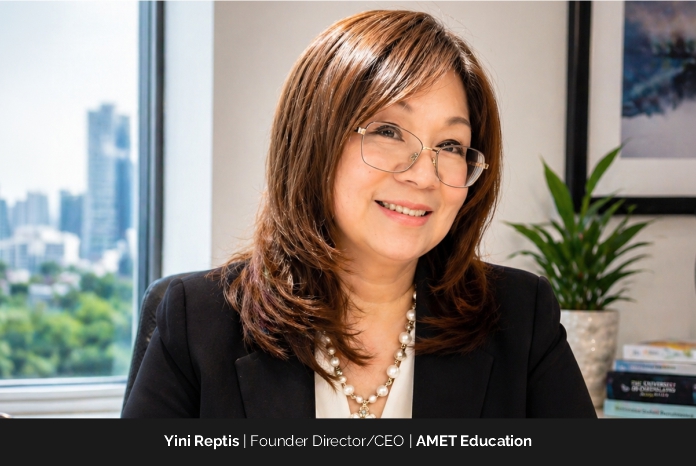
Every year, thousands of students leave behind familiarity, home, family, language, to pursue education abroad. It is a decision that carries both excitement and uncertainty, often made with the hope that it will open doors to a better future. Yet behind many of these journeys are individuals who work quietly to make that transition smoother, more informed, and far less overwhelming. Yini Reptis, Founder Director and CEO of AMET Education, is one such leader.
Yini’s work is rooted not in abstraction, but in lived experience. Having once been an international student herself, she understands the emotional and practical realities of starting over in a new country. Over the years, she has built an organization that reflects that understanding, one that prioritizes people, relationships, and long-term impact over quick outcomes.
From Personal Experience to Purposeful Leadership
Yini’s decision to build her organization was not driven by market opportunity alone. It came from something far more personal. When she first arrived in Australia in the 1990s as a student, the journey was far from simple. Information was limited, support systems were not as developed, and navigating everyday life required resilience.
“I understand that international students and their families are making one of the most significant investments of their lives,” she explains. “They rightly expect the highest standard of service.” That understanding has stayed with her. It informs how she approaches every decision, every interaction, and every service her organization provides.
Rather than treating students as part of a process, she sees them as individuals with unique goals, fears, and expectations. This perspective has shaped a model that goes beyond transactions and focuses on genuine guidance.
“It’s not what we get. But who we become, what we contribute, that gives meaning to our lives.” – Tony Robbins
The Evolution of Leadership
When Yini first began, the scale was modest, a small team, a single office, and a clear goal. Today, the organization has grown significantly, with a global presence and a large team supporting students across different regions. That growth required her to evolve as well.
“It is often said that leaders are made, not born, and my experience reflects that principle,” she says. In the early years, her focus was on performance, driving results, building momentum, and establishing a foothold. But as the organization expanded, she had to step back from execution and step into leadership.
This shift meant learning to trust others, delegate effectively, and create systems that could operate without constant oversight. More importantly, it meant building a culture where people felt confident contributing ideas and taking ownership of their roles. Today, her leadership is less about directing and more about enabling. She focuses on setting direction, creating alignment, and ensuring that her team has the support they need to succeed.
Recognition as a Reflection of Consistency
Recognition, in Yini’s view, is not something that comes from a single achievement. It is the result of consistency over time.
“Reputation is not something that can be manufactured; it is earned over time,” she says.
For her, credibility is built through actions, through delivering on promises, maintaining standards, and staying committed even when circumstances are difficult. She is quick to acknowledge that none of this is done alone. The strength of her organization lies in its people, and she credits her team for playing a central role in its growth and reputation.
“Some objectives may not seem realistic at the moment, but they are meant to push the boundaries.”
Values That Drive Decisions
One of the defining aspects of Yini’s leadership is her openness to ideas. She does not see leadership as having all the answers, but as creating space for better ones to emerge.
“I am willing to pursue bold initiatives, provided they are supported by rigorous analysis and a compelling strategic rationale,” she explains. This balance between curiosity and discipline allows her to explore new directions without losing focus.
She also places strong emphasis on involving her team in decision-making. “Genuine team buy-in is fundamental to the success of any initiative,” she says. By bringing people into the conversation, she not only improves the quality of decisions but also ensures stronger execution. Listening, in her view, is not a passive skill, it is a critical leadership capability.
Resilience Through Uncertainty
Few challenges have tested the global education sector as much as the COVID-19 pandemic. For organizations dependent on international movement, the disruption was immediate and significant.
For Yini, however, the period also highlighted the importance of preparation. “The COVID-19 pandemic created an opportunity to reassess our approach to risk management,” she explains.
Years earlier, she had already begun implementing a long-term strategy focused on diversification, expansion, and digital capability. That groundwork made a difference. Instead of reacting without direction, the organization was able to respond with clarity and confidence. By 2022, several of those long-term goals had already been achieved. The experience reinforced a simple idea: resilience is not just about reacting well, it is about preparing well.
Staying Connected to What Matters
Despite the scale of her responsibilities, Yini has made a conscious effort to stay connected to the students her organization supports.
“I derive great satisfaction from engaging with students, hearing their stories, and witnessing their progression,” she shares. Whether it is attending events, meeting students directly, or being part of milestone moments, she continues to stay involved.
One moment that stayed with her was attending a graduation ceremony where a notable number of PhD graduates had come through her organization. “In that moment, I was reminded of the genuine and lasting impact our work has on individuals and their futures,” she recalls. These experiences serve as a reminder that beyond strategy and growth, the work remains deeply human.
A Distinctive Approach to Student Support
What sets Yini’s organization apart is not just what it does, but how it does it. The approach is built around continuity, supporting students from the earliest stages of planning through to life after graduation. This includes everything from application guidance and visa support to helping students settle into a new environment and stay connected long after their studies are complete.
“This integrated, whole-of-journey model, combined with our high-touch service offering, has positioned us as a premium brand,” she says. By focusing on the entire journey rather than isolated stages, the organization creates a sense of stability for students navigating unfamiliar territory.
Innovation with a Human Focus
As technology continues to influence the education sector, Yini has taken a measured approach. She sees value in digital tools but remains clear about their role.
“This framework reflects our commitment to placing the individual at the center of everything we do,” she explains, referring to recent initiatives that align technology with personalized service. For her, innovation is not about replacing people, it is about supporting them. Technology can improve efficiency, but it cannot replicate understanding, reassurance, or trust.
A Philosophy of Mastery and Excellence
Over the years, Yini has drawn inspiration from the Japanese concepts of Shokunin (職人) and Takumi (匠), ideas centered on dedication to craft and continuous improvement.
“This philosophy represents a deep commitment to mastery, discipline, and continuous improvement,” she explains.
Central to this mindset is Kodawari (こだわり), the unwavering pursuit of excellence and the determination to deliver one’s best work, even when it goes unseen. It is not about perfection in a fixed sense, but about consistently striving to do better. It also emphasizes responsibility toward one’s work, one’s standards, and the people affected by them. This mindset has influenced how she approaches leadership and how the organization approaches its work.
The Future of Global Education
Looking ahead, Yini believes the future of global education will continue to evolve, shaped by both technology and shifting expectations. However, she is clear about one thing, the human element will remain essential.
“International education is not solely a transactional process; it is a deeply personal journey,” she says. Students are not just choosing courses or institutions; they are making life decisions. That requires guidance that goes beyond information, it requires understanding.
Her philosophy reflects this clearly: “People are our business.”
“Follow Your Passions and Believe in Yourself”
Guidance for Emerging Leaders
For those looking to build long-term impact, Yini offers advice grounded in experience.
“My advice is to lead with courage and not fear failure,” she says. Challenges, she notes, are often where the most valuable lessons emerge.
She also emphasizes patience, the understanding that progress is not always linear. Sometimes, stepping back is part of moving forward. Over time, these experiences build not just skill, but perspective.
A Legacy of Trust and Integrity
When asked about legacy, Yini does not focus on scale or recognition. Instead, she speaks about trust.
“Some objectives may not seem realistic at the moment, but they are meant to push the boundaries,” she says.
Her aim is simple: to be someone people can rely on. Someone who approaches work with honesty, consistency, and respect for those she serves. That, more than anything else, is what she hopes will endure.
Conclusion
This can be seen in the life and career path of Yini Reptis as she has stayed true to herself from being an international student to the current CEO of an international educational body. Even with the many changes in education in general, she maintains her dedication to people which results in both good policy and good lives of those who benefit from her policies. As one who has done much, she shows the way of doing things with diligence.
What is commendable about Yini is her consistency. She shows that regardless, if it is the big picture or simply dealing with students, she always does everything with care. This consistency has allowed her to garner the trust of those around her, especially students, their parents, partners, and even her subordinates.
It also becomes clear how practical her concept of development is. She is not pursuing development for its own sake; instead, she concentrates on setting up systems to enable it. Her idea of investing in staff, streamlining processes, and making sure the quality of the work delivered does not suffer due to the growth is a more deliberate approach, yet much more long-lasting.
Speaking of the future of the international education business, it is safe to assume that it will change and evolve under the influence of various factors such as policy changes, technological advancement, and even global events. However, certain values are likely to stay relevant forever, as shown by the case of Yini Reptis. Students will always be seeking mentorship, while parents will be searching for reassurance.
In fact, her experience in building an organization demonstrates the importance of constructing trust first and foremost, as people tend to stick to companies, they can trust when making decisions in such an ever-changing environment.