

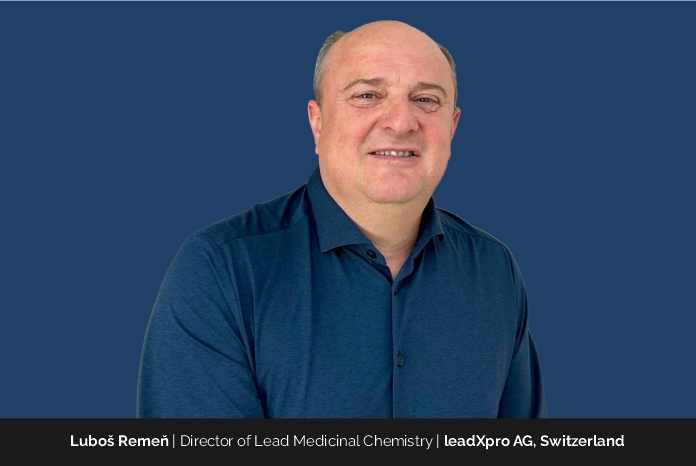
The power to create new matter from scratch – that was what first drew Luboš Remeň into chemistry. Over two decades, that fascination evolved into a career spanning Actelion, Idorsia, and now leadXpro, where his team tackles some of drug discovery’s most challenging targets. As Director of Lead Medicinal Chemistry at leadXpro AG, he reflects on structural innovation, leadership, and the human purpose that gives scientific discovery its true meaning.
Crafting Tomorrow’s Cures from Scratch
Luboš’s path began with a Master’s and PhD at STU Bratislava in Slovakia, followed by a postdoctoral fellowship at ETH Zürich in Switzerland. Immersed in the world of molecules, he learned to design and synthesize them, mastering a range of analytical techniques to confirm that he’d built exactly what he intended.
Drug discovery is a team effort requiring a coalition of experts – chemists, biochemists, biologists, pharmacologists, and specialists in formulation, metabolism, toxicology and many other scientific disciplines. The chemist’s role is to design and synthesize novel molecules and, together with the broader discovery team, rigorously profile them across a broad range of assays to assess their potential as drug candidates.
What captivated Luboš most was the sheer power a chemist holds – the ability to create new matter from scratch. “It’s a remarkably versatile foundation, one equally suited to academic research and applied science in industry,” he observes. At Actelion Pharmaceuticals in Switzerland, he channeled his skills into their most meaningful application as a medicinal chemist. He’s captivated by the search for a molecule whose final structure doesn’t yet exist – whilst its desired properties are known, its form has yet to be discovered.
“I remain fascinated by our growing ability to alter a molecule’s behavior rationally and predictively through structural modifications, iterating until the optimal candidate finally emerges. This is science at its most powerful – creating real added value for society and, above all, for patients. I’m deeply grateful to have applied my knowledge and skills in the service of that goal,” he affirms.
Designing Keys for Membrane Protein Locks
After over 20 years at Actelion and Idorsia, rising to project leader in medicinal chemistry, Luboš was drawn to leadXpro AG in February 2024. This Swiss biotech specializes in structure-based drug discovery, with a focus on membrane proteins such as ion-channels, transporter and GPCR`s. The journey to novel medicines begins with the selection of the protein target. To modulate its activity rationally, you need its three-dimensional structure. This is the essence of the so-called lock-and-key principle: the target is the lock, and the chemist’s task is to design and make the perfectly fitting key. The better you understand the details of the lock, the more precisely you can make the key. Knowledge of the structure enables identification of drug candidates in a faster, more targeted way. Sometimes, a structure provides the ideas for the first “key” for previously undruggable targets.
As membrane proteins are notoriously unstable once isolated, leadXpro built a proprietary platform to prepare, stabilize, and determine their structures via X-ray crystallography or cryo-EM – serving over 100 pharma and biotech partners worldwide. In addition, the company launched its own internal discovery programs on carefully selected targets that are not available for CRO work.
“”My role is to help build the Lead Discovery team, and together with my colleagues, define a strategy that combines state-of-the-art experimental platforms with cutting-edge computational tools – enabling rational design on some of the most challenging protein targets in drug discovery.” Luboš explains.
Tailoring Molecules Across Organs and Tumors
Luboš notes that the medicinal chemist’s first task is designing a ligand that binds to and modulates the target – validated initially under laboratory conditions. But targeted proteins live within the human body, distributed across organs, tissues, and cells. Understanding a target’s expression pattern is therefore critical, because molecular structure of a synthesized compound directly influences how it distributes throughout the body. Sometimes the molecule must remain in the blood; other times it must reach specific organs – such as the lungs as in pulmonary fibrosis – or cross into the brain. In oncology, it must reach the tumor microenvironment. Beyond distribution and binding, the molecule must fulfill many additional criteria – solubility, permeability, chemical and metabolic stability, target selectivity, and an acceptable safety profile. In short, it must be drug-like. “That’s why drug discovery demands immense time, investment, and commitment and resilience of the entire team,” he emphasizes.
From Static Snapshots to Molecular Movies
Over the past two to three decades, drug discovery has changed enormously – and Luboš has experienced much of this evolution firsthand. One of the most profound shifts has been the structural biology revolution – and at its forefront, the rise of cryo-electron microscopy. “When I started, structure-based design was largely limited to proteins that could be crystallized easily. Today, even challenging membrane proteins – GPCRs, ion channels, transporters – can be resolved, transforming target classes once considered undruggable,” he observes.
Looking ahead, Luboš anticipates the next leap – time-resolved X-ray and time-resolved cryo-EM to create “molecular movies” rather than static snapshots. This offers “real-time observation of molecular motions” of ligand-protein interactions, revealing mobility and flexibility that current technologies miss – and leadXpro is actively working to establish and integrate these tools to bring drug discovery to entirely new level of understanding and precision.
Alongside this, computational chemistry and AI have become daily essentials – virtual screening of billions of compounds, docking, predictive ADMET modeling, and modern molecular dynamics simulations and related technologies now de-risk molecules far earlier in the process, offering increasingly detailed insight into how molecules behave and interact at the atomic level. . The medicinal chemistry toolbox has also broadened with fragment-based approaches, DNA-encoded libraries, covalent inhibitors, and PROTACs introducing entirely new modes of action. Drug discovery has become a more integrated team effort, with different areas of expertise working in parallel rather than in sequential process.
For Luboš, the greatest impact is the fusion of high-quality structural data for previously inaccessible targets with increasingly powerful predictive computational tools, which he describes as “a shift toward rational design that genuinely excites me”.
The Integrated Power of Structure, Computation, and Biophysics
Luboš notes that historically, medicinal chemistry was a more iterative and empirical discipline – synthesize a molecule, test it, and use the resulting structure-activity relationship to guide the next round of design. It worked, and many valuable and important drugs have been discovered this way, but it was slow, and for particularly challenging targets such as membrane proteins, it offered little direct insight into how molecules engaged with the target at the molecular lavel. X-ray crystallography and, more recently cryo-EM changed that fundamentally.
“Atomic-level views of ligand-protein complexes allow us to see – rather than merely infer – binding interactions, clashes, and unused pockets. This shifts design from ‘make and test’ to ‘design with intent’. This sits at the heart of what excites me about modern drug discovery” he states.
Computer-aided drug design directly builds on this foundation. With reliable structural information in hand, computational chemists can use molecular modeling, docking, and free-energy calculations to explore chemical space computationally before synthesis – prioritizing the most promising candidates and avoiding dead ends. “It doesn’t replace laboratory work, but it increases hit rates and focuses effort where it matters most” Luboš says.
The third piece – advanced biophysical characterization – closes the loop. Techniques like Grating-Coupled Interferometry and Isothermal Titration Calorimetry give quantitative binding affinity, kinetics, and thermodynamics, beyond simple activity readouts. “Combined with cellular assays, they tell us not just whether a molecule binds, but how and why, and if that translates to biological effect,” he explains.
But what Luboš finds truly transformative is the integration of all three. Structure guides design, computation prioritizes, and biophysical data validates hypotheses. That feedback loop accelerates and de-risks the design-make-test-analyze cycle – especially powerful for membrane proteins. “This is precisely the space leadXpro operates in – bringing structural, computational, and biophysical expertise together to make rational design possible for targets that were largely inaccessible just a decade or two ago,” he says.
AI as Amplifier, Not Replacement
Luboš sees AI and modern computational tools as a transformative force – “not as a replacement for the chemist, but as a powerful amplifier.” Generative AI now enables de novo design optimized for multiple properties at once – potency, selectivity, solubility, stability – letting teams explore far more chemical space faster and from higher starting quality. Predictive ADMET models are equally vital, using machine learning to anticipate liabilities earlier and shift attrition to where it’s less costly.
AI is also becoming central to interpreting structural data. Luboš believes AI will play an essential role in decoding dynamic structural information: conformational ensembles, binding kinetics and the complex interplay between protein flexibility and ligand behavior – “complex, multidimensional data in an area where machine learning finds patterns that we’d struggle to extract manually.”
He emphasizes that AI augments rather than replaces the medicinal chemist. Scientific experience, synthetic intuition, and deep biological understanding remain essential, and experimental validation will always be needed to confirm predictions. At leadXpro, this philosophy underpins the Lead Discovery strategy – integrating state-of-the-art structural biology with modern computational and AI tools into a tightly integrated design-make-test-analyze cycle.
“That combination, I believe, points toward a truly exciting future for medicinal chemistry – and I feel deeply grateful to be contributing to it alongside such talented colleagues.” Luboš declares.
Expanding The Druggable Genome Frontier
Looking ahead, Luboš shares his hopes for where the most significant progress may come over the next years. First, a real expansion of the so-called “druggable genome” – particularly among membrane proteins such as certain ion channels, transporters, and GPCRs, which have remained largely inaccessible to structure-based design for decades simply because their structures couldn’t be reliably determined. As structural biology tools continue to advance, there is real hope that many of these targets may gradually become accessible to rational drug design, potentially creating new opportunities in therapeutic areas of high unmet need. He also sees significant promise in emerging molecular modalities – particularly molecular glues and targeted protein degraders – which offer the potential to modulate proteins beyond traditional binding pockets, including protein-protein interactions that have long been considered beyond the reach of conventional drug design.
Time-resolved “molecular movies,” combined with AI, hold the promise of revealing binding dynamics and functional impact in ways previously unimaginable. Together, these advances – broader structural access, new molecular modalities, and AI-driven design – may open new possibilities, where progress has historically been limited by earlier technical barriers.
He is genuinely encouraged that many targets once considered too challenging may gradually become accessible. “I’m truly happy and deeply grateful to be part of this process – hoping to contribute, together with my colleagues, to what I believe could bring drug discovery to an entirely new level of rationalization, precision, and ultimately, impact for patients,” Luboš reflects.
Bridging The Laboratory-To-Clinic Gap
Despite remarkable scientific progress, the path from laboratory to patient remains extraordinarily challenging. Many early-stage molecules never reach the clinic, and a significant number of those that do ultimately fail in clinical trials. Luboš humbly reflects on some of the key challenges the field continues to face: the limitations of laboratory models as proxies for the complexity human disease; the many targets where our collective understanding, despite significant advances, remains incomplete; and the considerable investments and timescales involved in drug discovery and development, which can sometimes lead to the discontinuation of otherwise scientifically promising programs.
Smarter AI solutions to reduce early attrition, combined with deeper scientific understanding, better tools, and closer collaboration across academia, industry, and regulators, should make the process more sustainable. “The science has never been more powerful,” he reflects. “The challenge now is to translate that potential into medicines that genuinely reach and help patients.”
World-First Structures Unlocking Undrugged Targets
Throughout his career, Luboš has had the priviledge of working across a diverse range of targets and therapeutic indications. In several projects, he and his team succeeded in discovering molecules with drug-like properties and demonstrated efficacy in animal models – the key criteria for advancing a candidate to preclinical development. Some of those molecules remain in the portfolio of his previous employer, and he follows their progress with great curiosity and genuine interest – even though the details remain confidential.
At leadXpro, the internal discovery programs focus on proton-sensing GPCRs – a biologically important subgroup of membrane proteins with broad therapeutic potential. The company has already achieved a world first, elucidating cryo-EM structures of two targets within this family, directly enabling structure-based drug design.
The portfolio also includes a potent, selective adenosine A2B receptor antagonist with significant potential in oncology, which has shown efficacy in proof-of-concept animal studies. They’re now exploring partnering and out-licensing opportunities to advance this candidate into the preclinical phase.
Leading With Trust, Purpose, And Resilience
Luboš notes that, while well-trained scientists are “programmed” to deliver results individually, leadership demands a complete shift – from personal achievement to team enablement. “That starts with self-leadership – the foundation of leading others,” he affirms. “ Leaders, he believes, must avoid two common traps: excessive delegation on one hand, and micromanagement on the other. Neither is productive, and neither creates the conditions in which great work happens. “I see modern leadership as less about having all the answers, and more about building the right environment – one of trust, purpose, psychological safety, and continuous growth – in which a talented, diverse team can find the answers together.”
Research is inherently challenging, requiring sustained resilience and enthusiasm to carry a team forward over years. Innovation inevitably involves mistakes – not as signs of weakness, but as essential steps in the learning process. “Mistakes, when correctly interpreted, are not the opposite of success – they are part of it,” Luboš insists. A culture that embraces failure openly, while remaining curious and adaptable, is what fuels long-term engagement and ultimately builds lasting success.
And the essential foundation of all of this, he believes, remains self-leadership. “Before you can truly lead others, you must first learn to lead yourself – and that, perhaps, is the most important lesson of all,” Luboš reflects.
Curiosity, Collaboration, & Learning from Failure
Having had the privilege of mentoring young scientists throughout his career, Luboš feels passionate about sharing what he has learned with the next generation. He humbly offers the following reflections for those navigating the challenges of medicinal chemistry and drug discovery.
First, follow your curiosity. Medicinal chemistry sits at a beautiful intersection of science, creativity, and human impact. That intrinsic motivation, more than anything else, will sustain you through the inevitable setbacks that are simply part of the discovery journey.
Second, invest deeply in your scientific foundation – but never stop there. Drug discovery is a team sport, and the most effective medicinal chemists are those who develop genuine curiosity about the disciplines around them: biology, biochemistry, pharmacology, computational sciences, and beyond. The more bridges you build across fields, the more effective you become.
Third, embrace failure as a teacher. In this field, most things don’t work – and that’s not a sign of inadequacy, but a fundamental feature of innovation. The scientists who progress are not those who never fail, but those who fail thoughtfully, reflect honestly and learn systematically.
Finally, develop your human skills alongside your scientific ones. Technical excellence will take you far – but the ability to communicate clearly, collaborate openly, and inspire those around you will determine how far you truly go. And never stop growing as a leader. Leadership is not a destination you arrive at – it is a continuous journey of self-reflection, learning, and adaptation. The best leaders I have known never stopped being students of both their science and of the people around them.
To summarize Luboš’s advice in one thought: stay curious, stay humble, embrace the journey, and never lose sight of the patient waiting at the end of it.
Conclusion
For Luboš Remeň, the true reward of a career in medicinal chemistry is not just in creating new molecules – but in the hope that they may one day reach and help a patient. It is a long and humbling road – but one he considers a profound privilege to travel.