

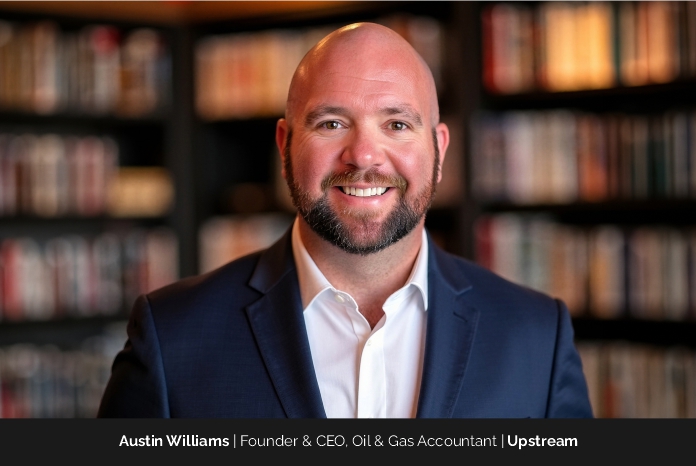
When introduced as Founder and CEO of Upstream, Austin Williams is quick to point out that he is, first and foremost, an oil and gas accountant. He took the plunge into entrepreneurship to help fill a gap created by the limited number of accountants entering the highly complex oil and gas sector. His extensive industry experience, technical knowledge, collaborative mindset, and innovative approach have earned both him and his company a strong reputation in oil and gas accounting, one built on trust.
Today, Upstream helps oil and gas owners cut through complexity and better understand their operations, financial performance, and assets. By combining accounting expertise with technology-driven insights, the company equips clients with the information they need to make confident, informed decisions. For Austin, building Upstream is about more than growing a business. It is an opportunity to give back to an industry that has shaped his career for more than fifteen years and to help others achieve greater success within it.
Rising from Humble Beginnings
Austin’s beginnings were humble. His mother worked as an executive assistant, and his father was a maintenance worker. Despite limited means, they provided him with the opportunity to attend Texas Tech University, where he acquired the knowledge, skills, and foundation to build his successful career.
In 2010, Austin began his career as a revenue accountant, setting in motion a professional journey that ultimately led to the founding of Upstream. Austin’s path to success was rarely straightforward. At every turn, he faced setbacks and challenges that tested his resilience and resolve.
Instead of retreating or changing course, Austin moved forward with determination, viewing obstacles as opportunities to learn and grow. They helped him deepen his industry knowledge and gain new perspectives that would later shape the founding of Upstream and, ultimately, the vision behind Upstream+.
Spectacular Growth of the Company
Founded in June 2024, Upstream quickly gained traction in the oil and gas industry. It grew from approximately $227,000 in revenue during its first year to roughly $744,000 in its second. The company is projected to surpass $1 million in annual revenue in 2026.
Unlike many firms that bill by the hour, Upstream operates on a fixed-fee model. Austin attributes much of the company’s growth not to aggressive sales efforts, but to the relationships it has built with clients.
“In any business, it comes down to trust,” he says. “Trust that you’re going to do the work and that you have the know-how to deliver. That’s how we’ve been able to grow.”
That trust has been earned by standing alongside clients through both opportunities and challenges. Austin and his team focus on helping companies protect profitability, gain clarity, and make sound business decisions, particularly during periods of uncertainty. Building that level of partnership has been instrumental in driving Upstream’s success.
“On day one, I tell every client that their success is our success,” Austin says. “We have a vested interest in them from the very beginning, and we’ve lived by that.”
Challenges: Raising Awareness and Scaling Up
When Upstream was founded, it was an unknown name in the oil and gas industry. Austin and his team’s first major challenge was introducing the company and its vision to a market that had never heard of them. As accountants with no background in marketing, building awareness and earning credibility proved to be a formidable challenge for them.
Once they had overcome that hurdle and established a client base, they encountered their second significant challenge: managing growth. Success brought new opportunities, but it also raised difficult questions about the company’s future. The question Austin and his team grappled with most was: “Do we want to scale?”
Austin believes that “Are we ready to scale?” is one of the most important questions any business owner can ask, particularly in the consulting industry. He notes that growth involves far more than attracting new clients. It requires the right infrastructure, the right people, the right systems, and clear accountability measures and key performance indicators to sustain long-term success.
“That was the hardest part, especially when you’re small and bootstrapping it yourself,” Austin says. “You just don’t want to outgrow yourself to where the quality of your work and the time your employees have with their families starts being jeopardized, because that’s when you start losing great talent.” He strives to ensure that both he and his high-performing employees maintain a healthy work-life balance, which helps the company retain top talent.
Austin founded Upstream on a business model that sets it apart from many firms in the sector. He views competitors as partners, not adversaries, and attributes much of the company’s growth to this collaborative approach. “I’m no one’s competitor,” he says. “I’m everyone’s collaborator.”
“We are also able to grow because we really focus and hone in on efficiency,” he adds.
Success Means Helping Others
Success, for Austin, means helping others reduce costs and improve profitability in the oil and gas industry.
He notes that this industry is influenced by several factors that directly affect profitability and operational efficiency. Every dollar matters because it is tied to operating expenses. Over the years, Austin has been called upon to tackle some of the industry’s most complex accounting challenges, helping companies put out fires, untangle difficult issues, and regain control of their financial operations. His exceptional work has generated a great number of word-of-mouth referrals. Clients often recommend him by saying, “Talk to this guy; he can help you.”
However, from the beginning, Austin aspired to do more than solve problems after they occurred. He envisioned providing clients with the visibility and insight needed to identify issues earlier and make better-informed decisions. That ultimately led to the development of Upstream+, an online platform designed to provide greater visibility into operational and financial performance.
The platform has helped clients uncover inefficiencies, identify cost-saving opportunities, and make more informed decisions. Austin says that success comes from seeing those insights translate into measurable improvements for his clients. The platform’s analytics often reveal costs that had previously gone unnoticed, creating opportunities for meaningful savings.
Austin frequently hears clients say, “I didn’t realize I was spending that much on that account. You just saved me $2,000 a month.” For a small oil and gas company, savings of that magnitude can be significant, freeing up capital that can be reinvested in the business.
Austin underscores that success means helping others succeed. If he can equip clients with the tools, insights, and guidance they need to become the heroes of their own stories and businesses, he believes he has done his job.
Embracing the Title of Founder
For a long time, Austin identified more as an accountant than an entrepreneur, even though he had founded the company and was leading its growth. He never wanted it on his business cards, LinkedIn profile, or email signature. People around him encouraged him to acknowledge the role he had played in building Upstream and embrace the title.
“Austin, you should be proud of it,” they would tell him. “You’re more than just an oil and gas accountant. You’re an innovator and an entrepreneur, and you should represent the fact that you own this company.”
Austin’s perspective began to change when he realized that clients, partners, and industry leaders wanted to engage not only with the accountant solving problems, but also with the visionary setting the direction of the company. Embracing that leadership role allowed him to broaden his impact and position Upstream for future growth.
“But I would say the very first title that really should be on my signature is that I’m a dad and a husband,” Austin says with great pride.
Regular Day of CEO and Oil and Gas Accountant
As CEO, Austin’s days are filled with meetings, client conversations, and problem-solving. Despite the demands of leading the company, he remains actively involved in the accounting work itself. Unlike many founders who step away from day-to-day operations, he believes that working directly with clients keeps him connected to the challenges they face and gives him a better understanding of how the industry is evolving.
“It helps me become a better innovator if I’m in the weeds and in the trenches,” Austin says. “That’s why I say I’m an oil and gas accountant first.”
He likes to begin his mornings by focusing on the commitments he has made to clients. On any given day, he may be processing accounts payable, performing bank reconciliations, speaking with owners and joint interest billing (JIB) partners, or helping clients gain greater clarity into their financial performance. Austin’s hands-on experience directly influences the continued development of Upstream+. By staying close to clients and the challenges they face, he is able to identify opportunities for innovation and uncover solutions that address the evolving needs of the oil and gas industry.
As the day progresses, Austin shifts his focus to the platform itself. This part of his day involves meeting with prospective clients, conducting product demonstrations, and showing users how Upstream+ can help them better understand their operations and financial performance.
Later in the day, his attention turns to the broader business. Austin works closely with the marketing team while also meeting with investors, bankers, and clients. He says that his regular day at work is a balancing act, reflecting the evolution of his role from accountant and problem-solver to entrepreneur, innovator, and business leader.
Leading with Transparency and Generosity
If Austin could be described as a leader in one word, that word would be “generous.” His generosity extends beyond his work with clients and defines the way he leads. Transparency is another hallmark of his leadership style.
Rather than keeping employees in the dark, he believes in sharing information openly and giving his team a clear understanding of how the business is performing. During monthly team meetings and biannual all-hands events, he discusses the company’s progress, challenges, and financial performance with complete transparency.
Austin is an “open book.” He believes that his openness helps employees feel more connected to the organization. “I realized once people see the numbers and know where we’re at,” he says, “they feel like they are a part of the tribe, they’re a part of the Upstream community, and they have a say.”
For Austin, leadership has always meant serving others and making a positive impact on the lives of those around him. Initially, much of his focus was on supporting his team and helping clients succeed. As the company has grown, however, his responsibilities have evolved.
Recently, Austin gathered his team and posed a series of questions: “What’s next for the company? Are we satisfied with the status quo, or do we want more?” The team’s answer was unanimous: they wanted more. That conversation helped shape a new vision for Upstream. Energized by his team’s response, Austin has since devoted more time to driving growth and innovation, with Upstream+ emerging as a key part of the company’s future.
The Use of AI
Like many industries, oil and gas is facing a shortage of experienced accounting professionals. Austin says Upstream helps bridge the accounting talent gap by co-sourcing with clients, filling critical roles, or managing entire accounting and finance functions. With expertise across specialized disciplines such as property accounting, JIB, revenue accounting, finance, accounts receivable, and accounts payable, the team often performs work that would otherwise require several employees.
“We wear a lot of hats,” Austin says. “So, we use AI to help with our work.”
Despite growing concerns about AI replacing jobs, Austin sees AI as a tool rather than a substitute for human expertise. He believes technology should enhance the capabilities of accounting professionals, allowing them to work more efficiently and focus on higher-value analysis and decision-making. That same philosophy is driving the development of Upstream+.
As traditional reporting no longer provides the visibility decision-makers need, Austin and his team are developing a customizable platform that gives operators, investors, and asset owners access to the information that matters most to them. According to Austin, every business relies on data to operate effectively, which makes innovation essential. “Nobody wants to see the same thing twice,” he says. “And everyone sees things differently.”
“That’s why we built a platform that is customizable to the user, so they can determine what matters most to them and be the hero of their own story,” he adds.
Goals and Future Plans
Austin’s vision for the future is to see Upstream become a recognized and trusted brand in the oil and gas industry. Through initiatives such as Upstream+, he hopes to build a company known for innovation, transparency, and meaningful insight. Austin’s ultimate goal is not simply to grow a business, but to create a brand people trust. He believes there is still much work to be done.
As Upstream continues to grow, Austin remains focused on expanding the company’s capabilities and creating new ways to serve clients. “We’re trying to get a lot off the ground at once,” he says. “It’s definitely going to be a rewarding experience.”
Beyond business, he is equally focused on serving his community. He has joined nonprofit boards, supported local events, and continued to look for new ways to contribute. “I want to be someone people can call on and know I’ll be there to help,” he says. “I want to leave my mark through something I’ve done really well.”
Austin and his wife, Megan, are also working to launch a nonprofit foundation focused on helping families navigate the challenges of caring for aging loved ones. Drawing on insights gained through her work as an occupational therapist, the foundation aims to connect families with resources, provide guidance, and help them make informed decisions throughout the aging journey.
“Ultimately, we want to make more to give more back to the community,” Austin says.
Advice for Aspiring Leaders
Austin’s first piece of advice for aspiring leaders is: “be true to yourself.” He believes authenticity and honesty are essential to building a successful business and a strong reputation.
He also tells aspiring entrepreneurs not to be afraid of taking detours along the way. Exploring new opportunities and gaining different experiences can provide valuable perspective, but, he adds, every decision should be made with a clear understanding of its long-term impact.
When evaluating opportunities, Austin advises leaders to think beyond the immediate reward. “What will it look like if I take this client on?” he encourages them to ask themselves. “If I do this, what will it look like in three or four months? Is this really something I am going to want to continue doing, or will it become a headache?”
Austin believes that answering those questions honestly is critical for an individual’s long-term success. If an opportunity does not align with a person’s strengths, values, or long-term goals, it may not be worth pursuing.
“Do things you enjoy doing and that you know you can do well,” Austin says, “so that whoever is buying your service can get the most value from it.”