

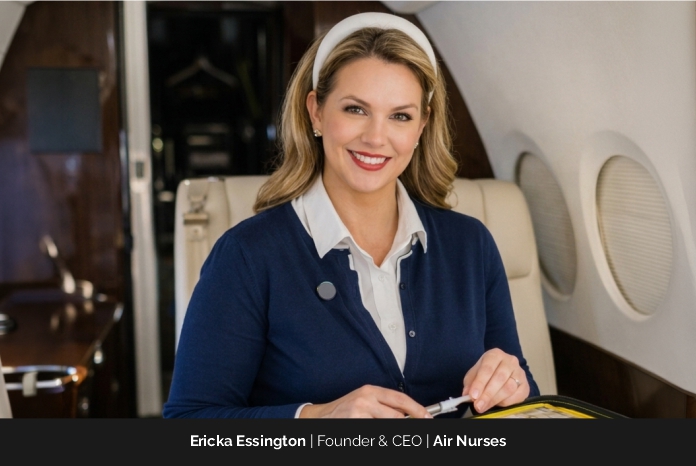
Ericka Essington, Founder & CEO of Air Nurses, believes that healthcare should meet people where they are – not force them to adapt to a system. After fifteen years as a flight nurse and healthcare executive, and a deeply personal experience with her own grandmother, she saw a gap – travelers who needed expert care but not an air ambulance. Ericka created a new model – one that’s flexible, personalized, and built around each individual – because everyone deserves exceptional care on their own terms.
Healthcare That Adapts to You
Ericka’s career has always lived at the intersection of medicine, transportation, and logistics. “For over fifteen years, I worked in critical care transport and air medical services – as both a flight nurse and a healthcare executive – witnessing how difficult it can be to safely move people when health concerns arise,” she shares.
Air Nurses was born from a deeply personal experience. When her grandmother needed air travel support, Ericka was shocked that no service offered the professional medical oversight required – only a commercial medical escort or a full air ambulance. Nothing existed for medically stable individuals who still needed expert care and monitoring throughout their journey.
“Because of my background, I recognized an unmet need. Not everyone needs an air ambulance, but many travelers and families require more support, flexibility, and clinical expertise than standard commercial options offer. I knew we could do better,” she says.
So Ericka envisioned a service that adapts to each traveler, not a take-it-or-leave-it model. Whether recovering from surgery, managing a chronic condition, facing mobility or age-related challenges, or simply wanting a clinician’s reassurance, she imagined flexible, personalized care built around the individual, not a predetermined mold.
Air Nurses bridges the gap by combining the clinical expertise of board‑certified flight nurses with the comfort, privacy, and flexibility of private aviation. Ericka’s model provides clients with highly experienced medical professionals in a tailored environment, allowing them to travel safely and comfortably on their own terms. “Air Nurses represents my belief that healthcare should adapt to patients, not force patients to adapt to healthcare,” she explains.
“I built the service I wished had existed for my own grandmother.”
Leadership Is Serving Others, Not Titles
Ericka’s leadership philosophy was shaped at home and throughout her career. “Watching my mother – a nurse who became a Chief Nursing Officer – taught me that leadership is not about titles or authority. It’s about serving others, building trust, and doing the right thing, even when no one’s watching,” she affirms.
Working as a flight nurse taught her that leadership reveals itself in uncertainty. “In critical care transport, there’s no time for ego, only quick decisions, clear communication, and essential trust. Those experiences taught me to remain calm under pressure and focus on solutions,” Ericka explains.
As a healthcare executive, she learned that a culture built on trust, accountability, and shared excellence drives outcomes, while leadership means fostering support and empowerment. Disaster response, including Hurricane Harvey, reinforced the value of servant leadership. “People don’t need perfect leaders in a crisis. They need leaders who are present, decisive, and willing to stand beside them,” she insists.
At her core, Ericka simply cares about people, and caring for others, whether patient, family, colleague, or organization, brings her the deepest fulfillment. “It makes me happy, and is simply the right thing to do. Today, I lead with transparency, humility, accountability, and a willingness to work alongside my team. Healthcare is ultimately about people, and I never want to lose sight of that,” she declares.
Innovation Is Seeing an Unmet Need Clearly
When Ericka first envisioned Air Nurses, no category existed for advanced nursing care integrated into private travel. Building a new model was both challenging and rewarding. People understood air ambulances and private aviation, but few saw this need. The first challenge was validating the problem. The second was helping others recognize the opportunity.
Drawing on her background in healthcare leadership, operations, and air medical transport, Ericka built a clinically sound, scalable model aligned with modern travelers’ expectations. After speaking with patients, families, aviation professionals, and healthcare partners, she discovered that people want personalized, accessible, integrated care – not fragmentation. They want continuity.
“Air Nurses was built on that principle. Every step of our growth has been guided by the belief that healthcare should travel with the patient, not end when they leave a facility,” Ericka states. “More importantly, innovation is rarely about creating something new, but seeing an unmet need clearly enough to build a better solution.”
“Not everyone needs an air ambulance, but everyone deserves access to exceptional care.”
Balancing Today’s Needs with Tomorrow’s Vision
Ericka is constantly balancing immediate needs with long-term vision. Her instinct is to focus on those they serve, which drew her to nursing. But as CEO, she also thinks strategically about the future. “Some days I speak with families navigating complex travel situations; other days I spend on partnerships, operations, business development, or growth planning,” she shares. “The key is knowing when to work in the business versus on the business.”
Ericka has learned to build a strong team and trust those around her. “No meaningful organization is built by one person. Success comes from surrounding yourself with talented people who share your values and empowering them to lead. Growth is not the goal itself, but what allows us to help more people,” she reflects, a perspective that keeps her focused on what matters most.
Building Awareness for a Service That Did Not Exist
Ericka’s biggest challenge was building awareness for a service that didn’t exist. People knew air ambulances, private aviation, and medical escorts, but few considered advanced nursing care integrated into private travel. She spent much of her time educating others that many travelers need more support than standard options, without an air ambulance.
She overcame this through relationship-building and a commitment to elevating care options. As more people experienced the service, awareness grew. What kept her moving forward was remembering why she started Air Nurses – as a service she wished had existed for her own grandmother. “If we focus on exceptional care, treating people with dignity, and supporting families as we would want our own supported, the rest tends to fall into place,” she says.
Success Is Helping People, Nothing More
For Ericka, success is helping people. Her goal has always been to build systems and relationships that allow her to say “Yes” when someone genuinely needs help. “Healthcare is about caring for others, and if you focus on people first, everything else follows. Many patients feel unheard. They want personalized care, better communication, and trusted professionals who understand their unique situation – not just transactions,” she insists.
Ericka measures success not by growth or finances, but by making a difference – whether a patient feels safer, a family feels supported, or someone receives the care they need when they need it most. “My goal is simple: to help as many people as possible and never have to tell someone ‘No’ when they need care,” she affirms.
“My goal is simple: to never have to tell someone ‘No’ when they need help.”
From Idea to Reality, Changing Lives
Ericka’s most rewarding milestone was seeing Air Nurses become a reality and make a meaningful difference in people’s lives. She believed there was a better way to support medical travelers, even with the uncertainty of building something entirely new. “Seeing families place their trust in us during stressful, vulnerable times validated everything we worked to create,” she says.
What makes her most proud is not a business achievement, but helping people travel safely, comfortably, and with dignity. “Every time a client or family member says Air Nurses gave them peace of mind or a journey they otherwise wouldn’t have taken, it reinforces why the company exists. That will always be my most meaningful measure of success,” she insists.
Balance Ebbs and Flows, and That’s Okay
For Ericka, work-life balance ebbs and flows. Sometimes the business requires more attention; other times, she focuses on herself, family, and the people around her. “The key is recognizing what’s needed in that moment and being intentional with my time and energy,” she says.
Healthcare is a people business – caring for clients, families, teams, and oneself. Some days that means working hard; other days, stepping away to recharge. Air Nurses never truly shuts down, so Ericka has learned that to care for others, you must first care for yourself.
“It’s not about achieving perfect balance, but making sure the people who depend on me – at home, within my team, or among our clients – know they’re valued and supported,” she insists.
People Deserve Options, Not One-Size-Fits-All
Ericka hopes Air Nurses brings personalized, compassionate care and peace of mind to patients and families navigating major life transitions, medical challenges, or travel needs. “Travel is stressful enough without health concerns. If we can help people travel safely, comfortably, and with dignity, while giving families confidence that they’re supported, we’re making a meaningful impact,” she remarks.
Air Nurses aims to demonstrate that healthcare need not fit traditional models. “Every patient is different, and the best care plans adapt to the individual – not the other way around,” Ericka says. “At its core, Air Nurses was built on a simple belief – people deserve options. I hope to continue expanding those options and helping more people access the care and support they need, wherever life takes them.”
Healthcare Must Fit into Patients’ Lives
Ericka predicts healthcare will become more personalized, accessible, and focused on individual needs. While systems and facilities matter, patients now want flexibility, better communication, and care that fits their lives – not the other way around. Air Nurses has shown that healthcare can be highly personalized, adaptable, and centered on the individual.
“Not everyone needs the same solution. Patients deserve options that reflect their unique circumstances. If I can inspire future leaders to think differently, challenge traditional models, and focus first on what patients truly need, I’ll feel I’ve made a meaningful contribution to the next generation,” she says.
Healthcare is About People
Ericka’s advice to aspiring healthcare leaders is to never lose sight of the fact that healthcare is about people. “Complexity makes it easy to become focused on processes, metrics, technology, and systems. But every decision ultimately impacts a person, a family, or a community. The patient must remain at the center of everything we do,” she insists.
Ericka notes that innovation is never a solo effort. The strongest organizations are built by teams with shared purpose and commitment to serving others. Disagreements will happen, but shared values keep everyone moving in the same direction. “Don’t fear challenging the status quo. The greatest opportunities often lie in problems accepted as ‘the way things are.’ Stay focused on improving lives and care for your team. Meaningful innovation will follow,” she recommends.
“At the end of the day, healthcare is still people caring for people.”
From Treating Illness to Preventing It
Ericka predicts the biggest shifts will be toward personalized care and wellness prevention. As patients become more engaged, they’ll need trusted professionals to help them stay healthy, identify issues early, and create tailored care plans – no more one-size-fits-all. Healthcare will also become more accessible and integrated into everyday life.
Patients want services that are convenient, flexible, and designed around their lifestyles, not traditional models. Technology will play an important role, but the biggest change is a shift in mindset. “The future of healthcare is not just about treating illness. It’s about helping people live healthier lives, preventing problems before they occur, and creating personalized experiences across the entire continuum of care,” she observes.
Healthcare Should Never Lose Its Humanity
Ericka’s primary focus is not on her legacy, but on helping people – families who need support, patients who deserve options, and healthcare professionals who dedicate their lives to caring for others. “If I leave anything behind, it’s that healthcare should never lose its humanity. We can innovate, embrace new technologies, and build better systems, but at the end of the day, healthcare is still people caring for people,” she states.
Ericka’s hope is for Air Nurses to demonstrate the value of treating every person as an individual and creating solutions that meet them where they are. “If future leaders build more compassionate, personalized systems focused on the needs of those they serve, I’ll consider that a meaningful contribution,” she says. “More than anything, I hope I’m remembered as someone who genuinely cared and worked to make things a little better for the people who needed help and those who care for them.”
Conclusion
Legacy is not about growth or metrics for Ericka Essington. It’s about whether a patient felt safer, a family felt supported, or someone received the care they needed when they needed it most. It means building a model where healthcare never loses its humanity – where she and her team never have to say “No” when someone needs them. That’s the mark she hopes to leave – people caring for people, one journey at a time.