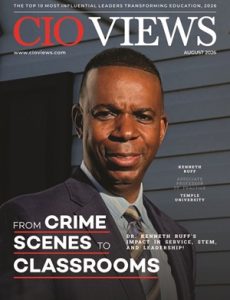

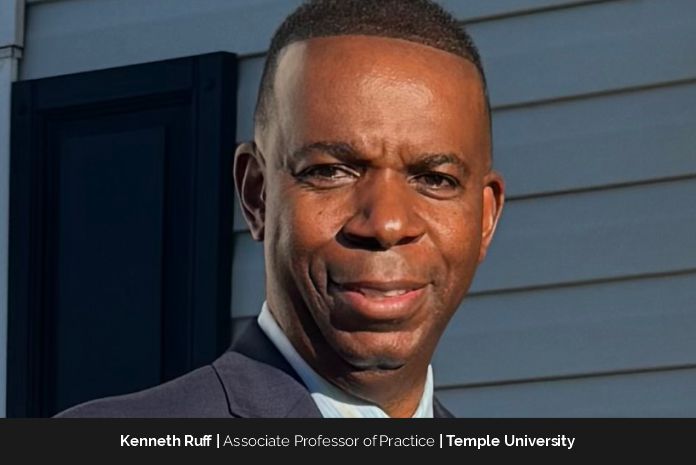
Purpose set the tone for Dr. Kenneth Ruff’s career from the very beginning. Recruited right off his college campus to become a New Jersey State Trooper, he was thrown straight into real-world service by his background in Criminal Justice and Law Enforcement. It’s a foundation that ultimately led to his current work as an Associate Professor of Practice at Temple University.
While earning a Master of Arts degree in Criminal Justice from John Jay College NY, Trooper Ruff embraced the art of teaching by stepping into the role of instructing fellow service members, serving over 600 law enforcement agencies across the state. That experience sparked something bigger. He saw a direct line between the protective duty of law enforcement and the transformative power of teaching, driving him to earn his state teaching certification.
To Dr. Kenneth, education became another form of advocacy and guidance. His commitment was recognized early on when Newark Mayor Sharpe James honored him with a Distinguished Citizen’s Award for Community Service in April 1987. That milestone locked in his path, launching a lifelong career dedicated to serving and uplifting others through education.
Choosing to earn that credential proved to be the defining turning point of his journey. Reflecting on the choice that opened doors to public schools and higher education, Dr. Kenneth notes, “Deciding to pursue a professional teaching certificate provided a gateway into public school and higher education. This publication speaks to the rewards of that decision.”
Walk the Talk to Win the Future
Real leadership starts with setting the example yourself. Dr. Kenneth believes in bringing an innovative, transformational mindset to help educators and students navigate today’s changing world.
At its heart, his approach is simple: prepare students to thrive both right now and well into the future. He views every moment spent teaching as an investment in human potential. In the short term, that means dedicating energy to helping more students graduate in Education and STEM disciplines. Down the road, the long-term reward comes from seeing those graduates step into the world as confident, successful young men and women who make a meaningful impact by contributing to society.
Keep Your Tank Full to Drive Results
High-performance careers demand a sharp line between work and home. Dr. Kenneth protects his personal life fiercely, giving his busy professional responsibilities their own distinct room to breathe. Between administrative duties and teaching a demanding slate of STEM courses, staying both constructive and efficient requires total command over his time. Being health-conscious plays a massive role in maintaining that stamina. As Dr. Kenneth puts it, “I believe mind, body and spirit are essential to performing at your highest level in the workplace.” Keeping those elements aligned provides the energy needed to stay forward-thinking every single day.
Face the Music to Fix the Root Cause
Leadership gets tested when hard truths meet systemic problems. To ground his shift from public school into Higher Education, Dr. Kenneth earned a Master of Science in Professional Education from St. Joseph’s University, PA.
With ten years of service as a certified teacher and decorated teacher of middle grades mathematics, Dr. Ken’s next steps were in administration. Having served as an Assistant Principal and Principal, Director for college pipeline programming at two Pennsylvania community colleges and Director and Faculty Advisor for professional teacher certification programming alongside his current role with the professoriate at Temple University, Dr. Ken knows the entire K-16 student journey inside out. Supported by Senior Leadership in the Provost’s Office, he brings a firm understanding and unwavering support for the student experience. His intense focus centers on college transitions, student retention, and helping students persist all the way to graduation, which sharpens his perspective and drives his passion in educational leadership and supervision.
That extensive vantage point highlights a critical issue across higher education, creating deep concerns regarding the overreach for underprepared college students. Admitting underprepared students without realistic pathways leads straight to five-year degree trajectories, mounting financial debt, and steep first-year dropout rates. This is not a problem unique to Temple University, nor is it a suggestion to close doors completely on students in this position academically. However, bringing in students without the proper academic foundation simply to fill seats is an unsustainable recruitment measure and a misstep. Paying for college is already a challenge, and an inability to maintain good academic standing heightens the dilemma.
High standards are non-negotiable, especially at a premier R1 research institution, where embracing institutional brand identity is a must. Dr. Kenneth emphasizes that faculty members must take active accountability across the teaching, research, and student services paradigm rather than pointing fingers at enrollment departments or excluding faculty roles in university enrollment articles. Without this, the full scope of these challenges cannot be accurately assessed. Sustaining coveted R1 status requires meeting this challenge directly. As he firmly remarks, “Problem-shifting is not problem solving.”
The current national climate offers an opportunity to reimagine core academic structures. As students arrive, faculty must look beyond the classroom to become vessels of engagement. Non-negotiable student accountability must be matched by faculty who deliver quality instruction, embrace innovative curricula with the latest technology, handle artificial intelligence responsibly in learning environments, advance courses, engage the community, and participate in grant-writing and philanthropy. In a rapidly changing world, last year’s syllabus may already be outdated. Faculty must step up as active agents of growth by maintaining high expectations while actively guiding students toward degree completion.
Put Your Energy Where the Engine Runs
Every empty seat in a classroom represents a missed opportunity to change a life. Dr. Kenneth focuses his daily energy on registration management, keeping a strong vision and thorough grasp of his professional role in that area.
He remains conscious of his presence as a vehicle to increase university enrollment. He approaches teaching as more than just delivering lectures, loving the work of delivering pedagogy that actively mentors and models for students. To him, the actual work lies in active mentorship, modeling strong professional standards, and guiding students directly through proactive advising outside of the classroom. This combination forms a core part of his clinical practice as an Associate Professor, keeping students engaged, enrolled, and moving forward.
Break the Mold and Build the Bridge
High performers who bring genuine joy to their work often ruffle a few feathers along the way. Dr. Kenneth chuckles at this perspective, openly stating, “They love to hate me.” Excellence can draw friction, but he uses that energy to drive real change in STEM classrooms by modeling the way forward for his students.
Within STEM colleges, he believes an instructor’s presence shouldn’t be reflective of an extremely rare Jackie Robinson experience. He offers himself as an advocate for students to enjoy a diverse faculty experience in the hard sciences. To be clear, he clarifies that this is not a proclamation for a need for DEI intervention, as that was never the intent or the intended outcome of DEI goals, and certainly not for the Brothers.
Rather than relying on empty rhetoric, he pushes for actionable pathways in STEM disciplines that move toward a teaching populus becoming more reflective of the community it serves. Backed by a wealth of research supporting this trend, this tactic aims to make a difference toward greater success for marginalized populations in the hard sciences while creating real-world pathways for underrepresented groups where solid representation remains far too rare.
Stand on the Shoulders of Giants
Throughout his career, Dr. Kenneth drew wisdom from incredible mentors, like Principal Leona Roberts in Willingboro Public Schools, John Gilbert Ridley at Bucks County Community College, and his dissertation chair, Professor Vivian Ikpa at Temple University.
Yet former Associate Vice Provost for Undergraduate Studies Michele O’Connor at Temple University left an indelible imprint in forming his vision for higher education. Carrying a “warm, welcoming and unscathed temperament,” she operated with complete authenticity in her space of influence. She understood the inner workings across all three pillars of higher education, which are teaching, research, and student services, while remaining steadfast on the importance of student services to move the university forward.
Her guidance from the Provost’s Office provided Dr. Kenneth with a pathway to work across all three pillars. He served for many years on the Transfer Experts Committee, evaluated General Education curriculum coursework, revised the UNVS 2002 Transfer Seminar Course titled Planning for Success, and led data-driven initiatives alongside institutional research.
This exposure allowed him to excel in his doctoral studies, earn recognition among the honorees for the Temple Chapter of the Golden Key National Honour Society for academic excellence, and complete his doctoral degree, all leading up to Temple’s peak enrollment year in 2017. Deeply indebted to her mentorship, Dr. Kenneth gained the grounding and confidence to know exactly what he is doing in his field today.
Roll Up Your Sleeves Where It Counts
For Dr. Kenneth, true fulfillment comes from working with diverse populations to advance his work in the community on a personal and human level through his startup non-profit, EDU-Safe Community Solutions.
Blending his roots in law enforcement and education, the organization delivers educational services, youth mentorship, and safety initiatives in the community. He targets areas including Middletown, Delaware, and neighboring townships like Wilmington, New Castle, and Newark for this venture.
While disturbed by the national climate regarding what is occurring in our communities, in our schools, and with the undermining of law enforcement practice and education, he remains motivated to tackle these multifaceted, longstanding challenges head-on. He works directly alongside local police, schools, and faith communities to build partnerships that are already well underway. As he says, “Having a measurable impact matters.”
Get Ahead of the Curve Before It Shifts
For those stepping into educational leadership today, sitting on the sidelines is not an option. To keep pace with the imminent and rapid changes in the field, this is a must. Dr. Kenneth urges rising leaders to become proficient and get certified in Artificial Intelligence, while also investing in it personally and professionally.
Educational leaders and teachers are currently grappling with the exact impact this technology will have within schools and inside the classroom, openly debating whether AI is a friend or foe. In terms of information technology, education has weathered major innovations in the past. Every major technological shift changed the game, from the birth of the internet and the dot.com revolution to the smartphone, but “AI hits differently.”
The immediacy of this innovation and how it is impacting the world is moving far more rapidly than our ability to identify the actual parameters of its impact. Its boundaries appear to be limitless, and its proximity to undermining reality is dangerous, especially while governance over this innovation remains in its infancy stage. Its speed, scale, and potential to blur fact and fiction demand immediate mastery. Leaders must learn to govern and harness these tools responsibly rather than letting technology outpace the classroom.
Tell Your Story on Your Own Terms
Mastering the art of self-narration in a crowded room is rare. However, it changes everything. Staying a lifelong learner means knowing how to spot true opportunity amid noise and skepticism. In an era dominated by social media spin, AI creation, and endless information overload, Dr. Kenneth sees immense value in owning his narrative.
Being recognized by CIO Views as an Influential Leader Transforming Education in 2026 gives him a platform to speak with unfiltered authenticity. Having pushed past institutional friction in both law enforcement and academia, he uses this milestone not as a final finish line, but as the opening chapter to share his journey.
Adapt to the Shift to Keep Moving Forward
Higher education leaders were well aware of the impending challenges regarding enrollment and retention long before the pandemic hit. Projected trends following a drop in birth rates since 2010 signaled a future dip in student numbers, and institutions explored various action plans to combat these expected declines. The Coronavirus pandemic only reinforced those existing drops.
Nationwide discussions turned toward innovative ways to explore college entry standards, but those adjustments produced trivial, weak results. True stability requires a deeper overhaul.
As Dr. Kenneth puts it, “The answer is to reimagine Teaching, Research and Student Service models that contribute to student sustainability.” Instead of relying on quick fixes, institutions must reshape their core practices so students stay engaged, supported, and equipped to finish what they start.
Write Your Own Script to Build a Lasting Mark
Legacy is something you build and live in the present by showing up as your authentic self. Dr. Kenneth Ruff brings that exact energy to every interaction, grounding his approach in a life of service. He believes that offering kindness, purpose, and responsibility to others may not always yield direct personal rewards, but embracing that commitment creates genuine value for everyone involved.
When he designed the Transfer Seminar course for Temple University’s College of Science and Technology, he built in a core prompt asking students to consider what defines them right now. His goal was to help students pinpoint and promote the best version of themselves today, establishing a solid baseline to build upon as they move forward. His reasoning stems from a hard lesson during his time in law enforcement, where he learned that if you don’t set goals for yourself, society has a way of setting them for you.
Transfer students bring a wealth of prior life experience into higher education. Helping them channel those existing responsibilities with sharp focus allows them to maintain a healthy work-life balance alongside rigorous STEM coursework. Dr. Kenneth remains a staunch advocate for high standards, knowing that students reap enduring benefits from meeting these demands as productive citizens prepared for today and tomorrow.