
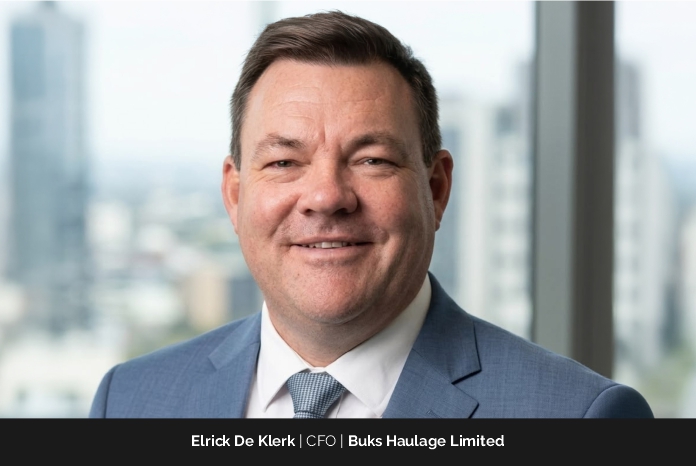
In this edition of our feature, we have the privilege of speaking with Elrick De Klerk, the Chief Financial Officer (CFO) of BHL Group. A renowned figure in the logistics industry, Elrick is a seasoned executive who cares less about micromanaging spreadsheets and more about empowering the people on the ground.
His professional journey has been anything but predictable. Starting as an accountant, he quickly realised that numbers only tell half the story. This prompted a shift into the chaotic, fast-moving world of supply chain operations.
If we had to describe Elrick in one word, we would choose “GROUNDED.” Quietly sharp and content to let others shine. He is integrity personified. Join us as we step into his story and the insights he’s gathered along the way.
Foundations of Business
This unconventional approach to numbers stems from Elrick’s early life in South Africa. Long before he managed global equity deals or electric fleets, his understanding of business was shaped at home by a very personal mentor.
“I grew up in a small town close to Cape Town,” Elrick shares, recalling how his mother, a school teacher, taught economics and accountancy. He credits her for triggering his early fascination with commercial markets. However, entering the corporate world as a young professional showed him that classic ledger work was a different kettle of fish from his ultimate career goals. “I started my career in accounting, but I soon realised that my actual passion is with business and not only accounting.”
Stepping out of the traditional accounting box allowed him to view a company as a living organism rather than a static spreadsheet. By grounding his financial training in real-world economics from an early age, he developed the ability to see the human stories and operational realities behind the data.
Leading Through Autonomy
To keep a massive logistics network moving, Elrick believes executives must learn to step back. To him, hovering over employees destroys initiative. A healthy business needs to give people the freedom to run their own departments within the company’s broader goals. “Micromanagement is a toxic trade and should be avoided at all costs,” he stresses.
His hiring strategy follows the same precise logic. He actively looks to recruit people who are sharper or more skilled than he is in their specific roles to prevent the business from stagnating. This operational depth directly feeds into how he views his executive responsibilities. “As a CFO, my role is not only to ensure that accounting and financial statements are compiled and reported correctly, but also to understand the operations of the business that generate profit or loss for shareholders and stakeholders.”
By profoundly understanding those underlying operations, he can focus on the bigger picture. “To maximise profit and ensure long-term growth, you need strategic decisions that help the group into the future,” Elrick reflects.
When building the teams capable of executing those decisions, technical intellect takes a backseat to human traits. In Elrick’s view, high EQ (emotional intelligence), trust, and basic integrity are far more valuable than a high IQ score, creating a collaborative environment where people feel secure enough to make decisions on their feet.
Shaping the Tech Horizon
By and large, staying ahead in transport necessitates custom tools rather than standard solutions. Instead of buying off-the-shelf software, Elrick’s team built their own in-house truck management system. This gives them the flexibility to capture real-time data, which is essential when calculating risks and returns on daily runs. This focus on data naturally ties into the rapid rise of AI tools like Claude and ChatGPT.
Elrick expects traditional, repetitive roles like basic bookkeeping and data capturing to fade away over the next decade as workloads shift toward data analysis and interpretation. Rather than fearing this shift, he is actively excited about incorporating AI to open up new operational possibilities. Yet, he maintains that while machine intelligence can influence a strategy, it still lacks the human intuition and deep business-model experience needed for final investment decisions.
Beyond software, Elrick sees a major physical shift coming down the road. It is the transition from diesel engines to battery-operated trucks. By balancing the fleet with electric vehicles, a transport company can generate its own electricity, bypassing the volatile swings of international oil prices entirely.
Navigating the Global Stage
Scaling a regional logistics footprint up to an international level requires a massive leap in operational maturity. In Elrick’s case, this defining shift happened when BHL transitioned from a localised operation into a key player within a massive global network.
“In 2023, we signed an equity agreement with a Chinese company, Jiayou International Logistics, listed on the Shanghai stock exchange,” Elrick notes. “This has been a major milestone for me, being part of a much bigger organisation and managing the BHL group as part of them has really expanded my experience in global finance and corporate culture.”
Guiding a company through an international integration of this scale meant learning to sync different working styles and corporate expectations. By anchoring the transition in mutual organisational goals, Elrick successfully leveraged the merger to broaden the company’s financial capabilities without losing the agile, on-the-ground responsiveness that built the business in the first place.
The Appeal of Daily Chaos
This practical mindset is exactly why Elrick is named among The Most Influential Finance Leaders to Watch in 2026. He earned this spot by proving that financial leadership belongs on the operations floor, not hidden away in a boardroom.
In transport and logistics, predictability does not exist. Rather than pointing to a single crisis that defined his career, Elrick thrives on the volatility and fast pace of daily disruptions. Managing these constant shifts has sharpened his problem-solving skills, benefiting both his professional and personal life. Yet, he is quick to share the credit for managing this chaotic environment.
As he puts it, “You definitely can’t overcome the challenges without your people working under you. It is definitely a team effort. All the team needs is guidance towards a mutual goal.”
This daily intensity requires a flexible approach to personal time. Because a CFO travels constantly, family life can easily take a back seat. Elrick avoids the standard corporate trap of trying to force a perfect 50/50 work-life balance. Instead, he focuses on immediate daily priorities. Some days require a heavy business focus, while others belong entirely to his family. This fluid approach protects his home life without hurting the company.
Defining the Legacy
Fair fields lie ahead for the next generation of finance professionals if they can grasp the true meaning of leadership. Elrick regards that stepping into a CFO role requires earned credibility. To these aspirants, he advises, “you need to make sure the team that works under and with you can trust and look up to you.” It has very little to do with pulling the longest hours or knowing more than everyone else. Instead, leadership is about helping people grow and enabling them to be the best they can be in their roles.
He emphasises that true leaders must always “know what they don’t know” and bring people into the company who bring real value to the group. Elrick always tries to set a personal example for his team through his own daily actions. Long-term, he hopes that when he retires one day, future generations of finance professionals will keep trust and integrity at the absolute core of the group.
This dedication comes from a solid personal bond, as the BHL group has always been close to his heart. Looking back over the last 20 years, he has found it deeply satisfying to watch the business grow. Elrick hopes he has contributed to this journey as they work to transform BHL into a world-class logistics and supply chain provider, one that compels competitors to look to it for leadership and insights into new market trends.