

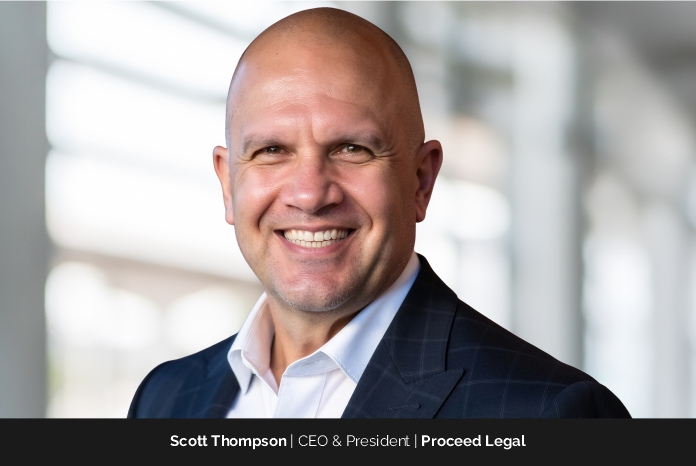
Proceed Legal, formerly known as Counsel Press, has helped attorneys navigate the highly technical and unforgiving requirements of appellate practice. But for too long, litigation support has remained unchanged. It is still purchased as a collection of individual transactions: one firm for court filing, another for service of process, and a third that is only contacted once a matter reaches appeal. Each transaction works well as a stand-alone task, but the risk, as Proceed Legal CEO and President Scott Thompson points out, develops between two transactions. The 88-year-old firm has rebuilt itself on the idea that the infrastructure that connects all the transactions holds the real value in litigation support. It is now rewriting what it means to support a case from filing to appeal.
Proceed Legal is beginning to change how the legal industry thinks about litigation support.
Counsel Press Rebrands as Proceed Legal
Since its founding in 1938, Counsel Press has established a culture of precision. In an appeal, what seems like a small procedural or formatting issue can create a serious problem. That is why, Scott says, accuracy, timing, and jurisdiction-specific knowledge have never been optional for them.
Over time, the firm noticed that same need for precision existed throughout litigation, not only at the appellate stage. Law firms were managing a growing number of courts, systems, vendors, documents, deadlines, and stakeholders. And the work was becoming more digital, but not necessarily more connected.
“Our vision expanded accordingly,” Scott says. The firm made strategic acquisitions, invested in technology, and focused on geographic growth. As a result, it added electronic court filing (e-filing), service of process, dispute management, and broader litigation support capabilities, while continuing to build on its appellate foundation.
The Proceed Legal name, adopted by the firm in 2025, reflects that evolution. It communicates forward movement while also carrying a natural connection to legal proceedings. “Most importantly, it describes the role we want to play for clients: helping them move complex matters forward with greater clarity, coordination, and certainty of outcome,” Scott says.
New Model Eliminates Individual Transactions
When litigation support involves a series of separate transactions, information has to be transferred. Responsibility keeps changing hands as well. That creates a disconnect between the various parties involved, and status becomes harder to see. And a law firm’s staff ends up spending hours following up, moving documents, reconciling invoices, or trying to figure out which provider is responsible for the next step.
Proceed Legal has replaced that approach with a new model. A partner supports legal teams across court e-filing, service of process, dispute management, and appellate services. Multiple individual transactions are not needed.
“The value is not simply convenience,” Scott says. “It’s continuity.” Shared standards, connected workflows, clearer ownership, and better visibility reduce the number of places where information can be lost, or responsibility can become unclear.
Proceed Legal’s appellate heritage adds another dimension. It brings appellate-grade precision to the entire litigation lifecycle: procedural expertise, disciplined workflows, technology-enabled validation, and human oversight.
Scott notes that technology can accelerate the work, but it cannot erase the complexity of thousands of court rules, local practices, and jurisdictional differences. “Clients need speed and judgment,” he adds. “Our value is in bringing the two together.”
Biggest Challenge is Biggest Opportunity
For Proceed Legal, its greatest challenge is also its greatest opportunity. It is bringing together companies with strong histories, established client relationships, distinct operating practices, and specialized knowledge. “Growth through acquisition can create scale quickly,” Scott says. “But integration takes considerably more discipline.”
The challenge is to preserve what made each organization valuable, such as its people, customer relationships, and local knowledge, along with creating shared standards, connected technology, and a unified experience for clients.
Scott and his team do not impose integration from the center. They believe the people closest to the work often understand the procedural and client-service realities better than anyone else. Their expertise helps build the larger organization successfully.
At the same time, leadership has to provide clarity. According to Scott, they need to make the teams understand why the firm is changing, what standards will remain non-negotiable, and how the different parts of the business fit together. “Scale can be purchased,” he adds. “Cohesion has to be built.”
Innovation and Tech Strategy in Litigation Support
In litigation support, innovation is about redesigning how the work moves, not about placing a new interface over an old process.
In 2024, Proceed Legal began acquiring companies that had complementary strengths in dispute management, court e-filing, service of process, appellate support, regional court knowledge, and workflow technology. Each brought something valuable, including expertise, client relationships, operating discipline, geographic reach, and a technology platform. “But acquisition is only the visible part of growth,” Scott says. “Integration is where innovation becomes real.”
The harder and more important work is connecting those capabilities so the client experiences fewer handoffs, more consistent standards, centralized tracking, better document movement, and clearer accountability from one stage of a matter to the next. “The legal industry has spent years digitizing individual tasks,” Scott says. “The next opportunity is to connect those tasks into a coherent operating system.”
When it comes to Proceed Legal’s technology strategy, its focus is on reducing unnecessary work and identifying procedural risk earlier.
That begins with asking pointed questions, such as where are legal teams re-entering the same information? Where are they downloading and moving documents by hand? Where are they chasing status, reconciling multiple invoices, or discovering a preventable issue only after a court rejects a submission? “Those are the places where technology should intervene,” Scott says.
The firm is also applying AI selectively where it can improve speed, consistency, and review. However, Scott and his team do not see AI as a substitute for procedural expertise, especially in an environment shaped by jurisdictional variation and exceptions. He underscores that the most effective model in legal operations is technology reinforced by human judgment.
Listening Closely to the People
At Proceed Legal, ensuring adaptability starts with listening closely to the people doing the work.
A managing partner may be thinking about risk, profitability, capacity, and client confidence, while an office administrator may need standardization and visibility across teams. And a paralegal or legal assistant may like to know, without sending a string of emails, whether a filing was accepted or a service was completed.
The firm also operates in an environment where requirements vary significantly by jurisdiction and can change frequently. Scott says that adaptability therefore depends on maintaining close knowledge of court procedures, local practices, filing mandates, security expectations, and client workflows.
Their approach combines customer feedback, performance data, operational reviews, and direct input from the legal professionals who support filings and service every day. That information is used to refine workflows, improve integrations, identify rejection patterns, and adjust support provided to different types of firms and matters.
The objective is not to force every client into the same process. Scott explains that it is to create a reliable platform that can support different jurisdictions, practice areas, volumes, and operating models without sacrificing consistency.
Firm’s Culture During Rapid Growth
Scott notes that culture becomes especially important during periods of rapid growth.
Proceed Legal has brought together teams with long histories, distinct regional identities, and great professional pride. The instinct in most firms is to flatten those differences into a uniform culture. Proceed Legal wants to preserve the expertise and relationships behind them while building a larger sense of shared purpose.
“Precision, responsiveness, accountability, respect for expertise, and commitment to the client are central to that culture,” Scott says.
He also wants employees playing an active role in improving the system, not merely operating within it. The person closest to a filing rejection, a difficult serve, an appellate record, or a recurring client question is most likely the first to see where a process needs to change.
“Long-term success will depend on combining discipline with curiosity: protecting the standards that matter while continuing to question how the work can be done better,” Scott says.
Meaningful Impact on Clients and Industry
The most meaningful impact of Proceed Legal is often measured in the work clients no longer have to do. For example, a paralegal no longer has to search across multiple systems for a status update and an administrator no longer has to assemble a complete operational picture from several vendors. Also, because of Proceed Legal, an attorney does not have to personally monitor every procedural step to feel confident that a matter is moving.
“A more connected workflow can give that time back,” Scott says. When litigation support is connected, legal professionals can devote more attention to case strategy, client service, and higher-value work.
And, at the industry level, Scott believes they are helping move litigation support from a transactional category toward a more strategic one. “The way a firm coordinates litigation support is no longer a back-office concern,” he adds. “It is becoming part of how the firm competes.”
Future Opportunities and Trends
Scott expects the next phase of litigation support to be defined by coordination.
“The future litigation winner may not simply be the firm with the most attorneys or the most technology,” he says. “It may be the firm that coordinates best.”
A modern legal matter can move across firms, courts, vendors, clients, experts, jurisdictions, and technology platforms. Even when every participant performs well individually, the process can still fail if the connections between them are weak. That, Scott believes, is where Proceed Legal’s biggest opportunity lies. He breaks that down into four advantages.
First is deeper integration across the litigation lifecycle. It happens when electronic court filing, service of process, proof management, dispute management, and appellate support function as continuous parts, not operate as isolated workflows.
Second is greater use of data. Scott says that firms need better visibility into rejection patterns, turnaround time, service performance, workload, cost, and operational risk. Third is intelligent automation, which removes repetitive work. Its value, however, depends on how well it is paired with procedural expertise and clear accountability. Finally, the infrastructure. “It allows law firms to grow without adding administrative headcount at the same pace as case volume,” Scott says.
The immediate opportunity for them, he adds, is to keep strengthening the nationwide platform without losing what makes it work at the local level.
Court rules, clerk practices, filing mandates, service requirements, client expectations can change dramatically from one jurisdiction to the next. National reach means little if it comes at the expense of courthouse-level knowledge. “That is why we are combining national technology, resources, and standards with established regional teams, procedural expertise, and client relationships,” Scott says.
Proceed Legal’s recent openings in Arizona and Nevada illustrate that approach. It places the firm closer to key courts and client work in the Southwest, in addition to connecting those local capabilities to the broader Proceed Legal platform.
“As we grow,” Scott says, “the central question will remain the same: does an expansion help us provide a more connected, accurate, and accountable experience for legal teams?”
The CEO’s Diary
Scott leads with clarity, patience, urgency, and consistency. Clarity, he believes, is a valuable leadership trait, especially when a firm is growing fast.
“People need to understand where the organization is going and why,” he explains. A strategy cannot live only in a board presentation. It has to make sense to the people responsible for serving clients, building systems, managing operations, and integrating teams.
Patience and urgency, though they pull in opposite directions, are two of Scott’s coexisting leadership traits. He points out that there is urgency around market opportunity, technology development, and client needs, but building a durable firm also demands patience. That patience shows up when he listens to people, understands how work actually gets done, integrates systems responsibly, and earns trust.
Then there is consistency. During a transformation, employees and clients are watching, closely, for what leadership repeatedly prioritizes. “For us, these priorities continue to be precision, accountability, expertise, and client confidence,” Scott says.
As CEO, he establishes direction, clarifies priorities, and creates the conditions in which strong people can make good decisions. Scott believes in empowerment, but not the kind that hands off a task and walks away.
“Teams need context,” he says. They have to understand the business objective, the client problem they are trying to solve, the standards that must be protected, and the tradeoffs involved. According to Scott, once that context is clear, the people closest to the work will develop a meaningful sense of ownership.
Proceed Legal has deep expertise. It has appellate attorneys, procedural specialists, operations leaders, technologists, client-service teams, and regional experts. Scott points out that the leadership challenge is to keep that expertise from remaining trapped in separate functions or geographies. “We have to connect the people who understand the problem with the people who can turn the solution into a repeatable practice,” he adds.
Looking ahead, Scott hopes to leave behind an organization that respects its history without becoming confined by it. He wants it to be a firm that “carries forward the precision developed over decades while remaining curious enough to keep reinventing how the work is done.”