

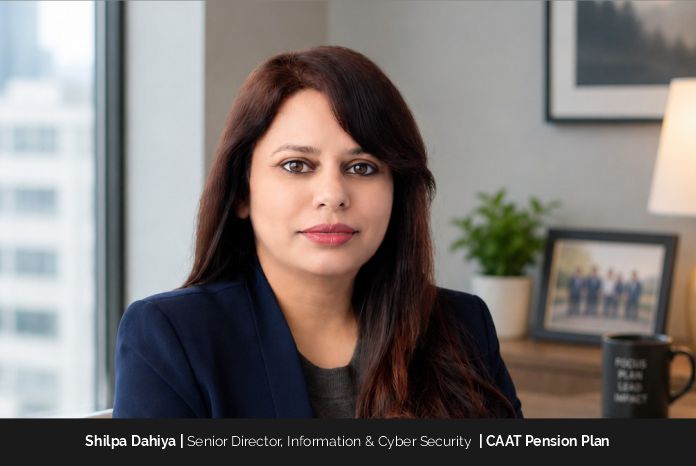
Across nearly two decades, with experience and impact spanning global environments as well as Canada’s public and private sectors, Shilpa Dahiya has built a reputation for reducing attack surface, translating complex cyber risk into decisive boardroom action, and developing high-performing teams that lead with clarity under pressure. Her journey is not simply about securing a place at the table; it is about earning trust, shaping consequential decisions, and leaving institutions more resilient than she found them.
Some of the most important achievements in cybersecurity are almost invisible: a risky design changed before launch, an incident contained before it spreads, a board decision improved because the risk was finally understood, or a team confident enough to challenge an assumption before it becomes exposure. Those quiet wins, accumulated over more than 18 years, explain why Shilpa Dahiya has become a trusted cybersecurity executive and a recognized voice in Canadian leadership.
Today, as one of top cyber leaders in Canada, Shilpa works at the point where technical risk, business consequence, executive judgment, and human trust converge. She has helped move cybersecurity conversations beyond tools and compliance toward resilience, accountability, and decision quality. Her work has included developing cyber roadmaps, reducing attack surface, securing support for difficult security decisions, advising leaders and boards, and building teams capable of operating with discipline when the stakes are high. From resolving complex cyber risks to becoming a significant voice in the boardroom, it was never a linear path for Shilpa to move on. She built credibility role by role, sector by sector, decision by decision.
Her identity is part of the story, but it is not the sum of it. Building a leadership career in Canada as a woman of color shaped the terrain she crossed; it does not explain the results she delivered. Those results came from preparation, technical acumen, business fluency, calm under pressure, and a willingness to own outcomes rather than simply identify problems. Recognition such as the 2026 CISO Forum Cyber Champion Award reflects that wider impact, but Shilpa’s most persuasive evidence is found in stronger systems, better decisions, and more capable people.
“Systems can be patched; trust must be earned, protected, and repaired.”
A Career Built on Substance, Not Spectacle
Shilpa’s interest in technology began with logic rather than machinery. She was drawn to patterns, dependencies, weak points, and the possibility of improving complex systems. Seeing an outcome was never enough; she wanted to understand what produced it, what could undermine it, and how it could be made stronger. That instinct – to look beneath the surface and examine root causes – became the foundation of her work in cybersecurity.
Long before she held a cybersecurity title, she was forming the habits that would later define her leadership: observe carefully, prepare thoroughly, refuse to be intimidated by complexity, and take responsibility for the result. She learned that competence earns attention, but consistency and integrity earn trust. In a profession where one rushed judgment can have disproportionate consequences, those habits became more than personal strengths; they became operating principles.
Building a life and career in Canada required resourcefulness. Shilpa did not arrive with a ready-made professional network or a clearly marked route into leadership. She learned by doing, accepted assignments that stretched her, asked questions that exposed the real issue, and built credibility role by role. Rather than treating unfamiliarity as a reason to stay small, she treated it as a reason to become more deliberate. That self-directed approach gave her both technical range and a lasting empathy for people entering rooms whose language, culture, or unwritten rules are not immediately familiar.
“I did not wait to feel completely ready. I learned to move while still carrying doubt – and to let preparation speak louder than permission.”
The Decision to Own the Outcome
The defining shift in Shilpa’s career came when she chose not to remain only the person who could diagnose and solve a technical problem. She stepped into the harder role: the leader responsible for setting direction, making trade-offs, aligning competing interests, and carrying the consequences of the decision. That transition changed the scale of her impact.
Cybersecurity leadership, in her view, is ultimately a discipline of judgment. Everything can appear urgent; very little can be treated as equally important. A senior leader must understand the threat, the business process, the people affected, the legal and operational constraints, and the organization’s capacity to absorb change. The task is not to eliminate uncertainty before acting. It is to make the best available decision, explain the trade-offs honestly, and create enough alignment that the organization can move.
That is why Dahiya wanted a voice at the table where resilience, investment, and institutional priorities are shaped. She was not satisfied with identifying risk from the margins and waiting for others to translate it. She wanted to help determine which risks mattered most, what action was proportionate, and how leaders would remain accountable after the meeting ended. ‘I wanted impact more than comfort,’ she says.
Turning Cyber Risk into Boardroom Action
One of Shilpa’s most consequential capabilities is translation. She can move between the language of technical teams and the language of executives without diminishing either. Boards do not need an avalanche of jargon; they need a clear view of exposure, consequence, options, residual risk, and the decision required of them. Technical teams, in turn, need more than abstract executive direction; they need priorities that can be implemented, owned, and measured.
Shilpa frames cyber risk in terms of what leaders are responsible for protecting: continuity, trust, sensitive information, critical services, financial resilience, and the organization’s ability to recover. That makes the conversation decision-useful. When a board understands not only what investment is being requested but why it matters, and when operational teams understand how their work connects to enterprise resilience, cybersecurity stops being viewed as a barrier and becomes an enabler of informed progress.
Winning support in the boardroom is only half the achievement. Shilpa is equally attentive to winning the confidence of the teams who must implement the decision. Approval secured through fear rarely produces sustainable change. Credibility is built through evidence, consistency, transparency, and the willingness to listen to operational reality. Some of the most meaningful moments in her career have come when she secured support for a difficult security decision while also earning the trust of the people responsible for carrying it out. That alignment is where transformation becomes durable.
“Security should strengthen confidence, not create paralysis.”
Reducing the Attack Surface – and Building the Capacity to Recover
Shilpa’s work is grounded in practical risk reduction. Attack-surface reduction, as she describes it, is not a single project, product, or campaign. It is a continuous discipline: identifying unnecessary exposure, challenging complexity that no longer serves the business, strengthening controls, clarifying ownership, and making difficult prioritization decisions before risk becomes incident.
The value of that work can be seen in outcomes that are easy to overlook because they are not dramatic: a risky design altered before launch; a control gap addressed before it is exploited; an incident contained before it expands; a roadmap that moves an organization from reactive activity to deliberate resilience. These are not merely technical wins. They are evidence that governance, operations, and leadership are working together.
For Dahiya, resilience is not a slogan and it is not a substitute for prevention. It is the organization’s capacity to know what matters most, limit the blast radius, make decisions quickly, communicate honestly, recover safely, and preserve trust. That requires more than technology. It requires rehearsed roles, clear escalation paths, trusted relationships, and leaders who can remain precise when information is incomplete.
Her focus is therefore not only on whether a control exists, but whether it will work under pressure; not only on whether a policy is approved, but whether people understand their responsibilities; not only on whether a plan is documented, but whether the organization has built the decision muscle to use it. In that sense, cybersecurity maturity is measured less by the appearance of control than by the depth of capability behind it.
“Cybersecurity is not the art of predicting every attack. It is the discipline of ensuring that one attack does not become an organizational identity crisis.”
Where Strategy Meets Operations
Shilpa leads across multiple horizons at once: today’s operational realities, the next stage of risk reduction, and the longer arc of transformation. Over-focus on the immediate creates exhaustion and reactivity; over-focus on the future can make strategy detached from the signals that matter now. Her answer is disciplined prioritization grounded in consequence, continuity, and trust.
She is as interested in the mechanics experienced by teams on the ground as she is in the quality of the board conversation. ‘Strategy that is disconnected from operations becomes theatre. Operations that are disconnected from strategy become reactive,’ she says. The leader’s job is to hold both: a clear destination and an honest understanding of what implementation requires.
That principle is especially visible during pressure. Shilpa rejects the idea that cybersecurity must be led through drama, fear, or hero culture. A program dependent on a few exhausted people is not resilient; it is fragile in a way that may be temporarily hidden by individual effort. She wants teams that surface bad news early, challenge assumptions respectfully, understand decision rights, and remain capable when the leader is not in the room.
“In cybersecurity, calm is not merely a personality trait. It is an operational control.”
Calm, in her leadership model, does not mean passivity. It means preserving enough cognitive and emotional control to assess facts, sequence decisions, and communicate without amplifying confusion. During a crisis, teams borrow the emotional temperature of the leader. Dahiya’s steadiness allows people to focus on what must be contained, what must be protected, and what must happen next.
The Achievements That Carry the Most Weight
Formal recognition matters to everyone, and Shilpa has been recognized for her broader contribution to the profession. Yet she is careful not to reduce achievement to a title, award, or visible milestone. The accomplishments she values most are those that demonstrate depth, discipline, and trust earned over time.
She points to cyber roadmaps that replaced fragmented activity with deliberate priorities; attack-surface reduction that created fewer points of vulnerability; executive conversations that turned technical uncertainty into an informed decision; and teams that matured from waiting for instruction to exercising sound judgment. Each outcome reflects a different dimension of leadership: strategic clarity, operational rigour, influence, and people development.
Her quiet wins are equally significant. An incident contained. A risky design changed before release. A difficult conversation held early enough to prevent a larger failure. A colleague she mentored stepping into a larger role, recovering from a setback, or becoming a mentor to someone else. These moments rarely dominate a magazine profile, but they are often the clearest evidence that leadership has created lasting capacity rather than temporary activity.
“The systems are stronger, the decisions are better, and the people are more capable because I was there.”
That is the standard by which Shilpa measures her own contribution. Not whether security appeared busy, but whether exposure was reduced. Not whether a presentation was persuasive, but whether the organization made a better decision. Not whether the team depended on her, but whether people became more capable because she challenged, trusted, and developed them.
Questioned Origin Makes You More Disciplined -The Road Was Uneven. The Standard Was Not.
Shilpa does not minimize the barriers she encountered. As a woman of color building an executive career in Canada, she sometimes experienced what she calls an uneven burden of proof – moments when confidence was interpreted differently, authority was tested more quickly, or competence had to be demonstrated repeatedly before it was assumed. From the time she started her leadership journey, she understood it was not going to be easy. But she never gave up. Those experiences shaped her, but they did not become the centre of her professional identity.
Early in her career, she responded by working harder, carrying more, and trying to remove every possible reason for doubt. Over time, she recognized the limit of that strategy. Excellence is essential, but flawless performance cannot correct every biased assumption, and perpetual overextension is not a sustainable leadership model. She shifted from chasing approval to building credibility: facts over theatre, clear trade-offs, precise communication, strong coalitions, and the confidence to remain anchored in her own standards.
Being underestimated eventually became information rather than injury. It sharpened her observation, preparation, and judgment. It also taught her not to underestimate others based on title, accent, background, or the confidence with which they first enter a room. Her identity shaped her empathy and her perspective, but her authority rests on the same foundation as any exceptional leader’s: substance, results, accountability, and trust.
“I stopped trying to perform a universal version of executive presence and focused instead on being clear, composed, prepared, and honest.”
From Critics to Sponsors, You Meet a Mosaic of Mentors Who Mold You
Shilpa’s approach to talent mirrors her approach to security: build durable capability, not fragile dependence. She has never believed that strong leadership means being the only person with the answer. The better measure is whether a team can make good decisions under pressure, challenge a flawed assumption, escalate bad news quickly, and continue operating effectively without waiting for permission.
Her own development was shaped not by one ideal mentor, but by a mosaic of mentors, sponsors, peers, leaders, and team members. Some strengthened her technical rigour; some offered a difficult truth at the right time; some advocated for her when she was not in the room; others showed her what kind of leader she did not want to become. She describes this network as a personal board of directors – people with different strengths who expanded her thinking and, at critical moments, her field of possibility.
She now tries to provide the same combination of encouragement and candour to others. That means hiring for potential as well as pedigree, giving people context rather than only tasks, creating stretch assignments, making unwritten expectations more visible, and delivering feedback early enough for someone to use it. It also means distinguishing mentorship from sponsorship. ‘A mentor helps you think,’ she says. ‘A sponsor is willing to spend credibility on your potential.’
Representation matters to Shilpa, but visibility alone is insufficient. A magazine cover can expand what someone believes is possible; opportunity is what allows them to act on that belief. Her goal is therefore not merely to be seen, but to convert influence into access, development, and room for others to lead.
Evolve with the Evolution
Over the course of Shilpa’s career, cybersecurity has moved from the perimeter of IT into the centre of enterprise resilience. It is now a boardroom priority, a geopolitical reality, a supply-chain concern, and a condition of public trust. The attack surface has expanded across cloud services, identity, digital products, third parties, data ecosystems, and artificial intelligence. At the same time, threat activity has become more organized, scalable, and economically efficient.
Artificial intelligence will accelerate both sides of the contest. It can help defenders identify patterns, reduce repetitive work, and respond with greater speed. It can also lower the barrier to sophisticated social engineering, increase the scale of attack, and introduce new questions about model integrity, data provenance, access, bias, and autonomous action. The next generation of cyber leaders will need to secure AI systems while also governing how AI is used to make consequential decisions.
Shilpa expects the strategic emphasis to continue shifting from prevention alone to resilience by design. Identity will remain a central control plane. Secure-by-design expectations will grow. Third-party concentration risk will receive greater scrutiny. Post-quantum migration will move from an abstract technical discussion toward real inventory, prioritization, and planning. The organizations that lead will not necessarily be those with the most tools; they will be those that understand their mission, rehearse failure, and make cybersecurity a shared discipline rather than a specialist department.
That evolution also changes the profile of the CISO. Technical credibility remains essential, but it is no longer sufficient. The CISO of the future must be strategist, technologist, crisis leader, educator, communicator, and ethicist – someone capable of seeing risk across systems while helping people make sound decisions in conditions of ambiguity. This is precisely the intersection at which Dahiya has built her career.
A Legacy of Stronger Systems, Better Decisions, and Wider Doors
Shilpa’s definition of success has become more exacting as her responsibilities have grown. Titles, recognition, and visibility can be meaningful, but they are not enough if they require a leader to abandon health, values, or the relationships that make achievement worth having. For her, success is alignment: doing work that matters, keeping her word, making principled choices, and creating outcomes that outlast her direct involvement.
She measures leadership through a set of quieter questions. Did the room become clearer? Did people have enough context to make a better decision? Was it safer to surface a concern? Was influence exercised responsibly? Did the work leave both the system and the people stronger? Those questions reveal a leader less interested in appearing successful than in building success that can withstand scrutiny.
Her advice to emerging cybersecurity professionals reflects the same discipline: build depth before chasing visibility; learn how systems fail and how risk actually materializes; communicate beyond the technical domain; do not confuse loudness with authority; and protect the identity and judgment that make your perspective valuable. Credentials may open a door, but lasting respect is earned through follow-through, humility, composure, and the quality of decisions made when conditions are imperfect.
Shilpa wants her legacy to be visible in institutions that are more resilient, cultures that are more candid, and professionals who are more confident because they encountered her leadership. She also wants the path into cybersecurity leadership to be less mysterious and less lonely for those coming behind her. But the defining story is not simply that she made room for herself. It is what she accomplished once she was there: reducing exposure, strengthening resilience, winning trust in the boardroom and across teams, and raising the standard for how cybersecurity leadership can be practised.
“The moment you stop trying to prove you belong is the moment you begin to lead from your full strength.”
From underestimated to unmistakable, Shilpa Dahiya’s journey is ultimately a story of earned authority. She did not build her reputation through spectacle. She built it through difficult decisions, disciplined execution, and the ability to turn complexity into clarity when clarity mattered most. Her career stands as proof that exceptional leadership is not defined by fitting an inherited mould. It is defined by the trust you earn, the resilience you build, and the standard you leave behind.