
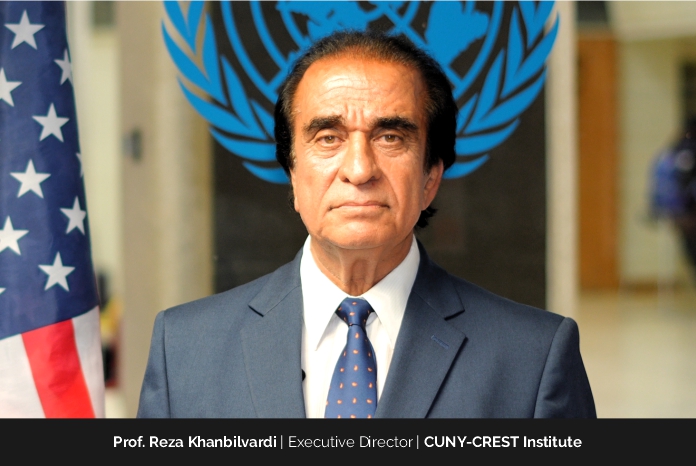
While the world seems busy identifying opportunities to excel as an individual, Prof. Reza Khanbilvardi became someone who not only focused on his own professional growth but also created opportunities for others alongside.
“From the beginning of my academic career, I was motivated by the idea that meaningful achievements come from bringing people together around a shared purpose,” Prof. Reza says.
Even when he was a young Assistant Professor, he never emphasized achieving alone. Instead, he connected with colleagues from multiple departments to assess what shared goals they had. The discussions led him to explore opportunities to collaborate. Prof. Reza always believed that when people from different disciplines come together, they have the capacity to bring in something far better and more fruitful for not only the teams working toward the goals, but also the society as a whole.
As he puts forth, “Rather than working in isolated groups, I believed we could accomplish far more by building interdisciplinary teams.”
The urge to encourage collaboration never faded. While working within a university in NYC, he sensed how terrific it would be for the research and education sector if CUNY (City University of New york) and City College of New York collaborated with others. Though the resources were limited, Prof. Reza knew that bringing together the expertise and infrastructure would lead to long-term success. His belief proved right when CUNY-CREST ( CUNY Remote Sensing Earth Systems ) Institute came into existence and became a nationally and internationally recognized entity in the field of research and education forcusing on Earth systems sciences, environmental engineering, and climate resilience using remote sensing technologies and AI.
“One principle has guided me throughout my career: the collective strength of a committed team is always greater than the sum of individual efforts,” Prof. Reza mentions. “That philosophy ultimately became the foundation upon which the CUNY-CREST Institute was built.”
For Humans To Be Invested, One Must Appreciate Their Efforts
Prof. Reza feels blessed to have always found an environment that made him feel comfortable to grow. Hence, he has always known what to provide to the teams as a leader and what not. In a place where people find themselves and their efforts valued and appreciated, they grow.
As Executive Director of the CUNY-CREST Institute, he strengthens these values through active recognition. His inclusion among ‘The Most Admired Directors to Watch in 2026’ highlights this dedicated focus on driving impact through team-first leadership.
“I have always believed that an effective leader creates an environment where people feel valued, respected, and empowered to contribute,” he admits. “My role is not simply to make decisions, but to listen carefully, build consensus, and create opportunities for others to succeed.”
Empowering colleagues and team members is a way of conveying to them that they matter. Their contributions matter. Their presence is important and being felt, and so is their absence. Prof. Reza understands that when a person feels unheard, they are hardly able to gain the courage to contribute.
While developing CUNY-CREST Institute, Prof. Reza made sure none of the team members felt ignored. He used to take input from each and every person in the team and implemented whatever felt suitable for the venture, irrespective of who it came from. The outcome was significant as every other person started treating the project as their own. The mission became a common goal. They became deeply invested in the success journey. That’s what Prof. Reza always aspired to achieve, and he did it because he knew how he needed to perform as a leader to give that sense of security to every participant and contributor in the team.
“Successful leadership requires understanding those different perspectives while creating a shared environment where everyone can contribute their strengths,” he states. “I believe every individual deserves to feel heard and appreciated, regardless of their role or experience.”
Success Is Collaboration-Driven
It is never a single person behind success. There is always a team that makes the person successful. It could be their family members who supported them through their tough times or a great team at work that never disappointed them. In both instances, a person was never alone.
Prof. Reza, after so many years in the research and education sector, knows that the story of success has many chapters, and each chapter is dedicated to people who supported and cooperated with them. He remembers how it wouldn’t have been possible for him to come this far if others had not trusted him with responsibilities in the initial stage. In fact, it is the trust that he received that ultimately keeps him encouraged to invest in the next generation of researchers, educators, and leaders, so that they too get a chance to achieve what they want to.
For him, this cooperation and support that made him and his venture successful came from the people he believed, trusted, and invested in. As he says, “Every successful professional has benefited from someone who believed in them and invested in their future. Traditional measures of success, i.e., research funding, publications, graduate student achievements, and scientific impact, are certainly important. However, they represent only part of the story.”
Prof. Reza, however, defines success as building an institution that attracts more and more talented people to become part of it because they believe in its vision.
“The future belongs to institutions that connect research, education, and real-world action. That is the vision that continues to guide the CUNY CREST Institute.”
Goals Must Have A Roadmap Built First
When you have a goal in mind, you must have a roadmap. A blueprint that guides you through. Proceeding toward achieving a goal is a step-wise process, and not having a strategy might eventually be misleading. Before one starts taking the steps, it is important to have the entire plan ready, which clears what steps to take next way before you take that current step.
“One of my earliest challenges was demonstrating that this vision would create lasting value for the university. I realized that enthusiasm alone would not be enough,” he remembers. “I needed a well-defined roadmap that clearly articulated both the short-term and long-term benefits of investing in a university-wide research institute.”
Until Prof. Reza convinced the authorities about the benefits of the institution they were going to create, moving forward seemed difficult. The institute creation project demanded financial resources, confidence of university leadership, and institutional support. That’s when the team developed a strategic plan to showcase the possible return on investment the venture would bring. That’s when the team secured its share of support.
Today, when CUNY-CREST has become an institution of world fame, Prof. Reza still remembers the challenges the team had to face. But then, the hurdles, according to him, made the team learn a lot more. Most importantly, to not follow a blind path, but have a road map prepared in the first place.
“Our mission is to transform cutting-edge research into practical solutions that help communities adapt, thrive, and build a more sustainable future.”
Trust Builds Stronger & More Balanced Teams
Investing in talent does create a good team, but unless the team members are trusted, they do not connect with the goals. According to Prof. Reza, leadership does not last when there is no trust. No matter how talented, intelligent, and smart people are hired, they won’t be able to perform if they are not respected. This respect comes from the trust the leaders show in them. When it comes to building a team, as Prof. Reza puts forth, there must be dedicated members who “share both the vision and the responsibility.”
To make sure the team members express themselves freely, the leaders must provide a comfortable environment where they are welcomed with any suggestion they have. Creating a space where no matter how ordinary or how wise an idea is, it is welcomed in the same way. Because one never knows what works when it’s time.
He remembers how wonderful and incredible a team he had while he was building CUNY_CREST and still is. “They bring creativity, commitment, and a willingness to solve difficult problems together,” he states. “Because we trust one another, responsibilities can be shared effectively, allowing everyone to contribute at their highest level.”
Adapting To & Transforming Ideas Equals Lasting Organizations
Change is the only constant. And this applies to every field and sector one is involved in. And the only way to keep up with this change is to adapt to it. Prof. Reza started his journey of founding institutional entities with the establishment of the Center for Water Resources and Environmental Research at The City College of New York in 1993. This yet again led to the development of the NOAA Cooperative Science Center in Remote Sensing Science and Technology (NOAA-CREST) in 2001, where he was the founding Director for two decades.
Whatever he learnt there was implemented when he founded CUNY-CREST in 2009. “Science, technology, and higher education evolve rapidly, and leaders must embrace innovation while remaining committed to excellence,” he shares. “Adaptability has become one of my guiding principles throughout my career.” Most recently, in 2024, we launched the United Nations University Hub on Remote Sensing for Sustainable Innovation in Resilient Urban Systems (R-SIRUS), where I am the Executive Co-Director of it (with Dean of Engineering). R-SIRUS at City College of New York is the first and only UNU-Hub in USA, which provides opportunities for many researchers, students and policy makers, and that is a major achievement by itself.
It is transforming ideas per the latest innovations and changes that never led CUNY-CREST to run outdated. Prof. Reza and the team keep a check on any updates and trends that come up from time to time and make sure they are implemented and deployed in such a way that they go hand in hand with the institution’s mission. Adaptability, which many of them think, doesn’t mean replacing. It simply means tweaking the present approach in a way that incorporates the new trends and updates, refreshing it per the latest changes.
“At CUNY-CREST, we continuously align our research and educational initiatives with the broader mission of The City College and the City University of New York while embracing emerging technologies and new scientific opportunities,” he confirms.
There Is No ‘I’ When You’re A Leader!
Prof. Reza believes that leadership begins with serving others rather than seeking personal recognition. A leader listens before speaking, supports the team before expecting appreciation, and creates opportunities that allow others to excel. Prof. Reza has experienced this throughout his career, and that is precisely why he never associates leadership with an individual. For him, every successful researcher, educator, or institution is the outcome of collaboration, integrity, service, and teamwork.
“Leadership is never about one individual. There is no “I” in leadership—it is always about “we,” he shares. “I hope that those who have worked with me carry forward the values of collaboration, integrity, service, and teamwork as they build their own careers.”
For him, the greatest reward in his decades-long journey has not been the recognition he received, but watching former students, postdoctoral researchers, and junior faculty evolve into accomplished scientists, educators, and leaders, carrying forward the same values they once learned. He remembers one of his mentors sharing a piece of advice that said, “Every great achievement begins with a single small step.”
“One principle I often share is this: if someone opens a door for you, do not simply walk through it—keep it open for those who follow.”
Learning Should Never Stop
From Prof. Reza’s perspective, education is not confined to classrooms, degrees, or research laboratories; it is rather a lifelong commitment that evolves with every new challenge. Even after decades of building globally recognized research institutions, he continues to approach every technological advancement and scientific breakthrough as an opportunity to learn rather than to lead. Whether it is artificial intelligence, Earth system science, satellite remote sensing, or emerging educational technologies, he believes staying curious is essential for staying relevant.
As he admits, “Leading a research institute requires continuous learning. Science, technology, higher education, and workforce demands evolve rapidly, and leaders must remain informed in order to guide their organizations effectively.”
This mindset is what naturally extends to the way he mentors young researchers. Rather than preparing students to simply complete academic milestones, Prof. Reza encourages them to become independent thinkers capable of solving tomorrow’s problems. He makes sure to devote his time to understanding their ambitions, helping them develop the confidence and resilience they would need to seize the created opportunities.
“Today, I see mentorship as both a responsibility and a privilege,” he says. “A great mentor does not provide all the answers; instead, they encourage others to think critically, solve problems independently, and become leaders themselves.”
“The challenges of climate variations, water security, and disaster resilience transcend borders. Guided by the UN Sustainable Development Goals, we bring together science, education, innovation, and international partnerships to develop solutions with global impact.”
Creating Opportunities & Not Sole Growth Should Be The Objective
Whether through the Center for Water Resources and Environmental Research, NOAA-CREST, UNU-Hub, or the CUNY-CREST Institute, every initiative he established was envisioned as a platform where students, researchers, and educators could discover opportunities that might otherwise have remained beyond their reach.
Seeing former students emerge as respected scientists, faculty members, policymakers, and industry leaders has now become his greatest source of pride for Prof. Reza. These achievements are living proof that meaningful leadership extends far beyond one’s own career. Institutions endure only when they continue to nurture talent, inspire innovation, and empower future generations to dream bigger than those who came before them.
His vision has never been to build organizations that revolve around one individual, but to create ecosystems that continue generating knowledge, opportunities, and leaders long after their founders have stepped away. That, he believes, is the true measure of leadership.
According to him, one becomes successful when every generation leaves stronger institutions, opens more doors than it found, and inspires the next generation to carry the mission forward with the same commitment, purpose, and belief in people. And that’s where his legacy lies.
“I have always believed that our greatest legacy is not the papers we publish, but the people we mentor and the communities we help serve.”