
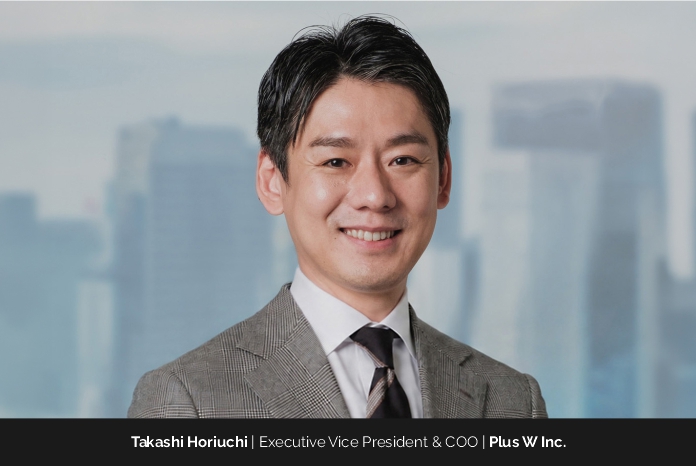
Takashi Horiuchi | Executive Vice President & COO, Plus W Inc.
“A world where diverse individualities are unleashed.”
Recruitment is often treated as complete when a candidate accepts an offer. Takashi Horiuchi sees that moment differently: it is where responsibility begins. In cross-border talent acquisition, sustainable results depend on the entire journey—how people are identified and prepared, how roles are designed, how organizations build an environment in which diverse talent can contribute, and whether individuals continue to grow after joining.
Takashi Horiuchi, Executive Vice President & COO of Plus W Inc., is helping build this broader model. Working with Founder & CEO Wakako Sakurai, he translates the company’s Vision—“A world where diverse individualities are unleashed”—into businesses, partnerships, teams, and day-to-day decisions. His focus is not the one-way movement of talent to Japan, but the creation of connected systems spanning education, technology, employment, and business development that generate value for individuals, local communities, and companies.
His remit extends well beyond talent acquisition. He works across business strategy, new business creation, technology and AI initiatives, international partnerships, organizational development, and project delivery. This breadth shapes his view of talent not as a standalone HR issue, but as an operating capability that determines whether a strategy can be executed.
Scientific Inquiry and the Decision to Build
Horiuchi’s approach to leadership is rooted in his graduate research. Using atomic force microscopy, he studied membrane proteins with the aim of visualizing their structures at atomic and molecular resolution. The work required him to question whether an image reflected the protein’s actual structure or an artifact of the experimental conditions. He had to form hypotheses, change conditions, repeat measurements, and keep testing until he understood the structure behind the phenomenon.
“What matters to me is not the academic credential itself, but the discipline I acquired through that process: do not settle for a superficial explanation; do not oversimplify complexity; distinguish facts from hypotheses; and keep working until an idea can be translated into action.”
He applies the same discipline to people and organizations. A résumé, title, or current skill set offers only a partial view of a person’s potential. Leadership, in his view, means understanding the roles, learning opportunities, relationships, and environment that will allow someone to contribute—and then helping build those conditions.
Horiuchi spent approximately twelve years in management consulting, primarily with Boston Consulting Group (BCG) and Accenture. His work covered corporate transformation, new business development, data and digital initiatives, and organizational capability. Consulting taught him how to structure complex problems, mobilize stakeholders, and connect strategy with execution. It also sharpened his awareness of the difference between advising a business and being accountable for building one.
He joined Plus W at its founding in 2020 because he wanted to make decisions under uncertainty, mobilize people and capital, create customer value and revenue, and carry responsibility for the results. “My role is to identify businesses that do not yet exist, make them sustainable, and remain accountable until they create value,” he says.
Closing the Gap Between Potential and Performance
Horiuchi’s perspective on talent acquisition evolved as Plus W built its work in Pakistan. The company met students and professionals with strong technical ability and a serious desire to grow. Japanese employers, however, consider more than technical credentials. Language, workplace practices, customer interaction, project experience, and the ability to build a life and contribute over the long term also matter. Candidates, meanwhile, often have limited opportunities to understand those expectations and prepare for them in practice.
“What became clear was not simply a numerical gap between labor demand and supply. It was a gap between latent potential and the ability to demonstrate it in a real business environment,” Horiuchi explains.
To help close that gap, Plus W established the PAK-JAPAN Centre in 2022 at National Science and Technology Park (NSTP), part of the National University of Sciences & Technology (NUST), in Islamabad. The Centre provides a local foundation for sustained collaboration among universities, public institutions, talent, and employers, connecting technical education, Japanese-language education, preparation for Japanese workplace practices, career support, and access to practical projects.
Crucially, the burden of adaptation cannot rest solely with global talent. Plus W also works with employers to clarify the capabilities they need, design appropriate roles, and strengthen the management practices and workplace environment required for diverse talent to succeed.
The model has produced tangible results. Two Pakistani professionals came to Japan and made valuable contributions at a development site in Nagasaki. Separately, in 2024, 28 participants completed a training program, and three subsequently joined Plus W’s development team. In 2025, in collaboration with Pakistan’s Overseas Employment Corporation (OEC), Plus W launched the one-year Advanced IT Skills Development and Japanese Language Education Program for 54 participants selected from nine universities across Islamabad, Lahore, and Karachi.
As of August 2026, Plus W collaborates with nearly 30 Pakistani professionals through both employment and contract-based arrangements and has undertaken approximately 70 development projects in total. For Horiuchi, the significance lies not only in these figures but in the connected infrastructure behind them—from talent discovery and capability building to employment, integration, and continued contribution.
These projects are more than a measure of volume. They provide practical settings in which Pakistani professionals demonstrate and deepen their delivery capabilities, while Japanese companies strengthen role design, cross-cultural collaboration, and the management practices required for global teams. In this model, capability is built on both sides.
Beyond One-Way Mobility
Pakistan is where Plus W has implemented this model most fully. It is not a standalone sourcing initiative, but a foundational operating model for building locally grounded, cross-border talent ecosystems. Building on that experience, Plus W is exploring opportunities across the Global South, including Tunisia, Nigeria, and Kenya. Horiuchi is clear, however, that the objective is not to view these countries primarily through the lens of Japan’s workforce needs.
“Each country has its own educational strengths, industries, cultures, and talent. We want to co-create with local universities, governments, and companies, generating opportunities that may exist locally, in Japan, or across other borders. The goal is a cycle of mutual growth, not one-way movement.”
Nor can a model developed in Pakistan simply be exported unchanged. Education systems, industries, policies, cultures, and individual aspirations differ. Sustainable expansion requires Plus W to preserve its core principles while designing each initiative with local partners so that local capabilities are strengthened and local opportunities expand.
Plus W is also creating career opportunities for Ukrainian professionals and supporting people displaced from Ukraine who have sought safety in Japan as they pursue meaningful employment. Rather than defining them only as recipients of support, the company seeks to recognize their experience, capabilities, and aspirations and connect them with roles in which they can build their futures.
Redefining Success in the AI Era
Horiuchi also wants to broaden the way the talent acquisition industry defines success. Metrics such as the number of hires, time to hire, and cost per hire remain relevant, but they measure only the entrance to employment.
“Relocation and hiring are not the outcome; they mark the beginning of a long-term responsibility. We should also measure readiness before employment, time to meaningful contribution, continued growth and performance, retention, whether the receiving organization has become better able to support diverse talent, and the durable value created for the employer, the individual, and the wider community.”
This perspective shapes his approach to generative AI. AI can organize information, surface evidence of people’s skills, personalize learning, support interactive practice, and improve assessment and matching. But using AI merely to make an existing recruitment process cheaper or faster does not address the deeper challenge.
“AI can present options and predictions, but it cannot decide which outcomes should matter to people, fully understand another person, build trust, or accept responsibility for the consequences of a decision,” Horiuchi says. “The more capable AI becomes, the more important human agency, imagination, judgment, and relationship-building become.”
At Plus W, AI is intended to support human judgment, not replace human agency. The aim is to make potential more visible while ensuring that people remain the authors of the value they create.
Leadership in Practice
Operating across countries, cultures, organizations, and time zones requires deliberate prioritization. For Horiuchi, prioritization is not a decision about which necessary work to abandon. It is a design discipline: deciding what must move first, who should own each part, where he needs to be directly involved, and the pace at which multiple initiatives should advance.
Delegation is essential, but it does not remove a leader’s responsibility when consequential decisions must be made or trust is at stake. Continuous learning, physical and mental well-being, and close relationships are equally important foundations for sustaining sound judgment and action over the long term.
Inside Plus W, Horiuchi fosters a strong sense of ownership and contextual understanding. He expects team members to look beyond the task in front of them and understand why the work matters, who will use it, which decisions it must support, and what outcome it is intended to create.
“Quality is a form of respect,” he says. “Our customers, partners, and talent make decisions based on the work we provide. Feedback should therefore do more than correct the current output; it should identify why the gap occurred and improve the next decision and the next piece of work.”
Building Infrastructure for Lasting Impact
Horiuchi’s work at Plus W is built on the premise that business growth and social value can be created together. By treating talent discovery, capability building, practical experience, role design, employment, and long-term contribution as one connected system, Plus W is moving beyond the boundaries of a conventional recruitment company. It is building infrastructure that connects people, education, technology, and business development across borders.
Through these collaborative networks across Japan and the Global South, Plus W is working to make its Vision—“A world where diverse individualities are unleashed”—concrete. This is Individualities in Motion in practice: enabling people to put their distinct strengths to work and turn human potential into progress shared by individuals, communities, and companies.