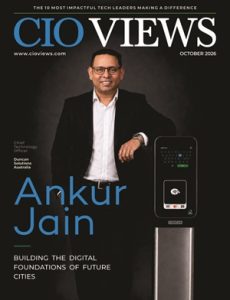

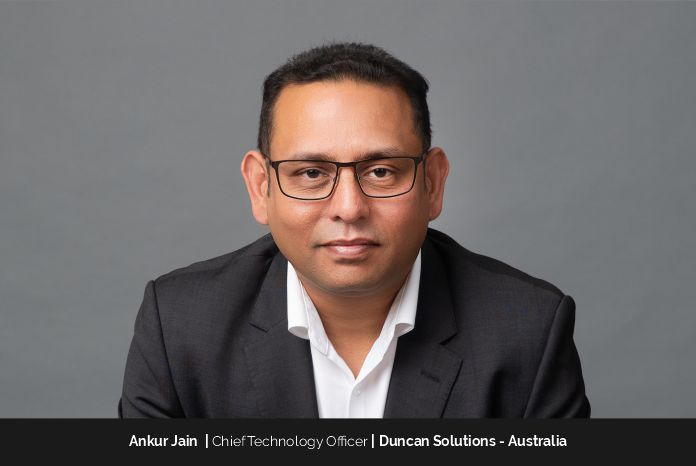
Duncan Solutions powers smart cities with its unified parking and payment systems. As CTO, Ankur Jain is steering the company’s evolution from a traditional, hardware-centric organization into a modern mobility technology company built for the smart cities of tomorrow. His work brings together technology, mobility, payments, and data intelligence to help councils plan and manage parking more effectively while improving the daily experience of citizens and communities. Ankur balances innovation and modernization with uninterrupted service delivery, ensuring that digital transformation creates lasting value without disrupting the critical services people rely on every day. For him, transformation is much more about people than technology.
From Fascination with Technology to CTO Chair
Ankur’s fascination with technology began at an early age. Unlike many of his peers, he was more interested in technology’s potential to solve problems than in computers themselves. “I was always intrigued by how systems worked, how processes could be improved, and how technology could simplify complexity,” he says.
More than two decades ago, Ankur began his career in the technology sector as an Associate Quality Engineer. He went on to hold a series of technology leadership roles before joining Duncan Solutions as CTO, bringing extensive experience leading technology teams across multiple industries.
Ankur found the role at Duncan attractive because of the opportunity to work at the intersection of technology, mobility, payments, and council parking operations. “Unlike many technology organizations that focus purely on digital products,” he points out, “Duncan operates in an environment where technology directly influences how councils plan, manage, and improve parking services. Every parking meter, payment transaction, enforcement solution, and mobility platform contributes to the daily experience of citizens and communities.”
Ankur’s leadership in managing large-scale transformations, integrating acquired businesses, modernizing legacy platforms, and delivering mission-critical solutions has made him a luminary in the industry. He believes that successful technology leadership is not just about building systems. It is also about creating sustainable business outcomes and empowers people to perform at their best.
An Achievement That Fills Him with Great Pride
Ankur has a string of achievements to his name. The one he is most proud of is helping shape Duncan’s modernization strategy while maintaining uninterrupted service delivery for customers. This has included driving initiatives focused on platform consolidation, payment modernization, technology simplification, cybersecurity improvements, and future-ready parking and mobility solutions. It has also involved identifying acquisition opportunities that can strengthen Duncan’s capabilities, accelerate innovation, and open pathways into new markets. According to Ankur, these initiatives not only improve operational efficiency but also help councils plan their technology roadmaps and adopt emerging capabilities with greater confidence and lower risk.
“Ultimately, the impact is reflected in more reliable services, stronger operational resilience, and better experiences for the communities that depend on them every day,” he adds.
Transformation Is More About People Than Technology
Most leaders mistake transformation for a technical challenge. Ankur was no different, until he led large-scale modernization initiatives involving legacy platforms that had been in operation for many years. From that experience, he learned that successful transformation is more about people, processes, and organizational alignment than technology.
He also found that balancing business continuity with innovation is no small task. Critical systems that customers depend on every day, he explains, cannot be replaced overnight. “That experience reinforced an important lesson: successful technology leadership requires understanding organizational change as deeply as technical architecture,” Ankur says.
He now firmly believes that the best solutions are those that people readily adopt and that create lasting value, not necessarily the most technically advanced.
For Ankur, operational efficiency and digital transformation are not competing goals. They should reinforce each other, he says. The most successful initiatives, according to him, are those that simplify operations, reduce costs, improve visibility, increase scalability, and create measurable business value.
At Duncan Solutions, Ankur and his team continuously evaluate how technology investments can streamline internal processes, modernize platforms, strengthen security, and help councils plan and manage parking more effectively. This includes assessing strategic acquisition opportunities and determining where new capabilities can complement Duncan’s existing products, expertise, and customer relationships.
“Transformation is most effective when it solves today’s challenges while simultaneously preparing the organization for tomorrow’s opportunities,” he says.
Planning Technology for the Future of Council Parking
Council parking presents a unique set of challenges, largely because of four critical requirements: reliability, security, compliance, and long-term performance. Ankur notes that parking technology cannot be planned as a collection of isolated products. Councils need systems that can work together, adapt to changing regulations and customer expectations, and provide the information required to make confident long-term decisions.
He believes technology planning should begin with a clear understanding of a council’s operational needs, existing systems, future objectives, and the outcomes it wants to achieve for motorists and communities. This makes it possible to develop practical roadmaps that modernize parking services progressively while protecting service continuity and existing investments.
“This environment requires a disciplined approach to technology planning while still maintaining momentum toward modernization and digital transformation,” Ankur says.
CTO’s Day at Work and Work-Life Integration
No two days of Ankur are exactly alike. His day at work may involve strategic planning discussions, architecture reviews, customer engagements, board-level conversations, and operational oversight. He also mentors tech leaders and evaluates emerging technologies.
According to Ankur, he generally divides his attention across three key areas: strategy and future planning, delivery and execution, and people development. Of the three, people come first. “While technology is important,” he says, “building strong teams remains the highest-leverage investment any leader can make.”
“Technology changes rapidly,” he adds, “but organizations succeed because of talented people who can adapt, innovate, and execute.”
Ankur’s work schedule is demanding. He, however, does not draw a line between his personal and professional life and strives to maintain a balance between them. He prefers the work-life integration approach, as he believes personal interests and relationships contribute to making a leader more effective.
“Leadership roles require flexibility, but sustainability is equally important,” he says.
At work, Ankur maintains clear priorities, delegates effectively, and builds high-performing teams that do not rely on constant executive intervention. The other factors that fuel his effective leadership are intellectual curiosity, an appetite for learning, time with family, and focus on personal well-being.
“The best decisions are often made when leaders maintain perspective beyond the workplace and remain connected to the people and communities they serve,” Ankur says.
Keeping People at the Center of Technology Decisions
As a leader, Ankur is collaborative, pragmatic, and outcome-focused. He is not one of those leaders who pursue technology because it is something interesting. For him, technology needs an anchor. It should always align with a business outcome, customer value, operational improvement, or societal benefit.
Ankur says that his decision-making is guided by three principles. First, simplicity over complexity. He believes that the most elegant solution is often the one that solves a problem without creating unnecessary technical debt.
Second, transparency and accountability. In his experience, high-performing teams thrive when objectives are clear, communication is open, and ownership is distributed across the organization.
Third, long-term thinking. He explains that decisions related to technology may not produce immediate results, but they often have consequences years into the future, especially in council parking environments, where systems and investment decisions can have consequences for many years. “This philosophy applies just as strongly to artificial intelligence (AI),” he adds.
He acknowledges that AI is undoubtedly one of the most significant technological shifts of his generation, but he is not in favor of implementing it haphazardly. He wants leaders to be more responsible and thoughtful when it comes to implementing AI. He underscores that technology should empower people, not simply replace them. According to him, the organizations that create the greatest long-term value will be those that use AI to amplify human capability, accelerate learning, and unlock innovation while keeping people at the center of decision-making.
Ankur is not someone who claims to have all the answers. His focus is on creating an environment where great teams can make great decisions and where technology serves both business outcomes and human progress.
Innovation, AI, and Collaboration in Smart Cities
Ankur notes that innovation is often misunderstood as introducing something new. For him, innovation in the smart cities space is about delivering meaningful improvements to citizens’ lives. In his view, a truly innovative mobility solution removes friction, improves accessibility, increases operational efficiency, and enables cities to make informed decisions through data.
“Whether it is cashless payment systems, integrated parking technology, AI-powered analytics, predictive maintenance, or real-time mobility platforms,” Ankur explains, “innovation should ultimately make urban environments easier to navigate, safer, and more sustainable.”
Moreover, he sees AI becoming a “powerful enabler” in smart cities, not as a standalone solution but as a capability embedded across the ecosystem. According to him, the real opportunity lies in helping councils, operators, and citizens make better decisions faster while preserving transparency, trust, and accountability. He sees particular value in systems that can improve predictability by identifying emerging trends, forecasting parking demand, highlighting potential compliance issues, and supporting more proactive operational planning.
Ankur does not expect the future of smart cities to be defined by individual technologies. He believes that the defining factor will be how seamlessly those technologies work together to improve community outcomes.
And, according to him, collaboration is fundamental to building scalable and sustainable tech solutions. No technology team can solve the challenges cities face on its own. Ankur says that success requires collaboration between engineering teams, operations groups, municipalities, payment providers, enforcement agencies, customers, and industry partners. The best solutions emerge when diverse perspectives come together around a shared objective.
“Technology may be the enabler, but collaboration is the accelerator,” Ankur says.
A Pragmatic Supporter of AI
Ankur, like most technology leaders, is curious by nature, with an impulse to seek new information and explore novel possibilities. He currently spends considerable time exploring developments in AI, Agentic AI systems, automation, cloud computing, cybersecurity, digital payments, and intelligent parking platforms.
In addition to understanding the technology itself, he focuses on understanding its practical applications and its potential impact on organizations, communities, and the broader economy.
AI, in particular, fascinates him, as it is now moving beyond simple automation into systems capable of reasoning, planning, and assisting with complex decision-making. “I have been heavily involved in evaluating and implementing both Generative AI and Agentic AI capabilities, particularly in areas such as software delivery, operational efficiency, governance, and customer experience,” Ankur says.
Despite his enthusiasm for AI, he remains a cautious and pragmatic supporter. He believes that every major technological revolution creates both opportunities and responsibilities. He cautions against automation for the sake of automation. It should not be the objective, he says, adding that organizations should focus on how technology can enhance productivity, elevate human capability, and create better outcomes for customers.
Ankur often reminds teams that technology exists within an economic ecosystem. “Businesses succeed because customers have needs, aspirations, and purchasing power,” he points out. “While AI will undoubtedly reshape jobs and industries, sustainable progress comes from helping people become more productive and effective rather than simply removing them from the equation.”
In Ankur’s view, the most successful organizations will be those that use AI to augment human intelligence, not replace it. He notes that technology creates its greatest value when people and machines work together, each contributing what they do best.
“Innovation should always be driven by value rather than hype,” Ankur says.
The Future of Smart Cities
Ankur believes that the future of smart cities will be built on connected ecosystems rather than isolated technologies.
The work he and his team currently do covers a broad spectrum of tech initiatives, including modernizing payments, integrating parking systems, leveraging AI-driven intelligence, strengthening cybersecurity, identifying acquisition opportunities, and embracing data-informed decision-making. This creates a digital foundation for more efficient, sustainable, and citizen-centric cities.
Looking ahead, Ankur sees AI becoming a foundational layer in council parking management, helping councils predict demand, identify occupancy and compliance patterns, anticipate equipment issues, optimize resources, improve service delivery, and make more informed planning decisions. “However, the success of these technologies will depend on how responsibly they are deployed,” he adds.
Ankur does not envision a future where technology replaces people. He expects it to remove barriers, augment capability, and enable communities to thrive. According to him, the cities that succeed in the future will be those that combine innovation with trust, efficiency with inclusion, and technological advancement with human-centered design.
“Technology should not simply support cities,” Ankur says. “It should help cities become more resilient, more sustainable, and ultimately better places to live for future generations.”
Advice to Aspiring Tech Leaders
Some young professionals dive in to solve a problem without taking the time to understand it first. Ankur advises aspiring leaders to understand the problem first and then pursue the solution. He also encourages them to develop both technical depth and business acumen. “The most effective technology leaders can bridge the gap between engineering excellence and organizational outcomes,” he says.
Even for tech leaders, technical expertise alone is not enough to sustain a successful career in the industry. Ankur urges aspiring leaders to invest in communication, stakeholder management, financial literacy, and leadership capabilities as well.
AI, the most talked-about topic across industries, is far more than a technology trend. It is becoming a fundamental business capability; therefore, according to Ankur, the next generation of leaders will need to understand it beyond the headlines. He asks leaders to learn how to govern it responsibly, implement it ethically, and align it with meaningful business objectives.
Ankur also advises aspiring leaders to remember that technology is ultimately about people. “The greatest innovations are those that improve lives, create opportunities, and generate lasting value for both organizations and communities,” he says.