
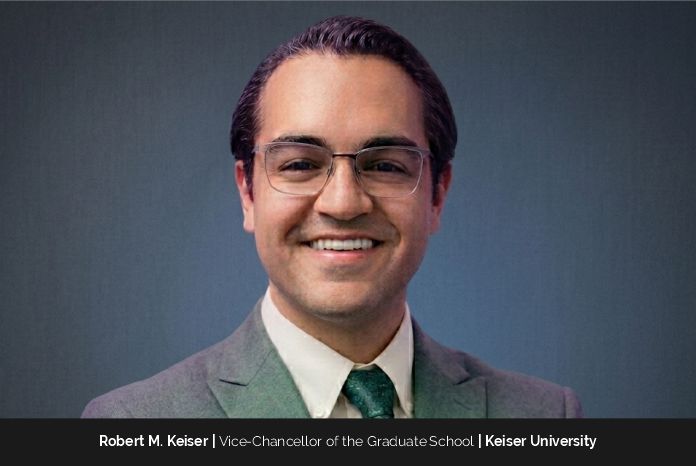
“I was born into education,” says Robert M. Keiser, the Vice-Chancellor of the Graduate School at Keiser University. His family co-founded this institution, now one of Florida’s largest private, non-profit universities. Robert started at the bottom of the ladder around age eight, scraping gum off desk undersides, before spending time across nearly every department in the ecosystem.
His fundamental preparation started at home. He grew up hearing how his family worked as their own janitorial crew, trading off chores under the moniker A&E. Robert watched his father handle hundreds of accreditation visits and saw his mother fly to Washington and Tallahassee to advocate for student needs.
These lessons formed the base of his career. “An institution is measured by what happens to the student standing in front of you,” he underscores. That certainty influenced every move he made since and is why he finally returned.
Taking the Scenic Route Back
Higher education was never Robert’s original plan. He built his initial career in construction management, government, and finance before turning to higher ed full-time. The change occurred during his time at The George Washington University. The environment felt cold, leaving him feeling reduced to a student ID number. He began to see higher education at a crossroads. One path centered on elite prestige, while the other offered practical value to working families.
The actual lightning bolt hit during Keiser University commencement ceremonies. Watching graduates wrap their professors in huge hugs and thank admissions officers, he saw firsthand what traditional schools were missing. It’s a model built around career focus and genuine support.
His path through the organization was a steady ascent, moving through financial aid, admissions, student services, government relations, an associate dean post, a campus presidency, and the leadership of a five-campus system.
Today, Robert leads the graduate and international divisions alongside his family, whose institutions also include Everglades University, Southeastern College, and the Primrose School of Royal Palm Beach. His core objective remains fixed on building a world-class system that opens doors wider and helps learners acquire practical skills for life.
Opening Doors Instead of Raising Walls
Applying to graduate programs at major schools opened Robert’s eyes to a systemic flaw. He saw top-tier universities stack the deck for selectivity, chasing elite applicants and research grants while ignoring broader student needs. “Graduate education shouldn’t be limited to the rich or the exceptionally brilliant,” he stresses. Its primary intent must be elevating society as a whole, rather than pre-ordaining a favored few for leadership.
To fix this, Robert built his vision around making advanced degrees accessible and directly linked to real job markets. High standards still count, but degree paths need practical value that serves working professionals beyond theoretical research.
Instead of slamming the door on candidates over minor flaws on paper, he believes schools should value hands-on industry experience, such as betting big on people across the board to construct a resilient, globally competitive workforce.
Putting People First
Taking care of students comes first for Vice Chancellor Robert. He emphasizes building a fair, supportive environment where students get every chance to succeed both in the classroom and in life. The mindset is distinct. Putting students front and center naturally brings success to the institution as a whole.
Backing faculty and staff carries just as much weight. He sets precise, high benchmarks for student-focused results while leading with empathy so team members can grow personally and professionally. The job boils down to casting a strong vision, building a positive culture, and giving talented people the freedom to excel at their work.
Staying Ahead of the Curve
Keeping graduate programs fresh requires staying two steps ahead of fast-moving tech, shifting policies, and evolving regulations set by accreditors like SACSCOC as well as lawmakers in Washington and Tallahassee. Robert stays sharp by sitting on industry boards and consuming a steady stream of higher ed literature daily.
Bringing artificial intelligence into Keiser University shows that forward-thinking mindset in action. Spotting the massive potential of these tools early, he earned a graduate certificate in AI integration from Stanford University to lead the rollout with real expertise. Robert regards adopting tech as a cultural transition rather than a simple software upgrade. Because automation will soon be everywhere, students must learn how it applies directly to their specific fields, requiring faculty and staff to incorporate these tools across both classroom instruction and daily operations.
However, new technology naturally jolts established routines. He knows that walking team members through change takes patience, targeted training, and empathy. People adjust at different speeds and need time to build confidence. Giving faculty and staff that space ensures they adapt smoothly and make progress as a unit rather than getting left behind.
Keiser University Keeps the Ball Rolling
Keiser University has spent decades proving that career-focused education changes lives. Since 1977, the school has focused on industry-relevant student success and preparing graduates to win in a fast-moving global economy. They endorsed career-driven learning long before the rest of academia realized how critical it was, giving working adults and diverse learners a massive return on their educational investment. “Although our student body consists largely of adult learners from diverse socio-economic backgrounds, we were ranked number one in the nation for social mobility in 2023,” Robert remarks, pointing to their consistent top-50 streak since U.S. News & World Report created the category.
Speed and flexibility keep the university well ahead of the pack. An early adopter of online classes back in the 1990s, the institution keeps raising the bar by weaving AI into courses, offering top-rated degree programs across every learning format, and teaching in multiple languages. They also take American degrees straight to international students in their home countries.
The result connects two distinct sides of higher education seamlessly. The university pairs the practical, job-ready focus of a workforce institution with the academic muscle, modern teaching, and vibrant campus life of a Level VI SACSCOC-accredited, global non-profit system.
Reading the Writing on the Wall
The future of graduate education is already being written by two powerful forces. One is artificial intelligence, and the other is expanding government regulation. Keiser University is preparing for both while keeping the needs of students and the workplace in view.
AI is being integrated across all degree programs, giving students the chance to learn how to work alongside emerging technologies and apply them effectively in professional settings. The university is also aligning its pedagogy with advanced industry standards, while making room for the human expertise and critical thinking that remain essential in an increasingly automated workplace.
Government policy brings a different set of challenges. Robert describes the recently enacted One Big Beautiful Bill Act as a watershed moment for higher education. Changes to the federal graduate loan system have created gap financing concerns, restrictions on international student visas and grants, stricter return-on-investment benchmarks, and taxation on university endowments.
Rather than treating such changes as a reason to stand still, Robert draws attention to Keiser’s ability to respond when the landscape shifts. In Robert’s words: “Whenever policy shifts occur, we seek creative solutions and transparently communicate both the challenges and opportunities to our stakeholders.” That openness supports continued improvement across teaching, administration, and student support, even as the rules keep changing.
Turning the Tide
Some milestones look impressive on paper. Others change the fortunes of an entire university. Robert’s five-year journey at Keiser University has brought both.
The first came through the turnaround of the graduate school. When he began his tenure, enrollment stood at roughly 1,100 students, and the school was facing a significant budget deficit. Today, nearly 3,200 students are enrolled, supported by a strong financial foundation. The growth has come without lowering the bar. Academic quality has risen alongside exceptional placement and retention rates, while every programmatically accredited degree program remains in pristine standing, with none facing probationary or reporting status.
The second milestone has been the rapid expansion of Keiser’s international presence. When Robert took charge of the International Affairs Department, the university had just two international sites. Since then, campuses and partnerships have been established across Spain, Bolivia, Ecuador, Peru, Indonesia, Sri Lanka, India, El Salvador, and Vietnam, alongside an expanded adult learning center in Managua, Nicaragua. The outcome is a more diverse campus community and wider opportunities for scholars around the world. What makes these achievements especially meaningful is what they have unlocked for the university family. Faculty and staff have gained raises and promotions, morale has improved, and students have benefited from greater resources and stronger career outcomes.
When the Chips Are Down!
The toughest test of Robert’s career came during his leadership at Southeastern College. Stepping into a campus presidency at 25 was daunting on its own, requiring him to earn the respect of doctorally credentialed faculty while learning executive management on the fly. On top of that, the institution was losing $2 million annually. He took decisive action, restoring its financial health and building a substantial operational surplus.
A bigger test arrived with his promotion to Executive Director, putting him in charge of five campuses across three states. The system carried a $6 million deficit alongside tough accreditation hurdles. By the end of his tenure, the organization was back in the black, clear of regulatory issues, offering new degree programs, and named a Best Workplace by the South Florida Sun-Sentinel two years running.
Those high-stakes turnarounds taught Robert that real leadership gets hardest when the right choice is also the toughest one. At times, that meant letting go of a former supervisor whose performance had dropped. He learned to set personal feelings aside, lean on sound judgment, and consult trusted advisors without passing off the final call. “I embraced the weight of making necessary, tough decisions rather than popular ones, knowing ultimate accountability rested solely with me,” Robert remembers with a sense of resolve. It is a clear-cut idea, perhaps. Yet, living by it mandates the willingness to stand behind a decision when there is nowhere else to place the responsibility.
The Engine Behind Lasting Impact
‘Does this serve students in the long run?’ That single question sets everything in motion for Robert. When an initiative passes that trial, it gets the green light. From there, execution relies on careful thought rather than quick impulses. He digs into research, talks with trusted advisors, tests ideas on a small scale, and stays completely open to honest feedback.
Steady progress requires keeping ego out of the equation. He avoids the trap of relying on old habits or assuming past wins will guarantee future results. If real-world evidence shows an approach isn’t delivering, he owns the issue right away and shifts gears instead of pushing forward with a broken plan.
In Robert’s experience, keeping an institution strong comes down to a constant loop. He spots a good idea, zeros in on the purpose, maps out the steps, launches the effort, tracks the results, and makes adjustments along the way. Adapting to actual evidence is how he keeps institutions resilient and focused on what matters most.
The Non-Negotiable Standard!
When asked about work-life balance, Robert standardly responds, “Prioritization is the key.” His commitment to his family sits right at the very top, well ahead of any professional obligation. Keeping his wife, kids, parents, and dogs taken care of gives him the mental space he needs to show up and do great work in his career. While the daily schedule rarely splits fifty-fifty between home and office, his energy and resources stay firmly directed toward his personal life. As he puts it, “If I’m not right at home, I’m not right at work.”
He makes time to be present for the moments that matter, whether it is a key milestone, a dance recital, or an important family occasion. “Time is a non-renewable resource; while money can always be earned back, I will never get those precious moments with my kids and wife again if I miss them,” he says.
That exact standard extends to everyone he leads. He expects his team members to put their families, however they define them, before their jobs. He makes clear to his staff that he will be genuinely disappointed if they fail to put their personal lives first, demonstrating that standard through his own actions every day. If he ever has to micromanage someone’s commitment or calendar, he knows he has the wrong person on board.
Anything outside of family and career takes a back seat. When free hours get tight, he cuts back on social outings and hanging out with friends. He does not drop them completely, but those activities fall further down the list to preserve time for what matters most.
Legacy Beyond the Laurels
Robert envisions Keiser University standing out as the world’s premier career-oriented, non-profit private institution. He strongly believes that higher education belongs within reach of everyone, rather than being locked away for a select few. “I hope that when the dust settles, Keiser University will be measured by lives changed and return on investment, not by prestige or endowment,” he conveys.
Advising The Aspirants
“If your primary motivation is to elevate the lives of students, you are stepping into the right field for the right reasons.” To Robert, that sentiment becomes a touchstone for anyone looking to step into higher education. If someone wants strictly financial gains or external prestige, pursuing a different industry makes more sense.
For those whose heart is truly in this work, stepping into as many different roles as possible builds the best foundation. He adds that teaching in the classroom, serving in university administration, working in athletics, and gaining experience across career services and student life open up the entire picture. Robert further advises that gaining global exposure completes that perspective. Such breadth helps aspiring leaders grasp what makes an institution exceptional. It also shows them what truly supports students and how best to empower faculty to deliver outstanding outcomes in teaching and research.