
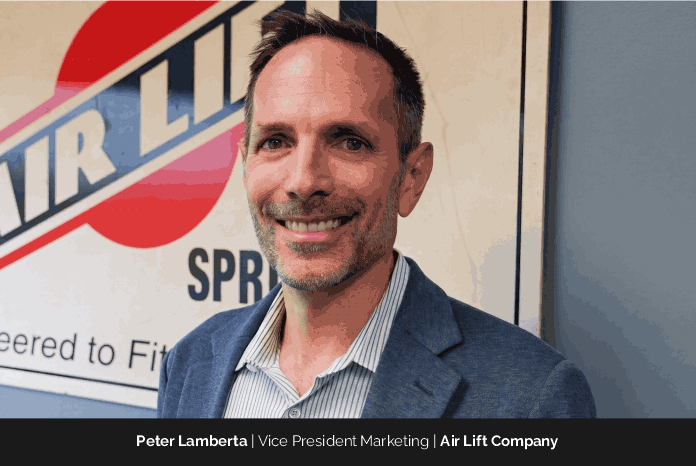
Peter Lamberta entered marketing from a technology background, yet it was observing which iconic companies of the 1990s faded away and which endured that ultimately forged his approach. The difference was never the product – it was complacency, missed signals, and losing touch with the customer.
Today, as Vice President of Marketing at Air Lift Company™, he’s redefining go-to-market strategy, building the data infrastructure to power it, and leading with a conviction that brand, data, and people must work as one. His goal isn’t just growth. It’s building something that lasts.
Why Complacency Kills Great Brands
Peter grew up in the 90s watching Nike™, Coca-Cola™, Apple™, and MTV™ define what a brand could be. They were everywhere and meant something. What resonated with him wasn’t the advertising. It was watching some brands stay relevant for decades while others faded, and realizing the difference was rarely the product.
“The difference was competition they didn’t see coming, technology they did not adopt fast enough, or a go-to-market model that missed the consumer,” he clarifies. “That’s the puzzle that pulled me in, and the lesson I learned is that complacency kills.”
Peter notes that the brands that faded were rarely beaten by a better product, but by their own comfort. He learned early to challenge the norm and embrace change rather than defend against it. “In marketing, the status quo has a very short shelf life,” he quips.
He adds that underneath all of it is the voice of the customer, and that brands lose relevance when they stop listening, and earn it back when they start again.
“Everything I’ve done in eCommerce, digital, and now brand, traces back to that one conviction,” he emphasizes.
Building Something That Outlasts Any Leader
Having gone into marketing through technology, Peter is a data-first marketer. He believes that attribution models are built at every level of the consumer journey, not just at the point of sale. They separate marketing that reports activity from marketing that reports impact. “If we cannot connect a piece of content to a behavior, and a behavior to revenue, we’re just guessing,” he insists.
Peter’s ambition has always been to help build the next iconic brand. That means deliberately defining what the Air Lift Company™ brand stands for: their values, personality, and the promise they make to a consumer who trusts them with how their vehicle performs under load.
In his view, data doesn’t tell the whole story – there’s a part of the equation that it cannot give you. “Data tells us what’s working. Brand definition tells us what’s worth working on. But neither succeeds without people. My role is to set a clear direction, empower cross-functional teams, and give them the tools, data, and autonomy to execute with confidence. That’s where strategy becomes measurable business growth,” he explains.
Peter defines success as building a brand and go-to-market model that achieves the company’s goals and outlives his time there. “Anyone can drive a quarter. The question is whether what you built still works when you’re not in the room,” he observes.
That means three things. The brand must have a clear identity that doesn’t depend on any one person. The go-to-market model must be documented, repeatable, and understood by every function that touches the customer. And the team must be strong enough to run it and improve it without him.
“If I left tomorrow and the machine kept accelerating, that’s success. Great organizations aren’t built around one leader; they’re built on trust, clarity, and people empowered to keep improving long after you’re gone,” he says.
Fix the Foundation, Not the Symptoms
The most significant challenge in Peter’s career was early in his time at KIK Consumer Products™ , when he was handed an app development project in partnership with Clorox™ and Walmart™ and asked to salvage it. It had launched with a rating of 1.9 stars in the App Store and was plagued with bugs. Two of their biggest partners were watching.
“There was no way to patch our way out of it,” he admits. “With a strong team behind me, we rearchitected the technology platform, ran an RFP, brought in a new development agency, and reimagined the entire consumer journey using a design-first, UX-led approach. We stopped asking what the app could do and started asking what the consumer needed it to do.”
By the time Peter left, the app was rated 4.7 stars with 400,000 engaged users, more than two million lifetime users, and it was supporting Walmart™, Amazon™, Lowe’s™, Home Depot™, and Costco™.
“The lesson I carried forward: don’t be afraid to get your hands dirty. When something is broken at the foundation, fix the foundation. The best leaders don’t simply solve problems themselves – they bring the right people together, remove obstacles, and create the conditions for lasting solutions,” he reflects.
Rewriting the Rules of Channel Strategy
Air Lift Company™ is now aligning its product strategy to its channel strategy and redefining its go-to-market by customer and consumer segment – a turning point in the company’s growth. Like many manufacturers in the aftermarket, the company has watched online price competition disrupt the three Ps of marketing: product, price, and promotion.
Peter explains that thanks to retail giants like Amazon™ and Walmart™ and their third-party models, any number of resellers can list their product at any price they choose, often without a direct relationship with them. A single seller discounting to win the buy box can reset the perceived value of a product nationwide within hours.
“We’re taking that leadership position back. The result is very distinct product lines, each defined by how a specific channel goes to market, so our customers who sell to the consumer are competing on a level playing field,” he explains. “Anyone who has attempted this knows how hard it is. You can’t solve that with a phone call. You solve it with product architecture, consistent standards, and the discipline to enforce them.”
Peter’s measure of success is straightforward: stabilized retail pricing, supported by a unilateral pricing policy that protects the value of the brand for everyone who invests in selling it.
“This work is repositioning the company, and reshaping how I think about the relationship between brand, channel, and product,” he notes. “It also reinforces something I strongly believe as a leader: proper planning creates certainty. Sustainable growth rarely comes from reacting to competitors. It comes from building the right foundation and executing with discipline.”
Shortening the Distance from Insight to Action
Peter is integrating innovation and digital transformation into brand engagement strategies by building the MarComm technology stack from the ground up. “The legacy marketing organization ran on manual processes and one-off campaigns. That model cannot scale, and more importantly, it cannot learn,” he explains.
Starting with the commerce engine, Air Lift Company™ is now implementing a PIM, a DAM, and a vehicle fitment database built on Auto Care Association standards, ACES and PIES. “All of this, combined with our CRM, will unlock everything else. When product data, creative assets, and fitment data are structured and connected, you can personalize, measure, and recalibrate quickly,” he says.
Peter notes that the unglamorous infrastructure work is what makes sophisticated marketing and automation possible, so they are building that foundation first, on purpose. “Great marketing isn’t powered by technology alone. It’s powered by giving talented people better information, better tools, and the confidence to make smarter decisions,” he insists.
Peter believes that the AI revolution will make marketing more effective and more measurable by providing access to an unprecedented level of marketing and consumer data and, for the first time, the ability to process it fast enough to act on it while it still matters. This will shorten the distance between insight and execution, so that campaigns and content can adapt in near real-time rather than in the next planning cycle.
“The marketers who win will be the ones who built the data foundation to feed it and the brand clarity to keep it pointed in the right direction. The technology will change what marketing can do. It will not change what marketing is for,” he predicts.
Great Leaders Create Conditions, Not Control
For Peter, people leadership is, without question, his most critical responsibility in shaping Air Lift Company™’s marketing vision. “Strategy is the easy part. Building a team that can execute it, challenge it, and improve it is the hard part. That’s where a leader either adds value or gets in the way,” he observes. “Beyond that, it’s culture. Specifically, a culture of collaboration and accountability. Those two must work together.”
As an Agile-trained leader, Peter believes that high-performing teams are built on a foundation of collaboration. However, he cautions that collaboration without accountability produces consensus and no decisions, while accountability without collaboration produces silos and finger-pointing. When you have both, the team moves fast, disagrees productively, and owns the outcome.
Peter sees his job as setting a clear direction, investing in planning early, removing obstacles, and giving the team the autonomy to execute. He explains that they’ve changed how the work moves, with fewer handoffs between functions, cross-functional teams that own an outcome, shorter cycles, faster feedback, and the willingness to put something in market with 80% confidence, learn from it, and adjust.
“I believe leadership is about creating an environment where talented people can challenge ideas, collaborate across functions, and deliver results that are greater than any one individual could accomplish alone,” he says.
Being Present Where It Counts, When It Matters
Peter notes that the hybrid schedules that emerged from COVID-19 changed work-life balance for him, though not in the way most would expect. As a strong proponent of being in the office, he believes that the face time, hallway conversations, and speed of in-person collaboration are hard to replicate on a screen.
“I have a long commute, so I stay in town for the three days I’m in the office. Those days are long and fully focused on the team and the business. In exchange, when I am home, I can be present for family activities. The balance is not day by day. The balance is structured throughout the week, and being deliberate about that structure is what makes it work,” he explains.
Build Leaders Who Will Outlast You
Peter sees his job as building the next generation. He notes that this requires trust because people grow when they’re given ownership, challenged to think differently, and supported along the way.
“I’m deliberately building a team capable of replacing me one day, and I’m not afraid to share that with them. That changes how you lead. You give people work that’s bigger than their current title. You let them own outcomes instead of tasks. You put them in front of the executive team rather than presenting on their behalf. And you’re honest with them about where they stand,” he elaborates.
As a MarComm leader redefining brand engagement, Peter hopes that his legacy includes two things. He wants to have built and empowered the next generation of marketing leaders, people who go on to run organizations of their own and do it better than he did.
“If the people who worked for me go on to lead their own organizations, carrying forward a commitment to data, customers, and accountability, that will mean more to me than any campaign I ever ran,” he reflects.
The second thing that Peter hopes to leave behind is a brand with real staying power, supported by a world-class go-to-market model that keeps working long after he has moved on. “The people and the machine. If both are still standing and still improving, that’s a legacy worth having,” he remarks.
Master Your Craft and Tie It to Revenue
Peter’s sage words of advice to aspiring professionals who want to excel in MarComm leadership: Master your craft and seek excellence in it. Then, tie every piece of your work back to the business’s goals. The marketers who plateau are the ones who stay on one side of the line.
The purely creative ones produce beautiful work that no one can connect to revenue. The purely analytical ones optimize their way into forgettable brands. The leaders who break through carry both. They can sit in a creative review and improve the idea, then sit in a P&L review and defend the investment.
Build the business acumen early. Learn how your company makes money. Then stay curious. Never protect the status quo simply because it’s familiar. The best marketers continuously reinvent how they think, how they learn, and how they create value. It will make your creative instincts sharper.
Conclusion
Peter Lamberta doesn’t chase trends or quick wins. He builds systems, develops people, and stays curious about what’s next. To him, marketing leadership isn’t about having all the answers, but asking better questions, empowering others to find solutions, and creating the conditions where both the brand and the team can thrive long after he’s moved on. For him, true success is quiet – a brand that holds its relevance, a team that runs without him, and a foundation strong enough to weather whatever comes next.