

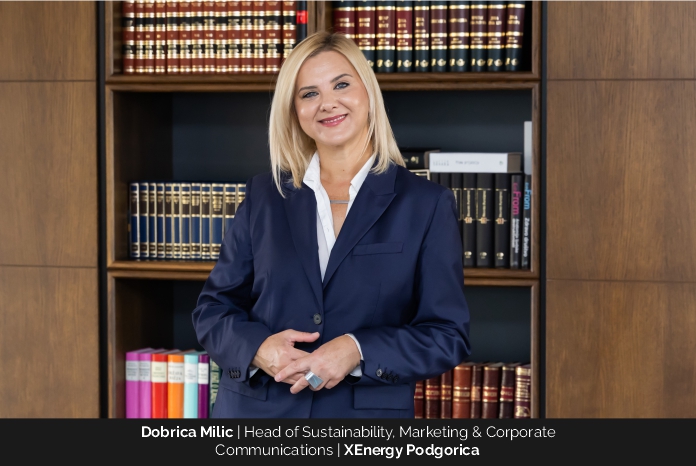
Navigating corporate communications in heavy industry and tourism relies on much more than issuing press releases or polishing promotional slogans. Major projects depend not only on technical execution, but also on clear communication with the public, constructive engagement with institutions and local communities, and a responsible approach to economic development and environmental protection.
Dobrica Milić contributes to these areas through her roles within XE Group. She serves as Head of Sustainability, Marketing and Corporate Communications at XEnergy Podgorica and is responsible for communications, media relations and strategic partnerships for Kotor Cable Car, operated by XExperience.
With more than fifteen years of experience across banking, hospitality, international organizations, tourism, energy and infrastructure, she brings a broad understanding of how communication can support business objectives, organizational change and stakeholder relationships. Her approach is based on collaboration, clear information and the belief that well-planned communication can help companies build trust and create value for the communities in which they operate.
Her career spans banking, hospitality, international bodies, tourism, energy, and infrastructure. Across every sector, her core priority remains constant: treating communication as a strategic management function that protects organizational reputation, guides internal decision-making, and creates lasting value for local communities.
Foundations Across Sectors and a Passion for Preservation
Dobrica’s career in communications began with a desire to pair creative storytelling with projects that deliver real social value. Over fifteen years, she has directed corporate campaigns and social responsibility programs that directed support to local communities, high-performing athletes, young scientists, and emerging talent whose achievements deserved broader recognition.
“I have stayed in communications for more than fifteen years because I genuinely love the profession,” Dobrica explains. “It gives me an opportunity to be creative and strategic, but also to contribute to something that reaches beyond business results. You realize that your work can help a valuable idea reach the right people, direct support towards a real need, or open a door for someone who has earned an opportunity.”
Her commitment to sustainability grew directly out of these community initiatives and her personal connection to Montenegro’s natural environment. Home to the Adriatic coastline, the Bay of Kotor, dramatic mountain ranges, clear rivers, and deep canyons, the country’s natural assets represent both a cultural identity and an ongoing responsibility.
“For me, sustainability is about finding a sensible balance,” Dobrica notes. “Montenegro needs investment, modern infrastructure, and economic development, but it also needs to protect the natural resources on which much of its future depends.”
Transitioning into energy and heavy infrastructure meant adapting to specialized technical environments. Joining XEnergy required Dobrica to learn the operational perspectives of engineers, construction crews, international consultants, financial institutions, and government authorities. She embraced this steep learning curve to understand how major utility projects move from technical blueprints into physical reality.
A clear illustration of this work is the Gvozd wind farm project. XEnergy is delivering the specialized infrastructure needed to connect the power generated by the wind farm directly into Montenegro’s national electricity grid. Once fully operational, the installation is expected to produce enough clean electricity to meet the annual needs of roughly 16,500 households.
“When you work on a project like that, communication cannot be limited to announcing construction milestones,” Dobrica asserts. “You need to explain what the infrastructure enables, why it matters to the energy system, and what its long-term value is for the country.”
“What we measure affects what we do. If we measure the wrong thing, we will do the wrong thing.”
— Joseph E. Stiglitz
Dual Role across XE Group Enterprises
Within XE Group, Dobrica’s responsibilities extend across two related areas of the business. At XEnergy, her work includes sustainability, corporate communications, reputation management and stakeholder engagement. She also coordinates corporate communications, media relations and strategic partnerships for Kotor Cable Car, operated by XExperience. While these responsibilities target different audiences, they draw on similar strategic skills. At Kotor Cable Car, built in partnership with the Italian manufacturer LEITNER, the installation connects UNESCO-protected Kotor with Mount Lovćen in an eleven-minute ride. Working closely with her colleague Jovana Boskovic, who directs marketing execution for the project, Dobrica focuses on destination storytelling that redefines how visitors experience the region.
Rather than presenting the cable car as a brief transit ride, her communication highlights the entire journey from the coast up to the mountain landscape. As the cable car approaches the milestone of carrying its one-millionth passenger, Dobrica’s strategy encourages visitors to extend their stay, explore local mountain communities, and discover attractions at the upper station.
“Through our partnerships, we do not promote only our own destination,” Dobrica says. “We help visitors discover that Montenegro extends far beyond its coastline, encouraging them to explore its mountains, lakes, national parks, local traditions, and communities. Successful destination marketing should create value beyond a single attraction and help distribute tourism interest more widely across the country.”
Additionally, she launched creative content formats, such as a video series featuring conversations with European ambassadors filmed during the cable car ride, blending destination promotion with natural discussions about culture, diplomacy, and Montenegro’s relationship with the European Union.
Change Management and Modern Leadership
Dobrica’s leadership style was forged in demanding environments marked by tight deadlines, incomplete information, and high stakes. Direct, organized, and focused on execution, she recognizes that communications leaders rarely manage massive internal teams. Instead, communications departments often operate as lean units relying on networks of external agencies, production teams, designers, and media partners.
“When many of the people involved do not report directly to you, authority alone achieves very little,” Dobrica points out. “You need to set a clear direction, define responsibilities, maintain standards, and create enough trust for different teams to work towards the same result.”
This collaborative approach extends to internal change management. As European regulatory frameworks increase transparency expectations surrounding environmental, social, and governance (ESG) reporting, companies operating in or trading with the EU face growing accountability. Dobrica emphasizes that communications must be involved from the very beginning of any major corporate shift.
“Communication cannot repair a poorly managed change process at the end,” Dobrica stresses. “It needs to be involved from the beginning, helping leadership anticipate reactions, address uncertainty, and build internal understanding.”
Her career history illustrates this focus on navigating complex organizational transitions. During her years at NLB Banka, she directed more than thirty marketing campaigns while managing major corporate restructuring efforts. Most notably, she developed and executed the Merger Communication Master Plan during the integration of NLB Banka and Komercijalna banka, completing the process with minimal client complaints.
During that same period, Dobrica led the NLB Women in Business Support Program in collaboration with the EBRD, providing female entrepreneurs with growth capital, practical training, and business network access. Furthermore, NLB Banka became the first bank in Montenegro to sign the UN Principles for Responsible Banking, reinforcing Dobrica’s belief that financial institutions create societal impact through the way they allocate capital and support business ideas.
“People rarely oppose a project simply because they oppose progress. Very often, they oppose what they were never given a fair opportunity to understand.”
Early Community Engagement and Professional Legacy
One of the most persistent hurdles in industrial communications involves navigating local community resistance to infrastructure developments. Dobrica notes that public opposition often stems from delayed communication rather than an inherent hostility toward progress.
“People often react negatively because they receive information too late, when the main decisions have already been made,” Dobrica observes. “Early communication does not guarantee that everyone will agree, nor should it be used to manufacture consent. Its purpose is to create an informed discussion, identify legitimate concerns, and give project teams an opportunity to improve their plans.”
Balancing these demanding roles with personal priorities requires conscious effort. As a mother, Dobrica rejects the idea that constant availability equates to good leadership, noting that executive exhaustion damages patience, creativity, and strategic judgment.
“I do not always balance them perfectly, and I think it is important to say that honestly,” Dobrica reflects. “For me, balance is not about dividing every day equally between work and private life. It is about being conscious of what matters at a particular moment and having the discipline to make a change when something important is being neglected.”
Looking to the future, Dobrica sees corporate communications shifting toward greater transparency, practical ESG reporting, and human authenticity. As artificial intelligence tools streamline routine drafting, she remains convinced that genuine human judgment, ethical grounding, and audience empathy will become even more vital to corporate reputation. Through her work within XE Group, Dobrica Milić contributes to demonstrating that communications professionals from smaller emerging markets such as Montenegro can apply high professional standards and support more responsible, sustainable economic development.