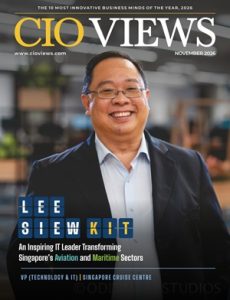

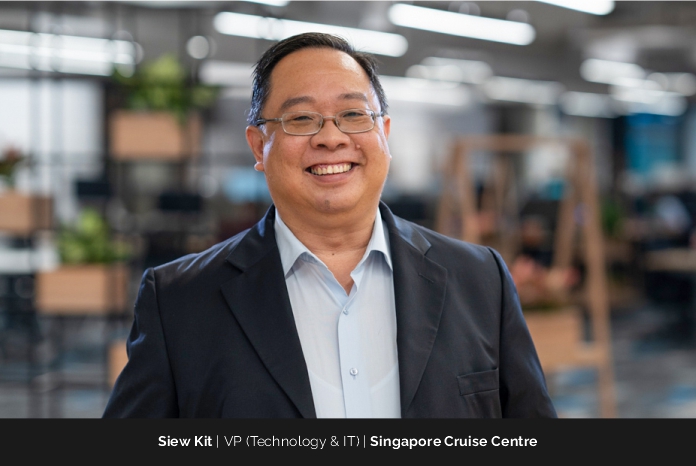
Lee Siew Kit is a multifaceted leader with extensive experience in driving technology and operational transformation. A highly accomplished veteran of the aviation and maritime sectors, he is a true all-rounder. He can lead, plan, and execute IT enterprise architecture, master plans, and teams of IT professionals and vendors. He is also equally capable of leading construction and automation projects or organizing social events. Throughout his career, he has handled transitions and challenges with impeccable skill, emerging as an inspirational leader others can look up to.
Siew Kit currently serves as Vice President (Technology and IT) at Singapore Cruise Centre, which manages and operates three ferry terminals and an award-winning international cruise terminal in Singapore. His focus also extends beyond work. He believes in giving back to society actively, both in his professional IT capacity and as an individual.
Alongside helping those in need, Siew Kit is also grooming the next generation of leaders.
Mapping the Career Trajectory
Siew Kit began his professional journey with Singapore Airlines (SIA). He joined as an Analyst Programmer and rose steadily to IT Application Team Leader, with a focus on air cargo, cabin crew, flight crew, and ground handling systems.
Over the years, he expanded his areas of influence, taking on senior roles such as Chief Technology Officer, Chief Information Officer, Head of Cyber Security, Data Protection Officer, and Chief Enterprise Architect, in between careers functioning as Practice Director and Client Service Lead in a vendor environment.
After 15 years in SIA, he joined SATS, which handles gateway services and food solutions, as Head of IT. When SATS separated from SIA, he expanded the IT team to more than 50 people on-site, and another 100 people off-site.
After 25 years on the customer side, Siew Kit crossed over to the vendor side. He joined NCS, a member of the Singtel Group, where he spent three and a half years. As Practice Director for Aviation, he built client relationships and brought deep business-domain expertise to the company, helping it to think up concepts, shape its products, services and solutions better suited to the industry and its customers. He ended his vendor-side career as Client Service Lead, with responsibility for sales, delivery, and client relationships.
During this period, he also delivered the proposed Master Systems Architecture and top 10 ideas for Changi Airport’s new Terminal 5. He subsequently returned to the customer side as General Manager, Planning (IT), for the T5 project, shortly before COVID-19 struck.
After the pandemic, he was headhunted by Singapore Cruise Centre to lead its digital transformation, drawing on his knowledge and expertise. He has now spent more than five years in the maritime sector.
For Siew Kit, one of the most rewarding aspects of his career has been successfully executing his Master Plan and Enterprise Architecture. This outcome, he points out, depended on many factors, such as the empowerment, autonomy, support, and commitment of the board, senior management, mentors, peers, and end-users. In addition to that, it needed the ability to adapt, a flexible mindset, and strong collaboration among team members, project members, and ecosystem partners. Siew Kit says that the industry’s recognition of the work was the ultimate reward.
Passion for Aviation and Technology Began Early
Siew Kit graduated from the National University of Singapore with First Class Honours in Electrical Engineering. His enthusiasm for technology began early and has never faded. He enjoys assembling LEGO blocks and, in the same spirit, treats coding as a personal challenge, striving to write the best-performing, most efficient code using few resources. For his final-year university project, he wrote a Power Distribution SCADA software.
Aviation was his other early passion, and that is what made him join the industry in 1992. He still remembers every aircraft type and the three-letter airport and city codes.
He is keen to learn about new technologies and the principles that make them work. One key lesson he has learned over the years is that implementing technology for its own sake usually leads to failure.
Siew Kit’s approach is therefore orderly. He first ascertains the challenge, problem or desired outcome, then derives design principles and options. He engages users to confirm that he has understood their needs, engages vendors to understand potential solutions, presents suitable solutions, and works closely with users and vendors to deliver a solution. According to him, throughout, he relies on tested, proven, and appropriate technologies to meet the final goals and outcomes.
Significant Contributions Over the Years
At SATS, during its divestment from Singapore Airlines, Siew Kit had to rebuild everything from scratch, including the data center, network, systems, SAP, IT policies, processes, and governance. He did that without disrupting the operations or business of either Singapore Airlines or SATS.
When serving as Practice Director at NCS, he had to conceptualize, sell the concept to customers, get their buy-in, and obtain support from the customers and support units in NCS, Singtel, and partners to deliver the concept that met the goals and requirements of the customers.
“Some of the solutions were transformational by nature, for example, new concepts for baggage operations and monitoring, the Master Systems Architecture, and top ideas for a new airport 15 years into the future, and more,” Siew Kit says.
At SCCPL, he has to map out the digital transformation roadmap, revamp the infrastructure with security in mind, modernize the core system to manage passenger movements through the terminals, adopt a hybrid cloud strategy to optimize hosting costs, security, and delivery time, implement airport-style self-service concepts to improve customer experiences, and use data extensively for insights, analytics, and decision-making.
Importantly, he also brings the ecosystem together to collaborate, enabling the majority of passengers to pass through immigration without presenting their passports using facial recognition, while reducing hard-copy printing to meet green sustainability obligations.
“In the above, the outcomes included better end-to-end customer service, optimized asset utilization, improved productivity through reduced reliance on manpower, and enhanced safety, security, and hygiene,” Siew Kit says. “They also led to enhanced competitiveness, added value to the organization, and encouraged end users to adopt a growth mindset, remain flexible, and respond quickly to changes. I also have a chance to work with eco system partners, like our authorities, our customers, airport counterparts, vendors, etc. to encourage collaboration and sharing of information to enhance overall industry efficiency and effectiveness.”
Overcoming Challenges with Great Acumen and Teamwork
Like most leaders, Siew Kit too has encountered his fair share of challenges. One major challenge arose when SATS was separating from Singapore Airlines (SIA), as the transition had to be completed within a tight timeframe and within a specific budget.
“I needed to build a new team capable of taking over the full suite of IT responsibilities and capabilities from SIA IT,” Siew Kit says. There were budget constraints and the added responsibility of ensuring that business operations remained uninterrupted. As one of the world’s largest ground handlers and inflight caterers, SATS operates in a high-volume, demanding airport environment where operational continuity is critical. Concurrently, he needs to support overseas ventures amid SATS overseas growth.
“Fortunately, I had a strong core team, the backing of our industry partners, and the trust and empowerment of the board, management, and my bosses,” Siew Kit says. “This enabled us to deliver within budget and on schedule, without disrupting operations or the business.”
Another challenge he recalls is the move from an end-customer environment to a vendor environment. It was a significant shift, not only in roles and responsibilities but also in mindset and behavior.
So, at NCS, he improved his non-technical soft skills, such as consultancy, presentation, marketing / selling and socializing skills. Siew Kit points out that selling solutions is never easy, especially when there are strong competitors in the market. Hence, he learnt to be creative and innovative and to establish good relationships with customers. He demonstrated the value he brought to the table and his ability to deliver on his promises. For Siew Kit, delivery posed another challenge, as he neither owned nor directly managed the resources required. He had to rely on the delivery team and partners to execute the work. Fortunately, he has good support from the rest to enable him to deliver to meet his promises and commitment.
Siew Kit considers himself fortunate to have worked with supportive bosses and valued clients and partners who helped him and contributed to his professional growth along the way.
Looking at Achievements with Great Pride
Siew Kit, a highly accomplished leader, speaks with great pride about three achievements. First, re-implementing the entire IT infrastructure, systems, organization, policies, and frameworks following SATS’ separation from SIA. He did that on schedule, within budget, and without disrupting operations, the business, or customers. The effort grew a team of 14 into a long-term organization of 50 local staff, 10 contract staff, and 100 outsourced vendors.
The second achievement that brings a smile to Siew Kit’s face was during his time at NCS. He established a strong client base and sold innovative, creative solutions and services. Once implemented, these delivered tangible benefits to customers, their IT users and their own customers.
Siew Kit also considers the successful delivery of Singapore Cruise Centre’s five-year digital transformation master plan, within budget and on schedule, a major achievement. It led to improvements in operations, customer experience, safety and security, and asset utilization.
“All these were achieved with no Systems Integrator, a small team of 5, but with strong support from customers, vendors and partners,” Siew Kit says.
Encouraging Innovation, Collaboration, and Continuous Learning
Siew Kit believes in continuous learning and rolling up his sleeves to gain real-world experience. He shares his experiences so that others can learn from what he has gone through. He also consistently supports and recognizes those working alongside him to deliver a project, job, or activity. “Saying thank you is never enough,” he says. “Regular gestures of goodwill are a must, like giving them a treat, going on team bonding trips with the team, etc.”
He also encourages his team to innovate, collaborate, and maintain a continuous learning mindset. According to him, he does this by sharing useful articles with the team and asking team members to share knowledge with others, including users, through regular brown-bag sessions. In addition to that, he assigns team members to work on prototypes or proofs of concept (POCs) and requires them to complete a minimum of 28 training hours per year to meet their performance KPIs.
Siew Kit wants his team to be innovative and creative and think outside the box. He also urges them to be flexible and adopt a growth mindset. “I don’t want my team to be hesitant to try something new if this new can help to address requirements, solve challenges, problem statements by users and the company, and bring the organization forward to enhance its competitiveness and growth,” he says.
And he is not the type of leader who thinks he is always right. He encourages team members to validate and challenge his ideas and concepts. Importantly, he organizes field trips to help team members bond with one another.
Always Giving His Best
Siew Kit’s work is demanding. But he loves a good challenge, whether at work or in his personal life. He always strives to give his best and never compromises on deliverables. He applies the same approach when it comes to maintaining a work-life balance.
In his spare and private time, Siew Kit is also an active community leader and volunteer. He is on a few advisory panels, committees, and boards to tap on his IT expertise, experience and thought leadership to provide guidance, advisory and feedback, on pro bono basis, to IT and non-IT societies, Standards Bodies, Community Clubs, Non-Government Organisations (NGO), education institutes, etc.
He feels that the society has taken good care of him. Hence, it is time to return to society in his own private time, without affecting his work and commitment. This also helps to achieve his work-life balance needs. Notable achievements include being Chairman of SIA’s 50th Anniversary Community Services Sub Committee and Chairman of estate’s MCST and Grassroot Organisation for several years to help look after the estate and residents’ interests and social needs.
“I prioritize and say ‘no’ to requests that are not a priority,” he says. He also allocates time for rest. Saturdays are strictly work- and email-free for him. He also takes regular vacations with family and friends. And he sings karaoke whenever possible to relax after work or over the weekend.
“Somehow, I always come up with solutions during periods of downtime and relaxation, such as when showering, walking, washing my car, or assembling LEGO,” Siew Kit says. He is also considering taking up meditation and exercise to achieve a better balance between work, personal life, and well-being.
Vision for the Future
Siew Kit plans to focus on a hybrid of aviation sector (airports, airlines, ground handlers, cargo and logistics) and maritime sectors (ferry and cruise).
He believes technology can make journeys smoother and more contactless as passengers move through key touchpoints in airports and seaports. Singapore’s One ID concept is one example. The aim is to spare passengers from queuing for ticketing, check-in, immigration clearance, security checks, and boarding using just their biometrics.
Many manual processes in airports and in ferry and cruise terminals can still be automated, he notes. In his view, operational technology (OT) and information technology (IT) must work closely together, because data shared between the two can improve process efficiency, staff productivity, and the accuracy of tracking and handling.
Data, Siew Kit adds, needs to be harnessed and put to work. AI will run on top of that data, but he points out that organizations must be wary of rogue AI that could disrupt operations and customer service, or leak confidential and personal data and damage the company’s reputation and image.
He underscores that their aim is never to adopt new technology for its own sake. Existing and new technologies (or hybrid) will be evaluated and used to address the real challenges, problems, and needs of the company, its staff, ecosystem partners and customers.
“Whatever technologies we adopt,” Siew Kit says, “we should have a clear enterprise architecture, design principles, a security-by-design framework, SLAs and KPIs to measure the success of implementation and utilization, and, importantly, cost management.”
Advice to Aspiring Leaders
Siew Kit advises aspiring leaders to be humble, committed, and willing to experiment. He encourages them to listen actively to feedback and comments, and even if they are negative, he says, they should respond positively.
He believes that it takes a team to achieve goals, not a one-person army. So, he tells aspiring leaders, “Be willing to partner.” He also advises them to understand their audience and their desires and motivation. He hopes that he could groom and guide his son and the next generation to continue to harness suitable technologies to help the industry and business to grow and succeed.
“And try and fail fast,” Siew Kit adds. “Don’t let failures hold you back. Failures are the mother of success.”
Finally, one must walk the talk. Leaders should not be leading in an ivory tower. He / She must roll up the sleeves, walk the shopfloor, understand and appreciate the situation, challenges, wishes, talk to end users, participate in live operations, and be ready to make decisions promptly. A good leader makes decisions (whether right or wrong), stands by them, takes full responsibility (admit when wrong), but takes a bow and thank all when right and successful. A poor leader is one who does not make decisions at all.