
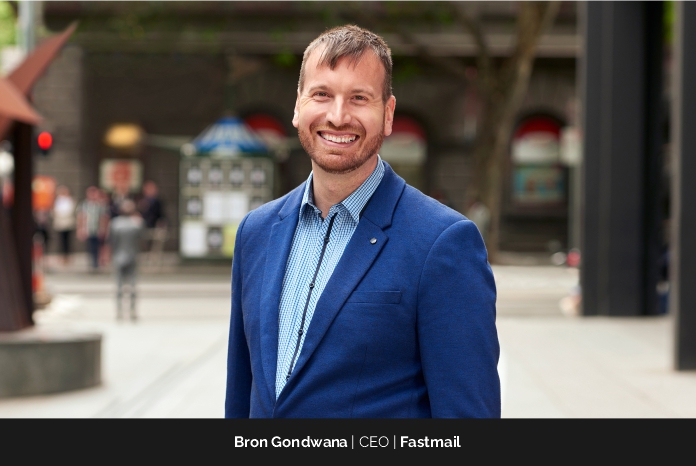
Bron Gondwana neither chases hype cycles nor believes in aggressive growth strategies. Still, as CEO of Fastmail, he has cemented his position as one of the most respected voices in the global email industry.
Under his leadership, Fastmail has transformed from a small email provider into a company influencing the future of email. Outside the company, Bron chairs multiple working groups at the Internet Engineering Task Force (IETF), where he is heavily involved in internet standards. His guidance has also helped many of Fastmail’s staff author IETF standards documents.
In an industry where things are often transient, Bron’s contributions to digital communication and email standards will endure.
From Editing a Newspaper to the World of Email
While growing up in a remote place in Tasmania, Australia, the thought of becoming a CEO never crossed Bron’s mind. However, as far as he can remember, he always loved communication.
Bron was home-educated until the last two years of high school. He started a monthly newspaper when he got a computer that was powerful enough to run desktop publishing software. Even after leaving home for high school, he continued editing it. On weekends, he would return to his parents’ place and work on the newspaper.
“One weekend would be devoted to collecting articles and editing, and the following weekend, I would apply the final touches to the monthly event calendar, printing, photocopying, and delivery,” Bron recalls. “My sister and I would deliver them on horseback.”
At his high school, in 1995, he was the only student with an email address, granted to him as the student council’s secretary. Later, he managed his university college’s computer systems. After graduating from college, Bron served in tech roles and ran email systems at a couple of companies before joining Fastmail in 2004. “I’ve been here ever since,” he says.
Following Opera Software’s acquisition of Fastmail in 2010, Bron found himself in a much larger corporate environment, where he experienced different leadership styles. “One leader in particular made a strong impression on me,” he says, “and I try to model my leadership style on the way he worked.”
Leadership Challenges Following Re-Acquisition
In 2013, Bron, together with some of his colleagues, bought Fastmail back from Opera. Initially, they operated the company from a single office in Australia without an explicit management structure. Then Fastmail acquired pobox.com (based in Philadelphia) in 2015, which increased the complexity of everything.
“We reached the scale where it was clear that somebody needed to step up to run the company,” Bron says. Of all the owners, he was the one who saw the need for it. He had trained enough people to take on some of his technical work, which gave him the mental space to focus on leadership responsibility.
One of the first major challenges Bron faced was internal tensions within the leadership team. It led to some “very rough leadership transitions” in the company, followed by a restructuring. Some teams were changed to operate from a single location as a result. Bron says that it was necessary to reposition themselves to align with the owners’ vision and goals.
“That whole time period was tough on a lot of people in the company, including me,” he adds. During this period, he spoke to an external mentor about the challenges he was facing. A few months later, Bron met the mentor again, who said to him, “I knew the company was going to be OK through this, but I wasn’t sure if you would be!”
Bron has ensured that Fastmail remains independent and privately owned. They do not have the pressure to chase growth at all costs or “enshitify” their product to chase metrics. “We can make decisions that are good for our customers and our team, and work on interesting problems with people we like,” Bron says.
“We’ve often said that being outside Silicon Valley has helped us avoid many hype cycles,” he adds.
Major Turning Points and Achievements
Bron sees Fastmail’s acquisition by Opera Software and then their buyback as major turning points. Opera gave them the resources to build a lot faster than they could have otherwise. They also got the opportunity to hire Neil Jenkins, the youngest member of the leadership team, who also serves as Chief Product Officer.
“In a hot tub in the Norwegian wilderness, on a team-building retreat with the Opera Engineering team,” Bron recalls, “Neil and I started sketching out a new protocol for email which would make our product efficient and super snappy.” It was based on Neil’s knowledge of JavaScript and web browsers’ capabilities and Bron’s experience in improving the core data structures of their Cyrus IMAP email server. This protocol led to their new AJAXUI interface in 2012, which was a major inflection point in Fastmail’s sales. Bron says that the company’s recurring revenue chart looks like two straight lines: one leading up to the release of the interface, and a steeper one afterward.
That protocol later became JMAP, an open standard at the IETF. Bron and his team helped standardise this modern email protocol in 2019. It is growing slowly, but Bron is confident that it will one day take over the world. “Even if it doesn’t,” he says, “it has definitely unlocked faster development for us, and continues to make our email client the best email experience out there.” They continue to add Contacts, Calendars, File Storage, and more to the protocol, making it a one-stop shop for building efficient clients to access their personal data.
Bron also considers the purchase of pobox.com a major achievement, primarily because it brought Ricardo Signes (Rik) into the Fastmail team. Today, he is one of the owners and runs the open-source Cyrus IMAPd team, building the software at the core of their system.
About Fastmail
Headquartered in Melbourne, Australia, Fastmail is an independent email service. Bron, Rik, Neil, and Rob Mueller, the only remaining founder from Fastmail’s original founding team, form the company’s board and work as peer Chief Engineers.
Fastmail’s customer promise is a set of values that guides everything it does in its mission to “make email better”: “You are the customer, not the product. You own your data. We are good stewards of your data. We are a good internet citizen.”
It makes email better by offering an awesome product that improves customers’ lives, and by helping build the standards and software that powers the rest of the email world. “I champion that mission, both inside and outside the company,” Bron says.
Fastmail does not set complex KPIs and goals. According to Bron, their strategy is simple: make email better, look after customers, be the kind of company people want to work at, and keep their operations as simple as possible. They charge a fair price and, in exchange, provide a very good service. Bron takes great pride in Fastmail’s ethical business model. “Not all businesses take this approach,” he says, “but for Fastmail’s owners this is good for the soul.”
Keeping Email Aligned with Privacy and Trust
Bron makes sure that they are open and honest with customers about what they can and cannot do. A good heuristic, he says, is to ask oneself: “If my customer saw exactly how this works, would they feel misled?” He explains that open standards allow people to make the trade-offs that are right for them. “A lot of the work we do through the IETF is with this in mind,” he adds.
From day one, they are clear with their customers. Bron points out that they encrypt all their data, but they hold the keys. This lets them have one of the most powerful search features of modern email providers. Users can also recover their accounts and use standard email practices to send and receive. “This also means, though, that we will respond to a valid warrant, and we are transparent about this, publishing an annual report on requests we have received,” Bron says. “All requests are validated and confirmed to be lawful before we respond.”
Fastmail has never offered end-to-end encryption because of usability trade-offs. However, the company is upfront about that and points customers to third-party tools that will help them manage their own encryption.
The Leadership Approach
Bron believes that the first person a leader must be capable of leading is themselves. Leaders need to figure out where they have the capacity and desire to go, and what consequences they can live with. It is equally important, he says, to recognise, “You can’t lead every person to every place.” If people lack the skills or the desire to go where the leader is trying to lead them, leadership becomes much harder. Bron says that when people have both the ability and the desire, leadership becomes much easier.
His job entails being willing to be interrupted at any time, doing whatever needs to be done, and giving others the space for deep concentration. As a servant leader, he believes his role is to help others achieve the company’s goals.
At the time of this interview, he and his team were in the process of setting up a new data centre in Amsterdam. Various aspects of this process, from logistics to strategy, had taken up Bron’s time. “Today has included everything from a phone call to our customs broker for the Netherlands just moments after I woke up, to helping a truck driver load a pallet full of servers for shipment, debugging a broken calendar issue for a user, and now, this interview,” he says.
Most of Fastmail’s owners are also in leadership roles. Bron meets them and other leaders three times a year in person for serious strategy discussions. The email business tends to move slowly, but their plans always include a line item: “adapt to a changing world.” Bron says that they rarely need to pivot quickly.
As Fastmail grows, Bron sees leadership less as having all the answers and more as hiring people who are better than him at what they do, then trusting them to do it. “We’ve got a small team of great people,” he says. “My role is to give them the space and context to make good decisions.”
“Small groups of people who trust each other can do great things,” he adds.
Work-Life Integration
Fastmail’s leadership team believes in a good work-life balance. That is why they don’t overload themselves all the time. “Sometimes things stack up, and you need to push through,” Bron says, “but other times ‘you’ve done enough’ and it’s good to rest.”
For Bron, the concept of work-life integration makes more sense than work-life balance. “Life doesn’t split easily into work and non-work hours, especially when you are running a business across different time zones, or for the people who are on-call for the systems,” he says. “Things break when they break. The important thing is to be getting your needs met.”
For many years, Bron’s personal life revolved around his young family, singing in choirs, and going to the gym. He is currently on secondment to Fastmail’s Philadelphia office, where he has found a choir and a gym. Although he has been a group fitness instructor for nearly 20 years, he cannot teach fitness classes in Philadelphia due to visa restrictions. So, he attends them as a participant. And he has a Peloton bike at home for days when he cannot make it to the gym.
Bron does not follow a fixed work schedule. His evenings in the U.S. overlap with Australia’s mornings, and on some days, he starts working early to manage things in Europe. Bron works hard, but also plays hard. He makes time to travel and to see his children, who are now adults, and his extended family every time he returns to Australia.
Emails and the Next Generation
Bron notes that email is still the number one social network in the world. Not only does everyone need an email address, but email is also their electronic memory. For example, when Bron was recently tracking down all the parts in the servers being shipped to Amsterdam to determine when the various replacement drives had been purchased and which quotes had been compared at the time, he knew he could find all the information in his email. He also regularly refers to emails from a decade ago to understand what he was thinking at the time.
It is said that the best predictor of how long a technology will last is how long it has already lasted. In a world where information is ephemeral, ever-changing, and hard to find again later, email stands out as a safe place. Bron explains that the message one saw yesterday will be exactly as one remembers it when looking at it again tomorrow. “It is your rock of stability in a changing world,” he adds.
Bron sees email as an “exo-brain”, a long term store of valuable memory, and is sure that the next generation will come to appreciate email as they grow in wisdom. “People compare messaging technologies by their immediate handling of today’s messages, more than by the rediscovery of last decade’s messages. Part of becoming an adult is needing more of the latter,” he says. “Email will start out as some boring old thing they have to have, but at some point, they will value its boring, reliable stability and learn to love it!”
What Is Success?
Bron does not dismiss the importance of metrics as a measure of success, but for him, a clear sign of success is when the Fastmail team can walk into any conversation with the world’s biggest email companies and be recognised as an expert and listened to. Today, when they say something, they are taken seriously. It gives Bron an even greater sense of accomplishment when he hears quietly that staff at other email companies use Fastmail for their personal email, or have even set their family members up with it.
He also says that they are making enough money to pay their staff, run their service, and make a good living for themselves. “We have the luxury to keep building the product we want to build, and have fun doing it,” he adds. “This is a direct result of being employee-led; the independence means we can make this choice.”
Advice for Aspiring Leaders
Bron believes that security only works if people actually use a product. If it is secure but is not usable, people will just choose a less secure option. So, Bron advises aspiring leaders to build something people want to use and solve their problems. “Don’t be their problems,” he adds.
He also encourages aspiring leaders to speak up when it counts. “In this space, you will occasionally see situations where the easy thing is to stay quiet,” Bron says. “I don’t encourage people to take that option.”
A few years ago, when the Australian government passed a bill, Bron and his team shared their concerns publicly, even though Fastmail was not directly affected. “We didn’t think the bill would be good for the Australian tech industry or for our customers, so we said so,” he says.
“The industry needs voices in the room when policies are being made,” he adds. “Everybody will have to live under these policies, and you owe it to your community to contribute your expertise to the conversation.”
Personal Mission
Bron notes that when something new comes along, such as AI, there is always a risk that open parts of the internet gradually become closed off because these systems are more convenient in the short term. Email remains the biggest federated communication network in the world. “It is worth defending,” Bron says, adding that his personal mission is to “keep email open.” He believes that email’s continued success depends on everybody being able to build or choose software from different vendors and have it all work together.
Through his work on internet standards and his efforts to make email the technology of choice, Bron is helping create a better communications future. “This is the place where my skills and experience can do the most good in the world,” he says. Currently Bron is focusing on a specification called DKIM2, in conjunction with co-authors from Google and Yahoo, aimed at defending against spam replay attacks.
He believes in creating more value than he extracts. “We could be richer with fewer ethics,” he says, “but you have to live with yourself every day for the rest of your life.”