
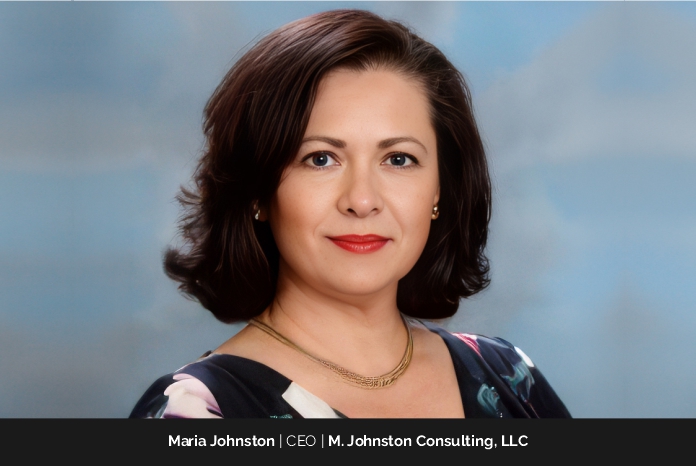
Maria Johnston didn’t set out to break barriers. She just wanted to pay for college. So, she took a job at the phone company – working full time, going to school one class at a time. Then she did something no woman had ever done at BellSouth. She became the first female RCDD certified engineer in a company of 85,000 employees across nine states.
The exam had a 60% failure rate. She passed. And when a rival company offered her $30,000 more – plus bonus – her boss told her, “Take it. You’ll be back.” He was right. That grit would later fuel her own consulting business, a leadership style built on listening instead of dictating, and a mission to mentor veterans and serve on community boards.
But more than anything, Maria wants young women to know one thing – never let anyone tell you what you can and can’t do with your life – not a high school counselor, not a room full of engineers who refuse to meet your eye.
From the Phone Company to the Boardroom
When Maria was 13 years old, she wrote two goals on her bedroom wall: be financially independent and get a college degree. “I felt I needed a degree to be financially independent. I kept asking people how they went to college. They’d say, ‘Don’t worry, when you get to high school, you’ll talk to your counselor.’”
However, the school counselor just looked at her straight‑A grades and said, “Maria, even though you’re a straight‑A student with great grades, you’re a Hispanic female. The best thing you can do is get married, have children, and forget about a career.” Maria walked out crying. But that didn’t discourage her.
She just wrote another goal on her bedroom wall: “Don’t let anyone tell you what you can and can’t do with your life.” She started asking her friends’ parents for help. One helped her apply to the University of Miami. She took the SAT, passed with great scores, and was accepted. But she didn’t know how to apply for grants or financial aid. Her dad didn’t see the value in her going to college and so he told her to get a job so she can help pay for their household expenses.
So, instead of graduating from the University of Miami, Maria ended up at Miami Dade Community College, while working at the phone company, which paid her college fees. “That’s how I started college instead of UM – because I couldn’t afford it,” she recalls. “Working full-time while going to school full-time wasn’t easy. I couldn’t work 8 to 5 and then go to school at night, so I took one class here, one there. It took me forever, but I did it.”
Always looking to move up the line at the phone company, leading people was one of the key items that Maria knew she needed to learn. The real turning point came in 1981 after watching her boss work and leveraging the opportunities she gave her. “That’s what drove me to keep doing a great job. Leadership wasn’t on my radar until I had a lot more experience – I was only 18 at the time,” she recalls.
Maria’s boss encouraged her to learn more so that she could be in her shoes. But Maria ended up way above. “When I finally got to lead people, I was at the director level. My goal has always been to help people grow in their careers, which is part of leadership,” she reflects.
The Certification That Changed Everything
The defining moment that shifted the direction of Maria’s professional journey was when her supervisor asked if she would learn how to engineer outside plant and inside plant (both copper and fiber facilities). The phone company was building a new product line in the deregulated environment, and this was something they wanted to pursue.
There was only one other person with this certification in the company. But he was in Georgia, and the company needed someone in Florida. Maria accepted the opportunity and started designing both fiber and copper facilities for customers and became a consultative seller without knowing that was what she was doing. She would sit with clients, ask questions about their business and their challenges and then would design the infrastructure to meet their needs. “I didn’t know it at the time, but I ended up becoming the first female certified engineer at BellSouth across a nine‑state region in the Southeast. Crazy, right? 85,000 employees and only one certified female,” she observes. I only learned this after I received a call from the only other employee in GA that had the same certification and he called to congratulate me.
When BellSouth became AT&T again and merged with Southwestern Bell, it grew to 380,000 employees, and Maria was still the only female RCDD certified employee. Because she took that opportunity, her career skyrocketed. “I got interviewed in front of 5,000 people because my certification was such a big deal,” she says.
Maria explains that her Registered Communications Distribution Designer (RCDD) certification was not open‑book, unlike the PE (Professional Engineering) exam, which at the time was open book and you can pass if you know your way around the manual. “You either know it, or you don’t. It had a 60% failure rate. It was crazy that I passed it – but I did,” she says.
That certification transformed Maria’s career prospects. She began getting job offers from other companies. Having been interviewed in front of 5,000 people from several different companies, she was suddenly getting offers for $25,000 to $30,000 more per year than she was making at the phone company, plus bonuses.
When Maria showed her boss the offer letters, he said, “Take one of those offers. Don’t worry, you’ll be back.” So, she did. Within two years, the phone company called her back with top pay and a sales position – something she’d never done before, but she found it interesting.
From Sales Plans to Utility Consulting
Maria started M. Johnston Consulting with one plan – to help small businesses establish a sales plan. “I felt many small businesses didn’t know how to do that. Thanks to my background in engineering, legal, lobbying, and sales, I could help them put together a plan to help them grow,” she shares.
But within two months, Maria started getting calls asking for help with power utilities. She knew the local power company because she had engineered their entire backbone. So, M. Johnston Consulting pivoted from sales plan development to dry utility consulting, working with developers as the interface to the power, gas, and telecom companies around the state of Florida.
Maria’s consulting work – for the power, telecom, gas, and wireless industries – is a niche market built on knowledge and relationships. She occasionally runs into people who do some of what she does, but not people who work with all the dry utilities.
“That’s why I get so much business – constant referrals and people asking for help. We’ve been in business for seven years now. It’s all been word of mouth, though I do advertise sometimes, with the Fort Lauderdale Chamber of Commerce, Leadership FL and other organizations around the State of FL.
Letting the Team Lead the Way
Having led teams with over 40 employees across 11 states, Maria let her team lead the way in their territories, with regular calls to understand how they’re handling challenges and providing input. “Every employee should be their own leader. They know their customers better than anyone else. I don’t like telling people how to do their jobs. I like to lead them to take the reins and accomplish the company goals. I’m a true believer in working as a team, not solo,” she insists.
During monthly in-person team meetings, Maria would hear challenges and solutions from other team members. She cultivated trust and empowered her team by asking for input and listening. “I would have employees from other states fly in, and we would sit around a table, bring up the biggest challenges they have, and hear everyone’s input. That’s critical. That’s my leadership philosophy: let the team bring solutions, talk it through, and figure out the best path together,” she says. “Not only did it show we were working as a team, but it also brought up ideas we might have missed.”
“I’ve learned that people will forget what you said, people will forget what you did, but people will never forget how you made them feel.” – Maya Angelou.
Being Female in a Man’s World
Maria admits that getting her RCDD certification and starting her own business were major career challenges and achievements. “Going from a steady paycheck to not knowing when you’ll get paid is a big risk, but it was the best decision I ever made,” she says. She’s also received the Leadership Broward Fun Lunch award in 2023 and numerous awards over her career.
But the toughest challenge has always been being a female in the technology and construction industry. When she became the first female certified engineer at the phone company, men on job sites wouldn’t talk to her. “I remember wearing a skirt with steel-toe boots, a safety jacket, and a hard hat on purpose so they knew I was a woman and the one who designed the work,” she recalls.
When an engineer rejected her idea, she went around him to someone else, who loved it. Then she told the first engineer that, and he suddenly agreed. “They wouldn’t even consider what I was saying because I was a female,” she says. Another time, when a client asked, “When is your boss going to get here?” she replied, “I’m the boss. I’m the director. I engineered the design, and these people work for me.”
When Maria’s friend became the first female technician in New York, her boss said, “Oh my lord, we don’t have a women’s bathroom.” They had to close off the men’s room for one woman. “Sadly, I still face this today,” Maria shares. “On calls with engineering firms, I’ll explain power standards, and they’ll say, ‘We want to hear it from the power company.’ It’s not as common, but it’s still insane. That’s why I wrote my book.”
Male dominance in the industry has made Maria’s career a constant fight to be heard, believed, and respected. “I want women to know – never let anyone or anything stop you from reaching your dreams. That’s why I wrote a book about all the things I learned throughout my career as a Hispanic female in business, and why I speak to women’s groups and young women in schools,” she shares.
Maria hopes to help women see that nothing is stopping them from achieving their goals. After her speeches to young women, grateful for her stories, they often approach her and tell her they’re going to make a plan. “That’s been the most rewarding outcome of my speeches,” she says.
“The brick walls are there for a reason. The brick walls are not there to keep us out. The brick walls are there to give us a chance to show how badly we want something. Because the brick walls are there to stop the people who don’t want it badly enough. They’re there to stop the other people.” – Randy Paush.
From Being Mentored to Mentoring Others
Maria has had great leaders and some not‑so‑great ones – a “huge learning opportunity.” She considers herself lucky to have been picked for numerous leadership programs and been assigned an extremely helpful mentor. That experience taught her to pass it along.
Through a mentorship program called ACP, Maria has mentored several military vets transitioning from military to civilian life, and is in contact with several of them, and sometimes their spouses, too. She sees mentoring as “a really rewarding part of my life.”
“I would help them put together resumes, look at different opportunities, and prepare for interviews. They still call me and ask, ‘Hey, Maria, what do you think?’ even years later. It’s been extremely rewarding to help these wonderful people who’ve done so much for our country,” she says.
Engaged In Every Community She Calls Home
When Maria reflects on her legacy, she points to her decades of service on nonprofit and advisory boards. “Sharing my knowledge and contributing to these organizations helped them continue to be sustainable. It’s very important to be engaged in your community,” she insists.
In the past year, she served on the board of 211 Broward as chair of the legislative committee. Having been a lobbyist at AT&T, she had the skills needed to “lead the organizations legislative agenda in Tallahassee, which was something she loved and really enjoyed doing,” Maria recently moved from Fort Lauderdale to Orlando, which is why she resigned from the 211 Broward board and is now working on re-engaging in her new community, which actually isn’t completely new as this is where Maria met her husband of 38 years, Mike. She had moved up to the Orlando area in 1983 from Miami in an effort to help her focus on college and her career progression. “There were too many distractions in the Miami area at that time so I needed to get away and focus on my goals. Quite honestly, It was the best decision ever as I wouldn’t have met my wonderful husband if I hadn’t moved and of course, not to mention the career opportunities that came my way.”
In addition to dealing with the challenges of running a company, Maria is serious about her wellness breaks. “For personal well‑being, I get regular massages – whatever helps me step out of business mode. I love to attend plays and musicals with my friends. This gives me a break from work,” she shares.
Conclusion
Maria Johnston’s journey proves one thing: she has never let anyone write her story for her. Today, she continues to do the work she loves, mentor those who come after her, and remind women everywhere that no obstacle is permanent and no dream is out of reach. Her legacy is not just in the cables and connections she engineered, but in the paths she’s cleared for others to follow.