

There is a fundamental problem the technology industry still hasn’t solved.
Technology works. People don’t use it.
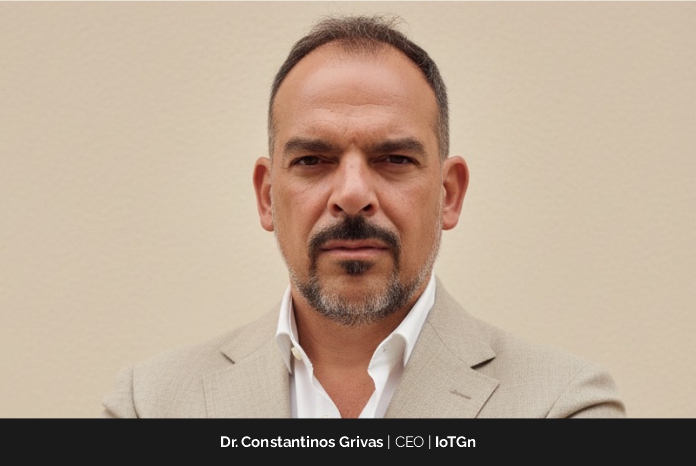
Dr. Constantinos Grivas has built his career at the point where innovation meets hesitation. As CEO of IoTGN, his focus is not on adding more complexity to the system, but on ensuring that innovation is actually adopted. In a market saturated with features, platforms, and increasingly complex ecosystems, his work centres on one question: What makes people hesitate—and how do you remove that hesitation altogether?
Where Innovation Really Begins
“Innovation fails quietly when people don’t use it.” It’s a simple observation but one that most companies overlook. Across Europe, digital capability has advanced rapidly. Devices are smarter, platforms more powerful, infrastructure more sophisticated. Yet real-world environments tell a different story: one where adoption consistently lags behind potential. Dr. Grivas approaches this gap from a behavioural perspective.
With a background in consumer behaviour and decision science, including research into cognitive biases such as the halo effect, he has spent years understanding why people accept or reject technology.
His conclusion is direct: “People do not adopt what they do not immediately understand or trust.”
That insight defines his approach: adoption is not a by-product of innovation; it is the system that determines whether innovation creates value.
Proof Before Theory: The Gonidio Model
Long before IoT, Dr. Grivas applied this thinking in one of the most complex industries imaginable: genomics. Through Gonidio, he helped bring predictive DNA analysis to consumers, translating highly technical genetic data into clear, usable outcomes.
While the science itself was complex, the experience was intentionally simple. It was designed around traffic-light results, supported by visual dashboards, and complemented by immediate, personalised action plans, leaving no need for interpretation. This clarity was not just a feature; it became the foundation for continuous improvement, where the real advantage emerged through ongoing iteration.
Each year, new supplement formulations were developed directly from aggregated user data covering anti-ageing, weight management, athletic performance, and holistic wellbeing.
This created a continuous loop: Data → Insight → Product → Behaviour → New Data
The outcome was more than commercial success as it established sustained market leadership. Gonidio introduced category-leading genetic tests, developed a supplement that remained a best-seller in Cyprus for over a decade, and built a system that people not only understood but consistently followed.
It wasn’t the science that scaled. It was the simplicity.
The Leaky Bucket of Innovation
“You can pour innovation into a business,” Dr. Grivas says, “but if adoption is broken, the value leaks out.” The industry, he argues, is still focused on adding more features, more specifications, and more complexity while ignoring the moment where most products fail: hesitation. “Innovation does not fail because of technology. It fails because of friction.”
At IoTGN, solving that friction starts from the ground up. Before smart homes can be intelligent, they must be connected. Weak signals, unstable networks, and inconsistent performance turn even the most advanced devices into frustrating ones. By focusing on Wi-Fi mesh systems, extenders, and reliable coverage, IoTGN addresses one of the most overlooked layers of the digital experience: the foundation.
If it doesn’t work everywhere, it doesn’t work at all.
The Event That Changed the Rules
The 2013 Cyprus banking crisis was a defining moment in Dr. Grivas’s career. It reinforced a principle that still shapes his leadership today: when external conditions become unstable, only clarity, resilience, and disciplined execution endure. ‘That period removes illusion,’ he reflects. ‘You stop thinking about growth. You focus on what actually works.’
Designing for Real Behaviour
What differentiates IoTGN is not just what it offers, but how it thinks. The internal standard is uncompromising: technology must work immediately, setup must be intuitive, and decisions must feel obvious.
If a user needs to stop and think, the system has already failed. “People don’t embrace complexity,” Dr. Grivas explains. “They choose what feels simple, reliable, and immediate.”
This behavioural lens shapes everything from product selection to customer experience turning technology into something people trust and use without friction.
From Data to Value: The Role of IoTGN Advisory
Adoption, however, is only the first layer. The second is value. Every connected device generates continuous data. Yet in most organisations, that data remains underutilised—collected, stored, but rarely transformed into measurable business outcomes.
This is where IoTGN Advisory comes in. As the strategic extension of the business, it focuses on one critical question: How does data become revenue?
The approach is not about adding complexity, but about structuring value by organising raw IoT data into usable frameworks, identifying monetisation pathways, and converting passive data into active business intelligence.
“Technology creates potential. Data creates value,” Dr. Grivas notes. “But adoption is what connects the two.”
Leadership in Complexity
Dr. Grivas’ leadership style reflects a balance between analytical depth and disciplined execution. Having operated across genomics, personalised healthcare, and international business, he brings a cross-disciplinary perspective to complex markets one that prioritises clarity over complication.
His approach is consistent:
- Simplify the problem
- Focus on what matters
- Execute without hesitation
In environments where uncertainty is constant, leadership becomes the ability to act without perfect information and adjust with precision.
The Event That Defined the Mindset
“The European tech industry doesn’t have an innovation problem. It has an adoption problem and most companies are still solving the wrong one.”
The Shift Toward Invisible Technology
Looking ahead, Dr. Grivas sees a clear direction for the IoT industry. “Not more complexity, but less. ‘The real success of technology,’ he says, ‘is when it becomes invisible.’”
The next phase of growth will not be defined by more features, but by less friction. The companies that lead will not be those with the most advanced engineering but those that make technology feel effortless.
Enabling Europe’s Next Phase of Growth
For Europe, the challenge is no longer innovation; it is adoption at scale. The real impact of digital transformation will depend on how effectively businesses and households integrate technology into everyday life. Positioned at this critical intersection, IoTGN focuses on making connectivity the foundation, simplicity the interface, and data monetisation the ultimate outcome.
“We are not just introducing technology,” Dr. Grivas explains. “We are making it usable, scalable, and economically meaningful.”
Final Perspective
For those entering the field, his advice is clear and direct: “Don’t build for intelligence. Build for instinct.” In his view, technology that requires effort creates resistance, while technology that works instantly creates momentum.
But his final observation is less comfortable and more defining: “Most companies are not competing on better technology. They are competing on who can hide complexity better. The ones who win are the ones who eliminate it completely.” In a market driven by constant innovation, that may be the most overlooked truth of all.