
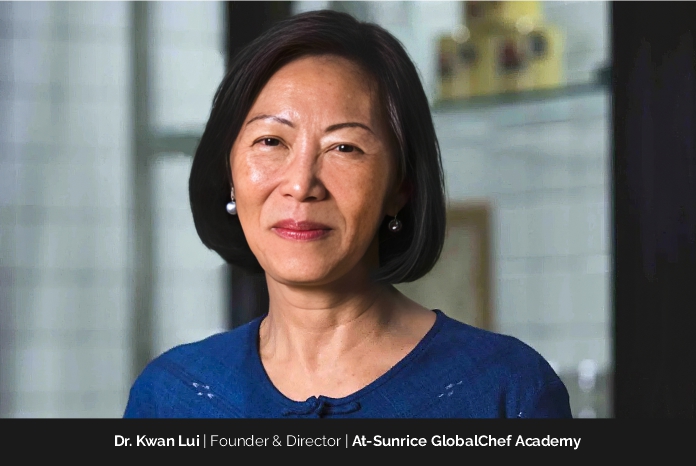
Dr. Kwan Lui spent years training chefs before she started the school that would become At-Sunrice. Most culinary programs at the time focused on technique, how to plate, how to reduce a sauce properly, that kind of thing. Business skills weren’t really part of it. Neither was much attention to the food traditions students came from, especially the regional dishes that were slowly disappearing as kitchens modernized. Dr. Kwan built her program around all three: the cooking, the business side, and the cultural knowledge that a lot of chefs were losing touch with. At-Sunrice GlobalChef Academy, which she founded, was her answer to that gap. Graduates leave knowing how to run a kitchen, sure, but also how to run a business and, in some cases, how to hold onto a food tradition that might not survive another generation without someone paying attention to it.
Having lived across Myanmar, Hong Kong, Thailand, and the US before settling in Singapore, her relationship with cuisine was personal long before it was professional. “Food became my language for belonging early on,” she says.
Her excellence in whatever she does began as early as 13. She excelled as a national swimmer, representing Myanmar, Hong Kong, and Thailand at the SEAP Games and the Asian Games. Sixty years after first competing, she returned to the Hong Kong Cross Harbour Race in 2025.
Moving between cultures, she sensed something about food. A recipe can hold a grandmother’s habits, a village’s history, or a riveting story. She didn’t think of it as a career path back then. It just stuck with her.
Genesis of a Life-changing Career!
After completing her Master’s in Communication and Development in Hawaii, Dr. Kwan intended to pursue a career as a social researcher focused on national development initiatives. Her academic training taught her to understand communities holistically, to study systems, and to look beyond immediate problems toward sustainable solutions.
In 1982, she started a company making authentic Asian spice pastes with no colouring, no MSG and no preservative. It was an attempt to fill a gap. She started exporting on the third year, then kept growing, until she was exporting to over twenty countries. Running it gave her hands-on training. She learned how factories work, how buyers think, how to get a product across borders without it falling apart.
Yet, when the time came to sell the company, she found herself reflecting on what had truly brought her fulfillment. “It came down to three words: food, cuisines, and education.” Those three words inspired the founding of At-Sunrice GlobalChef Academy in 2001.
Building a Global Culinary Institution
As an outsider to the professional kitchen, Dr. Kwan questioned traditional models. In her words, “I came to this not through a kitchen, but through business, research and training that taught me to look at needs holistically, and a spice company that taught me operations and scale globally.”
Before opening the Academy, Dr. Kwan traveled extensively, studying some of the world’s finest culinary schools. Copying existing models was out of the question. Instead, she observed what worked and what could be different. This approach made her open an academy located next a 1822 spice garden that balanced culinary craftsmanship with business knowledge, scientific understanding, cultural fluency and work & study pedagogy.
At-Sunrice applies a scientific talent profiling to every applicant, assessing not just ability but character. “We want to ensure that we admit the best-fit students, not only passionate about food with values, work ethic, and responsibility, but we also look for exactness, learners, and positivity, attributes which are essential for a craft profession,” she explains.
The curriculum brings together Asian and Western culinary traditions. Students study herbs and spices from both, work across Old World and New World cooking styles, and spend real time in working kitchens as part of the program, not just the classroom. The aim is employability, not just skill. That means technical training, but also things that are harder to grade- adaptability, creativity, resilience, the instinct to start something rather than wait to be told what to do.
One of the Academy’s signature events is The Spice Odyssey, a publicly ticketed capstone that graduating students curate and present themselves, with faculty mentoring them through it. It’s not really a final exam. It’s closer to a proof point, a chance for students to show, in front of an audience, that they can lead a project, be proud to present their unique creation and present an exceptional customer experience.
At-Sunrice now takes in roughly 2,500 students a year from over 35 countries. Dr. Kwan looks at this number as evidence that culinary training can cross borders without flattening the traditions it’s built on.
Where Passion and Profession Become One
Building an internationally recognized institution naturally comes with immense responsibilities. Yet Dr. Kwan doesn’t describe her life as achieving perfect balance.
“I won’t pretend it’s perfectly balanced,” she says candidly. “What helps is that the Academy and my businesses reflect my values, so work and life blur in a healthy way rather than competing.”
During a recent visit to Hong Kong, she returned with traditional lao po bing, or “old wife pastry,” filled with preserved winter melon. It nudged her to think about how it could be reimagined using one of WellSpent’s signature ingredients: upcycled orange peel.
Orange Peel Magic, developed through WellSpent™, transforms discarded orange peels into sustainable ingredients that are versatile, nutrient-rich, and beneficial for gut health. This one-of-a-kind initiative utilizes orange peels, which are collected from nearly 950 orange juice dispensing machines.
In her words, “That curiosity doesn’t stop when work does.” Travel, discovering new, sharing meals with close friends, attending concerts, and scuba diving with her grandchildren all become opportunities to observe, learn, and imagine new possibilities.
She also believes meaningful success is never achieved alone. According to her, “Success and fulfilment, especially for a woman would not be possible without the wholehearted support of parents, husband if one is married, and children.”
Looking ahead, she acknowledges that building a strong succession team remains one of her most important priorities.
Leadership Rooted in Curiosity and Collaboration
Leadership, in Dr. Kwan’s eyes, is less about authority and more about creating an environment where others can thrive. Circularity is an important part of Dr. Kwan’s philosophy, both in food systems and in leadership. Rather than leading from a distance, she embraces apprenticeship, working alongside her team, building mutual respect between experienced chefs and newcomers, solving problems collectively, and fostering a culture built on learning, empowerment, transparency, and collaboration.
“I try to lead with curiosity rather than certainty,” she explains. It works as the guiding principle of the Academy. She follows a consistent approach, whether it is regarding exploring artificial intelligence, developing new food formulations, or experimenting with upcycled ingredients. What is that mantra? Ask questions first, test ideas, and improve continuously. For Dr. Kwan, leadership is ultimately about creating the conditions that allow others to do their best work, not becoming the loudest voice in the room.
The WellSpent™ Revolution: Redefining Sustainability Through Culinary Innovation
Dr. Kwan doesn’t consider sustainability an isolated initiative or an industry buzzword. This belief found its most significant expression in WellSpent™, an initiative she founded in 2022. A simple observation and an even simpler question led to her Eureka moment.
As she puts it, “I didn’t like the word ‘waste’ because it carries a negative connotation.”
During a visit to a brewery, she encountered the term spent malt barley, referring to barley that had already been processed once. What fascinated her was not what had been discarded, but what remained. Spent barley contains three times more protein than raw barley. Similarly, okara, the soybean pulp left behind during tofu production, is another nutrient-rich ingredient often overlooked despite its immense nutritional value.
That realization changed the way she viewed discarded food ingredients in particular, side streams from food production. Instead of treating them as waste, she began seeing them as resources waiting to be rediscovered.
Today, WellSpent™ focuses on ten unavoidable food side streams abundantly discarded every day in Singapore, including okara, orange peel, moromi, eggshells, spent barley, coconut residue, brewed tea leaves, coffee grounds, prawn shells, fruit and vegetable peels, and fermented mango peel. What makes the initiative unique is that it is deeply embedded within the Academy’s learning ecosystem.
Every day, nearly 200 students actively participate in research, development, product testing, and innovation. Working alongside faculty, they transform these ideas into commercially viable products. These include eggshell sea salt, orange peel marmalade, spent coffee cookies, okara sourdough bread, and macarons enriched with eggshell calcium.
Together, these creations demonstrate how sustainability and gastronomy can coexist without compromising quality or taste.
These products are sold through business-to-consumer e-commerce platforms, supplied to corporate pantries, showcased during gourmet dining events, and increasingly introduced into institutional catering for hospitals, schools, army camps, senior care homes, and correctional facilities.
The Academy’s initiative, named Happy Gut All Day Breakfast, reflects this philosophy. Every Monday, students and staff share meals made with WellSpent™ ingredients, reinforcing the connection among nutrition, sustainability, and everyday culinary practice. More than 17,500 meals have already been served, while organizations such as Google regularly order WellSpent™ products including okara sourdough bread, macarons, and Orange Peel Magic for their corporate pantries.
Unless the community is engaged, it would remain academic. Dr. Kwan organises a monthly Saturday event named WellSpent SatLuxe, a ticketed gathering featuring lunch, workshops, a produce market, samplings, and celebrations, often joined by industry chefs and international trade promotion boards.
For Dr. Kwan, however, the greatest achievement extends beyond product innovation. In her words, “It really reshaped how students see their craft, not just cooking, but stewardship and innovation.”
The Academy has also expanded this philosophy into education. It has introduced a Specialist Diploma in Culinary Medicine. This program combines nutrition, food science, gut health, and scientifically validated Western and Asian principles with traditional knowledge.
At the same time, scientific research is highlighting the importance of gut health as the body’s “second brain.” This reinforces the timeless belief that “you are what you eat.”
Turning Adversity into Opportunity
For At-Sunrice, the COVID-19 pandemic became one of its greatest tests. The Academy’s educational model had always centered on apprenticeship, practical kitchen experience, and hands-on learning. Overnight, these very strengths turned into its biggest challenges.
“The pandemic hit our core model hard, since we depend on hands-on, in-kitchen apprenticeship,” she shares.
Instead of waiting for circumstances to improve, the Academy accelerated two entirely new directions. The first was the development of At-Sunrice DigiChef Academy, expanding online diploma programs and extending quality culinary education beyond physical classrooms. The second was the creation of WellSpent™, transforming food side streams into innovative products while embedding sustainability directly into culinary education.
The experience reinforced one of Dr. Kwan’s strongest leadership beliefs.
“A crisis in your core offering can become the catalyst for your most important new one, if you’re willing to look at it that way,” she articulates.
Her 1973 master’s thesis, oddly enough, was about using satellites to train social workers in remote areas. It sounds unrelated to food. But the same interest, reaching people who aren’t in the room, using whatever technology exists to do it, shows up now in her online diploma programs, which teach students spread across several countries who’d never otherwise sit in the same classroom.
Despite being a privately owned academy, it prioritizes Singapore’s education system. All Singapore students receive up to 90% tuition subsidies from SkillsFuture Singapore whose current priority is to support mid-career changers aged 40 and above. This marks a major shift in the Academy’s student profile, traditionally aged 17 to 35, now extending to 40 and even up to 70 years old.
What actually keeps it working is harder to sum up in a phrase: relationships with employers that hold up over time, a willingness to change the model when it stops working, and a work-study setup where most students walk out with a job already lined up. It stays relevant by keeping up with industry shifts, national agenda and students’ aspirations – “Partnership is in our DNA”
Redefining Success Beyond Recognition
Dr. Kwan’s impact on food and education has earned her major recognition: two World Gourmet Summit lifetime achievement awards, an Honorary Doctorate from Johnson & Wales University, and Purdue University’s Distinguished Alumni Award for her work in entrepreneurship. Her notable publications include the Singapore National Symphony Orchestra’s Symphony of Taste, a music-meets-cuisine cookbook that won Best Charity Cookbook at the Paris Cookbook Fair, and Wine & Food of Asia. Published in partnership with 67 Pall Mall, the latter celebrates wine culture alongside the heritage cuisines of 13 Asian countries. Currently, she sits on the board of The Microbiota Vault in Switzerland which provides a global framework to safeguard microbiomes from human, animal, and environmental sources.
At-Sunrice has earned numerous milestones. It is now one of Singapore’s leading culinary institutions. Dr. Kwan’s definition of success has evolved considerably. “Early on, success meant accreditation, enrollment, reputation,” she states. Today, those achievements represent only part of the story. Dr. Kwan adds, “Now success is about impact.”
The questions she asks herself are different.
“Are we reducing the food waste our industry generates? Are we preparing chefs for a future shaped by AI and changing consumer values, not just the kitchen of today? Are our graduates carrying forward not just technical skills, but a sense of purpose?”
She believes lasting success is measured less by what the Academy has accomplished. She weighs it by what its graduates, industry partners, and future generations accomplish through its education.
Inspiring the Next Generation of Culinary Leaders
Dr. Kwan hopes every graduate leaves At-Sunrice with more than professional competence. She wants them to recognize cooking as a powerful tool. It can preserve cultures, strengthen communities, promote environmental responsibility, and contribute to food security. The same philosophy extends to educators. She believes institutions must demonstrate that rigorous culinary craftsmanship can coexist with sustainability, emerging technologies, and new educational approaches.
Aspiring leaders who are set to enter the education and hospitality sectors, she advises, “Do not wait to feel like an expert before starting.” She also encourages future leaders to let setbacks redirect them rather than define them.
Preparing the Academy for Tomorrow
Dr. Kwan advocates that culinary education must constantly evolve. Rather than chasing trends, At-Sunrice attempts to anticipate them. She believes that artificial intelligence has opened new possibilities in personalized learning, blended pedagogies, specialized culinary careers, and food entrepreneurship. The result is improved employability. At the same time, growing awareness of gut health, nutrition, and preventive wellness is reshaping how future chefs think about food itself. Her current initiative, Regen with IDO, maps what the Academy will look like over the next decade, drawing on 25 years of experience and focusing on Innovation, Digital transformation, and Overseas expansion. In 2026, At-Sunrice partnered with the not-for-profit Alibaba.Orange to offer free access to certificate modules for anyone wishing to enter the world of food professionals.
For Dr. Kwan, technology will never replace craftsmanship. Instead, it should enhance learning while allowing chefs to focus on creativity, judgment, and human connection.
“The chefs who’ll thrive next are technically excellent and adaptable, not just trained for today’s standard.” It is a philosophy that reflects the journey she herself has lived, from entrepreneur to educator, from researcher to innovator, and from culinary pioneer to sustainability and wellness advocate.