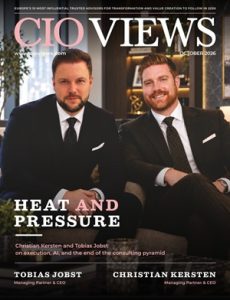

Heat and Pressure
Christian Kersten and Tobias Jobst on execution, AI, and the end of the consulting pyramid
“Two years from now, there will be no associates or junior consultants left in consulting – what consulting companies are billing today as a “junior”, is a prompt – and the client already knows it.”
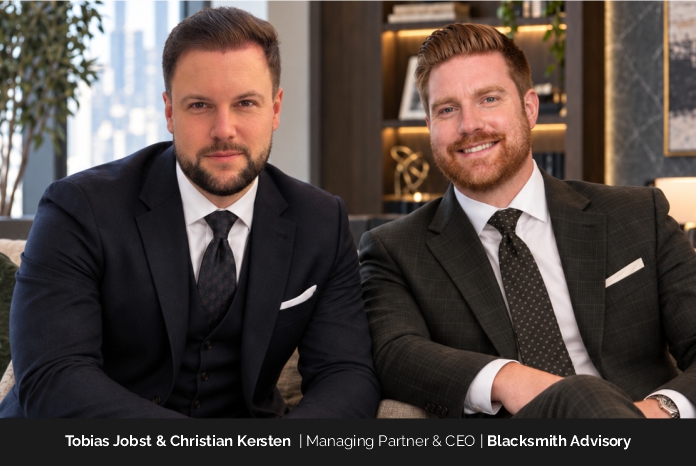
Tobias Jobst, Managing Partner & CEO · Christian Kersten, Managing Partner & CEO
Strategy decks or theoretical excellence cannot rescue a struggling business. Christian Kersten and Tobias Jobst have seen enough well-conceived transformations falter in execution to know that. So, when it was time to set up their own firm, they decided to move beyond advisory theater and focus on transformation execution. Blacksmith Advisory, which they lead as Managing Partners and CEOs, was founded on the belief that organizations in crisis are like raw metal under heat and pressure, and transforming them takes skill, patience, and disciplined execution. It is outcome-oriented craftsmanship. “Most transformations do not fail on strategy; they fail on ownership. Clients rarely need a better answer – they need someone who stays until the answer has actually been implemented,” Christian says.
Christian and Tobias’s work begins where many advisory engagements stop. They are called in when a transformation has stalled, timelines are slipping, stakeholders are frustrated, and confidence is eroding. Like blacksmiths who turn metal into something durable and useful, they leave organizations in better shape than they found them. The situations are recognizable: a carve-out losing time, a technology recovery under board scrutiny, a value-creation program with investors questioning every move, a PMO or TMO that has to establish control within weeks. In each of them the question is the same – who owns the next decision, and when will it be made?
“Most transformations do not fail on strategy, they fail on ownership. …” · “Organizations in crisis are like raw metal under heat and pressure. Transforming them takes skill, patience, and disciplined execution.”
Two Different Paths Converging at Blacksmith Advisory
Christian and Tobias began their professional journeys at different points and traveled different paths before founding Blacksmith Advisory. Their unconventional approach to transformation advisory is largely influenced by their experiences.
Christian Kersten
The imprint of Germany’s Ruhr region is unmistakable in Christian’s way of working: substance over show, directness over politics, execution over theory.
Christian’s academic and professional journey reflects a strong international perspective, with extensive experience across Europe, the Middle East, the Americas, and Asia. Throughout his career, he has led complex transformation and value creation initiatives, restructurings, technology recoveries, and enterprise-wide M&A transactions for organizations operating across diverse industries and global markets. He holds a Dual Executive MBA, earned with distinction, from Purdue University and TIAS School for Business and Society, further strengthening his global business and leadership foundation. Most recently, he went deep on AI at the Massachusetts Institute of Technology (MIT).
Before co-founding Blacksmith Advisory, Christian helped build and scale one of Germany’s leading strategy and transformation advisory firms. It offered him an insight into what clients truly value in high-stakes transformation. It was not more concepts, but the ability to turn complexity into decisions, decisions into action, and action into measurable results. “We came out of that world. We know exactly how much of it is theater, because we produced some of it ourselves,” Christian says.
“Advisory must move beyond elegant strategy documents that look convincing on paper and collapse on contact with a Monday morning”, Christian says.
Tobias Jobst
The experiences that shaped Tobias’s approach to transformation began early in his career. Working on complex M&A transactions, post-merger integrations, and performance improvement programs, he repeatedly saw technically sound strategies fail because organizations struggled to align leadership, execution, and culture. That insight continues to define his work today.
Growing up in Munich, “Mia san Mia” was more than a football motto for Tobias: ambition without arrogance, loyalty and responsibility taken rather than assigned, trust earned through actions rather than claimed in slides. It still shapes how he leads.
Tobias developed an early appreciation for loyalty, discipline, resilience, and long-term thinking—values he still associates with the city. After completing his Master’s degree at Munich Business School, he broadened his international perspective through an MBA at Florida International University before further specializing in Mergers & Acquisitions at Columbia Law School in New York.
A rigorous strategy consulting background taught Tobias to analyze problems systematically, challenge assumptions, and measure outcomes. It also meant late nights, the demands of traditional consulting, and countless hours spent traveling between airports, hotels, and client sites. Over the years, he has advised investors, founders, and executives on cross-border M&A, transformation, and value creation across Europe, North America, and particularly the Middle East. Having built businesses and led projects in the UAE, he has become recognized for combining international best practice with a deep understanding of the region’s commercial environment and investment landscape.
“Today, I believe the role of a trusted advisor is not just to identify opportunities but to help organizations turn them into measurable value while bringing people along on the journey,” Tobias says.
AI Augments, Senior Leadership Judges
Blacksmith Advisory reenergizes a stalled transformation with disciplined execution. It brings senior advisory, interim leadership, program and transformation office expertise, and value creation management into one integrated setup. The firm’s approach is pragmatic. It keeps as much governance as necessary, as little bureaucracy as possible, and the focus is always on decisions, execution, and measurable impact.
A key differentiator is the way the firm uses AI as an augmentation layer for transformation. AI does the analysis and agentic AI keeps the workflow moving. Agents consolidate the fact base, draft minutes and action lists, chase open actions and assemble the steering committee pack, so the senior team can focus on the decisions themselves. Those decisions stay human – secured by hard controls outside the model, such as permissions, defined approval points and a complete audit trail, rather than by trust in the model’s good behavior. “Our differentiation lies in combining digital leverage with experienced transformation leadership,” Christian says. “AI has made analysis cheap. It has not made judgment cheap; it has made judgment scarce. No model has ever sat in a steering committee and told a board member he was wrong. That is still the job.”
Christian’s time at MIT sharpened that view. “The productivity gain does not come from the tool. It comes from redesigning the work around it,” he says. “Factories did not become more productive the day they installed the electric dynamo. The gains came decades later, to the firms that rebuilt the work around it. Almost every company has rolled out AI by now; very few have redesigned how they work. That gap is a transformation problem – and transformation is our trade.”
Tobias believes AI will not diminish the importance of consulting. In fact, it will elevate the importance of judgment, leadership and execution. It is because technology can generate options, identify patterns and accelerate analysis, but it cannot build executive alignment, navigate political complexity or inspire organizations to embrace change. “Two years from now, there will be no associates or junior consultants left in consulting – what consulting companies are billing today as a ‘junior’, is a prompt – and the client already knows it,” Christian says.
The harder question, Christian adds, is not what gets billed but where the next generation’s judgment will come from. “If juniors hand the learning to the model, they skip exactly the struggle that builds expertise.”
Case Study 1: Negotiating the Cost Line in a Carve-Out
In a carve-out, the SPA decides who pays for what and it is signed long before anyone knows what the separation actually costs. Blacksmith was brought in on the sell side after cost responsibility had already been fixed in the agreement, with the investor’s team preparing to charge a large share of the stand-up costs back to our client.
The work began with a distinction the SPA did not spell out: transition costs — everything required to run the business separately from day one — against transformation costs, meaning everything the new owner wanted to improve while doing it. AI did the volume work: thousands of cost line items, TSA schedules and project-related information/ budgets read, normalized and classified against the wording of the agreement, with every borderline item flagged rather than decided. Two senior partners then took that classification apart line by line and built the negotiating position: what is defensible, what is arguable, and what we concede early to protect the rest.
The result was a position the client could hold in the room, item by item, and a settlement that moved a high single-digit million-euro amount across the line in our client’s favor. Building the fact base took days. The negotiation took the full senior bench.
“A model can classify ten thousand cost items faster than any team I have ever staffed,” Christian says. “It cannot sit opposite an investment director and hold a number for four hours. That is where the money is actually made — and no associate does that either.”
Case Study 2: Finding EUR >10 Million Inside a 200-Initiative Portfolio
The major corporation called in Christian and Tobias to create transparency across a historically grown, decentralized IT project landscape. The two set up a group-wide project and portfolio management model, consolidating more than 200 initiatives and measures across a triple-digit million-euro IT portfolio. Through prioritization, consolidation, and a systematic clean-up of the portfolio, they identified > EUR 10 million in immediate savings potential.
“It was not only a reporting exercise,” Christian says. “It created the governance backbone for better intake, prioritization, stage-gates, risk management and executive steering.” He sees the same pattern in AI today. “Many AI portfolios look the way that IT landscape did: dozens of pilots, few in production, and nobody able to say what any of them returns. The answer is the same discipline – one intake, prioritization by value and by the cost of being wrong, and measurement before anything is scaled.” The project demonstrated how effective transformation advisory can convert complexity into management visibility, better decision-making and measurable value. Importantly, it showed that value creation is often hidden inside complexity, which is a core tenet of Blacksmith Advisory.
As Tobias puts it, “Financial performance is the outcome, not the starting point.” Once an organization has a clear operating model, transparent facts and disciplined governance, management can make better choices and resources can flow to the initiatives that truly matter.
“A successful transformation is not one that achieves short-term cost savings or delivers a stronger financial result in the next reporting period,” Tobias says. “It is one that leaves behind stronger leadership, better governance, faster decision-making and a culture that continues creating value long after the consultants have left.”
Leading Under Pressure
Uncertainty and intense pressure are the natural conditions of transformation. It is a race against demanding deadlines, high stakeholder expectations, and decisions that have far-reaching financial implications. Tobias has therefore made resilience a feature of his leadership.
“One lesson I learned relatively early is that resilience does not mean avoiding pressure. It means developing the ability to remain focused despite it,” he says.
He holds the work to a standard of his own. He never recommends something he would not be willing to implement himself.
Christian’s answer to the same pressure is systematic. His leadership is built on three simple principles: Create clarity, build trust, and execute with discipline. He believes people can deal with even the most demanding transformations if they understand the direction, the rationale, their role, and the next concrete step. That is why he establishes transparent governance, clear priorities, decision rights, and measurable outcomes from the outset.
When he steps in to solve a challenge, Christian’s sequence is to stabilize before scaling. Establish a fact base first, then create a simple governance and reporting logic so management can see what is happening, and then deliver a few visible interventions that create immediate relief. “The key is not to overpromise,” he says. “In difficult transformations, clients do not need optimism without substance. They need honesty, structure and a credible path forward.”
He applies the same sequence to AI programs, and he is blunt about the starting point. “For a CIO, the question is no longer whether AI comes into the company. It is already there – through private accounts, because employees who admit to using AI still risk being judged for it,” he says. “The question is whether it is governed.”
Governing AI: Blacksmith’s sequence for CIOs
- Find out where AI is already used. Proxy logs or an anonymous survey shows the real picture within weeks. Reward disclosure rather than punishing it.
- Fix the basics before the rollout. Identity, endpoint security, data classification and, above all, permissions: an assistant such as Microsoft 365 Copilot sees everything a user can access, so years of oversharing in SharePoint and Teams surface on day one.
- Offer a governed alternative before blocking consumer tools. Secure it with hard controls outside the model: least-privilege access, allow and deny lists, rate limits and human sign-off at the points where real decisions are made, not at every step.
- Treat tokens as a cost line. Budgets per team and use case, routing from small to frontier models, and one metric: cost per completed task, not price per token. A more expensive model can be cheaper if it needs fewer attempts.
- Measure before you scale. Two or three quick wins, piloted against a control group with KPIs fixed in advance; then decide per use case whether to scale, rework or stop.
- Build skills, not just licenses. Since February 2025, Article 4 of the EU AI Act has required organizations deploying AI to ensure sufficient AI literacy among their staff. That is the argument for the training budget.
Christian does not see fact-based sharpness and humanity as opposing forces. The best leaders are demanding on the facts and respectful with people. They speak clearly, but not destructively. They challenge assumptions, but they also listen. For him, successful transformation depends on that balance.
Leadership, in Christian’s view, is not about over-engineering complexity but about creating the conditions for progress, accountability and action.
CREATE CLARITY. BUILD TRUST. EXECUTE WITH DISCIPLINE.
The Road Ahead
“When we founded Blacksmith Advisory, our ambition was never to establish another management consultancy,” Tobias says. Their ambition has always been to build a firm that clients would view as a trusted partner during the moments that matter most, whether navigating acquisitions, leading transformations, improving performance, or preparing organizations for the future. Tobias expects the firm to continue strengthening its position as an international boutique focused on transformation, value creation, and executive advisory.
“We deliberately combine strategic thinking with implementation because we believe organizations deserve advisors who remain engaged until measurable outcomes have been achieved,” he says.
International growth will continue to play an important role in that vision. As he has worked extensively across Europe, North America, and the Middle East, Tobias believes the future of advisory lies in combining global best practices with deep local understanding. Markets may differ, but organizations everywhere need trusted leadership, disciplined execution and sustainable value creation.
Tobias also hopes to see Blacksmith Advisory helping reshape perceptions of the consulting profession. According to him, consulting should not be judged by the number of presentations delivered or frameworks developed, but by the strength of the organizations left behind.
If, ten years from now, clients describe Blacksmith Advisory as a firm that consistently helped leadership teams create measurable value while strengthening their organizations, Tobias would consider that an extraordinary achievement. His personal ambition is to build one of the most trusted consulting firms, not the largest.
Europe is facing an unprecedented set of challenges, including geopolitical uncertainty, the energy transition, AI adoption, digital transformation, industrial restructuring, and increasing regulatory complexity. In this challenging environment, companies need capabilities to execute complex change with discipline.
Christian envisions Blacksmith Advisory becoming one of Europe’s most trusted execution-focused transformation partners for boards, owners, private equity investors, and executive teams. The firm’s role, he believes, is to help organizations turn transformation into measurable value by combining fact-based analysis, senior leadership expertise, AI-supported delivery – machines for the fact base and the reporting, senior people for the decisions – and disciplined implementation.
“Our role is to help clients make sharper decisions, create greater transparency, accelerate value creation, and build transformation capabilities that remain long after the project is complete,” Christian says.
“Blacksmith Advisory wants to operate exactly at that intersection: technology-enabled, fact-based, and deeply human in the way transformation is led,” Christian says.
Advice for Aspiring Transformation Advisors
Christian advises aspiring transformation advisors to gain an understanding of a range of disciplines, including strategy, finance, technology, processes, people, governance, and communication. Nobody needs to be an expert in every field, but a transformation advisor must know how to connect experts, translate between them, and identify where decisions are blocked.
The bigger shift, in Christian’s view, is where that understanding gets built. The traditional route — join a firm as a graduate and learn the trade on client time — is closing. “If the analytical entry level disappears, you cannot serve an apprenticeship inside a consultancy any more,” he says. “Go into industry or a scale-up first. Own a budget line, ship something, carry the consequence for three years. Then come into advisory with a scar rather than a slide.” In his reading, the realistic path now runs the other way round: domain depth earned inside an operating company, applied later from the outside.
His second piece of advice is to develop intellectual honesty. Clients need advisors who tell them what the facts indicate and what the consequences are, instead of confirming what everyone wants to hear. “This requires courage, but also empathy,” he says. “You can be direct without being destructive.”
Christian tells them to become AI-native without becoming AI-dependent. They should use AI to accelerate their work, challenge their thinking, improve drafts, analyze patterns and create more capacity for judgment. But they should also know which of their skills they would still have without AI – and keep training those deliberately. “Automation dependency is real,” he says. “Pilots who leaned too heavily on the autopilot lost the skills they needed the moment it failed. Advisors are no different.” But Christian also points out that trust is ultimately earned through human interaction.
“Equally important is developing an entrepreneurial mindset,” Tobias says. Regardless of whether someone works in consulting, industry or private equity, thinking like an owner creates a completely different level of accountability.
CONNECT, TRANSLATE, UNBLOCK · Strategy · finance · technology · processes · people · governance · communication
The Legacy
Transformation may be successful when it delivers value, but for Christian, it is truly sustainable when an organization is able to make better decisions and execute more effectively after the advisor has left. He hopes his legacy will be helping organizations become more capable, not merely more efficient.
If the next generation of leaders and advisors learn one thing from him, Christian wants it to be that “technology can carry more of the work, but people must carry judgment, trust, and accountability.”
“If clients, colleagues, and future leaders look back and say that we helped organizations create measurable value while building stronger leadership teams and healthier organizations, that would be a legacy worth leaving,” Tobias says.
Sidebar: Specialized Business Consulting for Strategy Execution and Value Creation