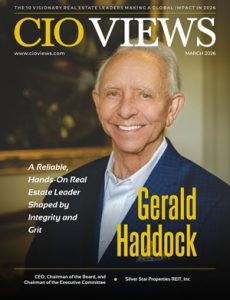

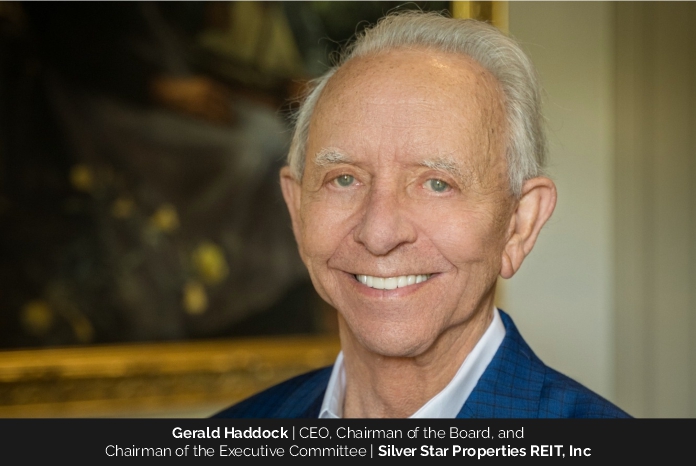
Gerald Haddock has been Chairman/CEO and Executive Chairman of the Board at Silver Star Properties REIT Inc. since 2023, while continuing to lead Haddock Enterprises LLC as President, a role he has held since founding the firm in 2000. Gerald also serves as a Director at Baylor Health Care System Foundation and Union Acquisition Corp. He finds balance in art, golf, and the responsibility he feels toward 4,500 stockholders.
Lessons That Shaped Lasting Success
For Gerald, success is driven at different stages based on personal experiences. After moving from academia to business, and fulfilling a strong partnership career at Fulbright and Jaworski in Houston, he joined the Bass family and Richard Rainwater in Fort Worth. He recalls the first lesson Rainwater shared: “Take a risk. Don’t be afraid of failure. Learn from your failures, apply them to the next transaction, the next deal, and strive for success.”
Rainwater also cautioned him that “you can’t swim upstream,” reminding him that even the best talent cannot overcome a hostile economic environment. Most successful companies operate by experimenting, adapting, and learning from every exposure. It’s important to be a good businessman and investor, applying those skills wherever opportunity appears.
Riding the Tide of Opportunity
Having learned early that “you can’t beat the economic environment,” Gerald put into play the lesson – “always get the tide behind us” – when launching Crescent Real Estate in 1990. With the RTC and government selling distressed assets, his team followed a clear thesis: “Buy properties that are upside down, buy them cheap.” Acquisitions from the Crescent office towers in Dallas to The Woodlands in Houston helped turn Crescent from a startup into a multi-billion-dollar real estate powerhouse.
Gerald notes that real estate is inseparable from economic conditions and an investment that everybody should be involved in. In the 90s, targeting triple-A locations and depressed office properties proved successful, reinforcing his belief in “opportunity shaped by the economic environment.” As AI reshapes the industry, he sees tremendous opportunity in real estate. His current turnaround work led to selling underperforming commercial office assets and shifting into self-storage, which he calls “the highest-performing and most resilient sector in real estate,” with significant room for growth in the small-cap space.
Gerald stresses that it’s not always the monopolist or oligopolist that holds all the opportunities, pointing to niche plays where one can make money by “picking up the acorns.” AI amplifies those margins by handling marketing, pricing, maintenance scheduling, and accounting. “Three or four AI agents and one person could run a 200-plus-unit storage facility,” he notes.
At Silver Star, his goal is to build a strong entrepreneurial base, move through the small-cap space, secure a major listing in two to three years, and build another large company, while staying committed to finishing the turnaround. “You don’t get points for stopping at the 50-yard line. I want to reach the goal line and finish it,” he insists.
Mastering Timing and Execution
Gerald’s biggest ongoing challenge in real estate is timing, as the right entry point can add substantial value, sometimes transforming into an opportunistic investment. Inspired by Warren Buffett and Benjamin Graham, who shaped the foundation of value investing, he notes the challenge is choosing the right asset class and the appropriate time to jump into it.
A second challenge is execution, which is totally different from strategic thought. “Strategy sets direction, but execution must carry it forward – and the two must align. Without buy-in, it is probably not going to be as successful as it could be,” he observes.
Gerald’s uses a simple measure of performance: “If you’re supposed to be a top 10 team and you come in the top 20, you’ve not succeeded. Investors want management teams who ask how good they can be, not how adequate.” Overcoming challenges around timing and execution helps teams stay well prepared going forward.
Strategic Shift Toward Smarter Growth
In Silver Star’s shift from commercial office to AI-enabled self-storage, timing and execution remain consistent challenges, albeit essential for creating value. The company owns office assets across major Texas metros, but as COVID-19 reshaped demand, it sold its office portfolio and pivoted to storage. It now operates four institutional-quality self-storage properties, along with several DSTs it manages for fees, preparing to expand once the office portfolio is fully divested.
Gerald also works with JPMorgan to refinance the 16-property Walgreens portfolio, originally acquired for tax efficiency. Only four legacy office assets remain. “We’ve sold almost 47-48 properties well over $300 million,” he notes. Most of the turnaround is now under control, and his focus stays on scaling the storage footprint across Dallas, Houston, and San Antonio.
Competing Through Connection and Smart Scale
Gerald acknowledges that competition in self-storage is constant, explaining that the company relies on its “neighborly community connect philosophy,” combining AI-driven pricing, maintenance, and marketing with in-person relationship-building. He stresses that self-storage still requires selling, and Silver Star focuses on outselling major institutions.
“People are made to have human contact when they’re selling,” he says. “I haven’t bought into the fact that AI is going to be a good salesperson.” The mix of AI, strong management history, and a hands-on community approach – inviting people in, making political contacts, engaging chambers and city officials – helps create buzz around each property.
“Competition is ultimately about being willing to start small. Everybody had to start small at some point,” Gerald adds. He recalls doing it at Crescent and in the energy sector, and intends to repeat that growth path at Silver Star: creating more value by starting at a lower base and scaling with intention.
Achieving Through Discipline, Creativity, and Lifelong Curiosity
Gerald is proud of the foundation he built in law, noting that his long-term dream has always involved transactions and that the discipline he gained in a large firm remains central to his work today. He also values his ability to stay focused and resilient in business, emphasizing methodical thinking and execution, supported by personal creativity.
Sports keep him grounded, and caddying for his granddaughter, an “elite golfer with no boundaries,” inspires him and strengthens his faith in the next generation. He recalls a milestone from 20 years ago: winning a major art valuation case in Manhattan. The victory “was the talk of the New York art circles” and sparked his enduring passion for British Impressionist art. This led to building the Haddock Center and assembling one of the largest Newlyn Art School collections outside the UK.
Art awakens Gerald’s creativity, and he describes using AI to compare French and British Impressionists, ultimately producing “a college-level thesis on comparisons, valuations, and future outlook.” Creative work keeps him energized and sharp when he returns to business challenges.
For Gerald, the through-line is simple: staying vital requires curiosity. “To remain vital long term, one has to have opportunities for creativity,” he insists. Whether through art, AI, or learning from his granddaughter, he believes a “self-embracing, somewhat fun environment” is what ultimately breeds long-term success.
A Hands-On Leader Driving a Turnaround
Gerald’s role at Silver Star blends his CEO and COO responsibilities, as “in a turnaround, the CEO has to be hands-on.” His operating background shapes his approach to leadership, and he stays deeply involved in pricing, marketing, execution, and strategy.
Drawing on lessons from his time at Baylor College of Medicine, Gerald recalls how the CEO managed 42 direct reports during a turnaround. “You take on the role required in a turnaround,” he says. This experience reinforced his belief that leaders must “touch every department” when stability is at stake, and he applies the same principle at Silver Star.
Gerald also combines his CEO role with that of Executive Chairman. With a small four-member board, he leads weekly 45-minute meetings for frequent alignment. He believes long-term governance should separate oversight and operations, but notes, “there’s a time for everything,” and right now, close involvement is necessary.
Gerald enjoys his work, calling it “a labor of love and responsibility.” With 4,500 shareholders depending on the company’s turnaround, he feels blessed that people are counting on him and remains fully committed to building a successful self-storage business. A recent note from a stockholder reinforced that commitment: “Thank goodness you have the character, stamina, and perseverance to stay with us.”
At Silver Star, Gerald continues working to build the culture, motivated by responsibility, enjoying the work, and embracing the challenge, seeing turnaround leadership as “pure adventure.” “That right there is what drives me,” he says. “It’s not the money. We live to satisfy other people – our colleagues, employees, and stockholders. That’s what I do.”
Balancing the Personal and Professional
Gerald notes that balance is easy, but takes focus. Without that, business life will take over, because people naturally drive toward success. He believes that personal fulfillment strengthens professional performance and that a comfortable personal life leads to business success, especially in roles that require harmony, social connection, and working with people from different walks of life. “Happy wife, happy family, happy husband, happy executive,” he quips.
Creativity is paramount for Gerald, having made four indie films, including Reelection, starring Tony Danza – a story showing that the value of a second chance lies in learning, not revenge or unrealistic goals. The protagonist discovers the importance of adapting to a progressive world and understanding both conservative and liberal viewpoints. “If people understand each other, there’s an opportunity for success,” he reflects.
Gerald believes the same applies to work and home. Families should understand the demands of business, and businesses should respect the need for personal fulfillment. “Today, we call it the culture of the institution,” he says. “Good culture is going to carry the day every time.”
Gerald’s future focus is on helping his granddaughter pursue Division I golf, staying creative, and remaining active well into his nineties. Professionally, he continues to build Silver Star, manage investments, and champion amateur athletics through his foundation.
He also serves on the Golden Arm Foundation board, aiming to raise its profile alongside the nation’s top sports honors. Gerald elevates the work, embraces challenges, and prioritizes his family above all. “I want to continue what I’ve been doing – just take it to a higher plane – and take care of my family. They’re lovely, and they come first,” he insists.
Strength of Values in Leadership
Gerald’s personal values stem from his family in East Texas, near Shreveport. Growing up in a Baptist-oriented household, his brother, a Baptist preacher, thirteen years older, became a formative influence after their father unexpectedly passed when Gerald was nine. Stepping in as the breadmaker for the family, he learned conservative but compassionate values and developed an understanding of people.
Those early experiences taught him to communicate across lines others might not recognize today. Gerald’s leadership abilities developed early, showing up as he became President or Student President of the Dean Council, Distinguished Alumnus of Baylor University, and recognized in law and business.
In his legal career, Gerald learned that it was leaders, not followers, who made the difference – a perspective he carries into business. Those values also guided difficult decisions, like turning down a financially attractive transaction because he “didn’t want to be seen running a casino in Las Vegas. It didn’t fit who I am.”
Gerald insists that we must recognize our own traits and beliefs. “If you go down a road you’re uncomfortable with, you won’t be happy, and you won’t be the best you can be,” he reflects. He views his commitment to 4,500 stockholders as part of that responsibility and stands by it. “A person becomes who they are rather than what they do,” he insists. “Wins and losses happen, but you still have to stand up and be a real person, no matter what happens.”
Leadership Through Meeting Real Needs
Reflecting on his leadership style, Gerald sees leadership and service as linked. He explains that every business depends on understanding what people genuinely want. “Service doesn’t require a title, but leadership always requires an understanding of what people need. Whether it’s customers, clients, or shareholders, you can’t lead without recognizing the role of service. You can’t sell people what they don’t want. Real estate is a real market,” he observes.
That logic guided his work at Meritage Homes, where the team shifted toward first-time homebuyers by focusing on affordability. The strategy moved the company from eighth to third or fourth place nationally. For Gerald, it’s part of protecting the American Dream: giving young people the chance to own a home. He considers that work an example of leadership through service – meeting real needs with practical solutions – and brings the same approach to self-storage.
As first-time homebuyers sacrifice space, Gerald sees an opportunity to serve them by providing storage options as a natural extension and part of his long-term plan for the company. He describes the company’s self-storage expansion as entering the fourth quarter, with the toughest stretch already behind them. In his view, effective leadership comes from aligning capitalism with people’s needs. That’s where business thrives, and that’s the kind of leader he strives to be.
A Mindset for Growing Strong Leaders
Gerald advises aspiring leaders to meet people where they are instead of trying to accelerate their growth before they’re ready. “Potential only thrives when it’s nurtured at the right pace. Leadership is like planting seeds – inspiration is half internal and half cultivated, and only some seeds grow, but planting them is essential,” he remarks.
Gerald truly enjoys connecting with others – cashiers, greeters, anyone he encounters – because people are the backbone of the country. He points to Warren Buffett’s patience as an example: watching people for decades before choosing a successor. “Developing leaders takes time, commitment, and a genuine love for people. Discipline matters, but people matter more,” he emphasizes.
Conclusion
Gerald Haddock’s legacy reflects integrity, fairness, competence, and a reputation for getting things done – and done the right way. Having lived “Sinatra-style,” with a few regrets and the reality that some dreams simply won’t happen, he acknowledges that he’s no Jay Gatsby chasing illusions, or Ishmael hunting a white whale. What matters to Gerald is staying true to who he is, doing his best, choosing the right people, and remaining, above all, reliable – the one word he believes captures everything he stands for.