

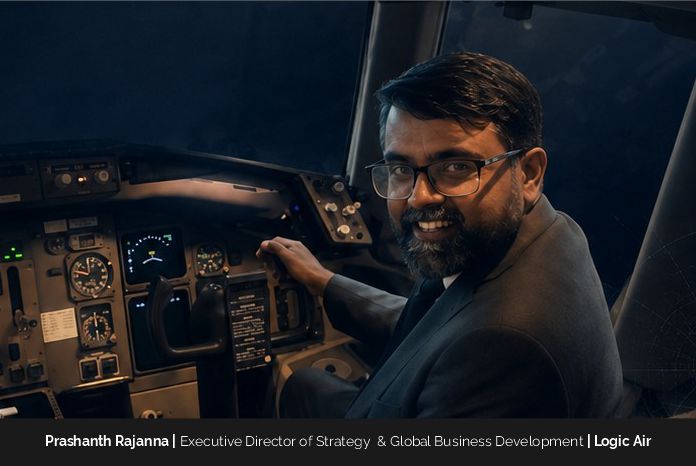
In aerospace, strategy may be written at 35,000 feet, but it is tested on the hangar floor. Prashanth Rajanna is at home in both worlds. In the two years since joining Corporation Logic Air Inc. in August 2024, he has helped a Quebec aerospace SME connect three decades of engineering and certification heritage with a larger ambition: to be recognized as a trusted integration partner for complex aircraft modifications, advanced navigation, test infrastructure and emerging defence opportunities.
Today, Prashanth serves as Executive Director of Strategy & Global Business Development. His remit reaches well beyond conventional sales. It spans market positioning, capture strategy, partner development, executive customer engagement and the difficult work of ensuring that a promising idea can be engineered, fabricated, certified and supported in the real world.
That breadth fits Logic Air. Founded in 1990, the Blainville-based company is a Transport Canada Approved Maintenance Organization with an FAA supplement and EASA approval. It reports more than 600 aircraft modified, more than 100 customers worldwide and over 175+ STCs. Its capabilities extend from technical consultation and design engineering to manufacturing, on-site installation and after sales support. Prashanth’s task has been to turn those assets into a sharper, more globally relevant growth story.
“My role has never been limited to selling an idea. It is to connect the market need, engineering capability, certification path, supply chain and execution – then make sure the promise survives contact with the shop floor.”
A Mandate Larger Than a Title
When Prashanth arrived, Logic Air already possessed what many young aerospace companies spend years trying to build: approvals, experienced technical people, modification history and a portfolio of certified solutions. The opportunity was not to reinvent the company. It was to make its value easier for major customers to see, expand the addressable market and bring greater structure to pursuits whose timelines are measured in years rather than weeks.
He began by linking business development more tightly to program execution. Opportunities were reframed as capture plans with defined customer needs, partners, technical assumptions, decision gates, commercial logic and a credible delivery route. Instead of treating engineering as the step that follows a sale, he brought it into the pursuit from the beginning. That change matters in aviation, where an attractive concept has little value unless the certification basis, configuration, interfaces and test evidence can all be defended.
Prashanth calls this thinking global while executing locally. He wants Logic Air to compete for international work, but never at the expense of the detailed accountability that makes a smaller company trustworthy. In his view, scale is not only headcount or revenue. It is the ability to coordinate complexity, respond quickly and accept ownership for an outcome.
Global Experience, Applied at SME Speed
His approach was shaped over more than 25 years across India, Europe, the Asia-Pacific region, the Middle East and North America. Before Logic Air, he worked across programs and leadership roles involving Airbus, Pilatus, De Havilland Canada and a range of engineering, avionics and defence initiatives. Those experiences taught him how large OEMs evaluate risk, how governments view industrial participation and how local suppliers earn their place in global programs.
At Logic Air, he found a different but complementary advantage: proximity. Decision-makers, engineers, production teams and partners can solve problems around the same table. A good SME can move from concept to physical evidence faster because information travels a shorter distance. Prashanth’s role is to preserve that speed while adding the capture discipline and executive communication expected by large aerospace customers.
“A small aerospace company should never imitate a large organization. Its advantage is closeness – to the customer, to the engineering problem and to the people who must deliver the solution.”
From Supplier to Innovation Partner
One of the clearest expressions of that strategy has been Logic Air’s growing contribution to Airbus Canada and the A220 ecosystem at Mirabel. During 2025 and 2026, Prashanth helped position the company for work involving representative test vehicles and cabin-safety, passenger-flow and impact-testing workstreams. The significance was larger than any individual fixture or modification. These activities called for coordinated engineering reviews, structural concepts, manufacturing, procurement, logistics, facility preparation, configuration control and on-site test support.
For Prashanth, such programs demonstrate how a Quebec SME can contribute to aircraft development when it accepts end-to-end responsibility. His focus has been to convert incomplete information into controlled assumptions, expose dependencies early and build modular execution plans that can absorb change. That means asking difficult questions before metal is cut: What data must be frozen? Which interfaces are safety critical? What should be fabricated in-house? Which suppliers can be trusted? What can be transported and assembled at the customer site? What evidence will close the work package?
A recurring principle is control of the critical path. Where schedule and integration risk dominate, Prashanth favors an execution model that keeps the most important engineering-fabrication interfaces close to Logic Air and its aligned partners. The goal is not vertical integration for its own sake; it is predictable delivery. In a test program, a low purchase price cannot compensate for a missed window or an unresolved interface.
Making Legacy Strength Relevant Again
While the A220 work has broadened Logic Air’s development and test credentials, Prashanth has also renewed attention on one of the company’s most distinctive assets: certified Performance-Based Navigation solutions. Logic Air’s enhanced navigation portfolio includes SBAS/LPV capability and second-flight management-computer solutions for Boeing 737 Classic and Next Generation aircraft. His contribution has been to reposition those solutions for today’s operating environment. Rather than presenting LPV as a historical retrofit, he frames it around operational access, redundancy and resilience – particularly for operators serving remote airports, northern communities and regions where ground-based infrastructure is limited. He has taken that story to aviation stakeholders across North America, Europe, Africa and India, connecting Canadian certification experience with wider satellite-based augmentation initiatives.
In 2026, he authored a Logic Air white paper that brought the technical, operational and strategic arguments into one narrative. The purpose was not simply marketing. It was to help operators, regulators and partners understand why certified navigation modernization can extend the useful relevance of an aircraft while improving mission flexibility. His longer-term ambition is to adapt that expertise to newer platforms, defence missions and international augmentation systems rather than relying indefinitely on the success of legacy programs.
A key strength behind that ambition is Logic Air’s deep understanding of legacy-aircraft avionics architecture. This experience enables the company to customize, integrate, install and certify modern avionics aboard established platforms – extending fleet life while meeting evolving regulatory requirements and improving operational efficiency, reliability and performance. Prashanth has leveraged this distinctive capability to work beyond conventional business development. His focus is equally on development: advancing proven products and solutions, adapting them to emerging operator needs and creating new pathways for their application across civil and defence fleets.
“Past achievements can open the door, but present-day execution earns mindshare. We have to show how proven capability solves the operator’s next problem – not only celebrate what it solved ten years ago.”
Building an Ecosystem, Not an Island
Prashanth does not believe a company of Logic Air’s size should attempt to own every capability. He sees the stronger model as a coordinated ecosystem: Logic Air at the centre of customer need, engineering integration and certification, supported by specialist partners in structural fabrication, composites, additive manufacturing, machining, cabin systems and other enabling technologies.
Over the past two years, he has helped develop and activate relationships across Quebec and international markets, using trade missions, OEM engagement and focused technical collaboration to widen what the company can offer. The commercial logic is straightforward. A customer with a complex modification should not have to manage several disconnected suppliers. The integrator must make the interfaces disappear, while preserving specialist depth behind the scenes.
That ecosystem model also allows Logic Air to pursue larger programs without pretending to be larger than it is. It combines the agility of an SME with access to broader capacity, and it gives partners a credible route into OEM and operator opportunities that would be difficult to pursue alone.
The Patience Required for Defence
A second horizon in Prashanth’s strategy is defence and dual-use aerospace. He sees natural relevance in Logic Air’s navigation, avionics, certification, aircraft-modification and rapid-integration capabilities, particularly for northern and remote operations. But he is equally clear that defence cannot be treated as a search for quick wins. It requires early positioning, compliance maturity, relationships with OEMs and government, an understanding of industrial participation and the discipline to stay engaged through long procurement cycles.
Logic Air also brings significant military-aircraft experience through the modernization of 16 A-4N Skyhawk aircraft for Top Aces. The program involved complex avionics and electrical integration, structural modifications, installation and sustained operational support – approximately 100,000 hours of specialized work demonstrating the depth required to keep demanding legacy platforms mission-ready.
His work has included building visibility at defence and aerospace forums, exploring collaboration with major industry partners and translating Logic Air’s civil capabilities into mission-relevant propositions. He is careful to distinguish a pursuit from an award. For him, a credible pipeline is not a collection of logos or meetings; it is a portfolio of opportunities with a real customer problem, a funded path, defined partners and an executable capture plan.
“Defence rewards persistence, preparation and trust. If a company only wants the low-hanging fruit, it will leave the most strategic opportunities to competitors willing to invest before the revenue is visible.”
Leadership at Two Speeds
Prashanth’s leadership style operates at two speeds. The first is immediate: close the clarification, secure the drawing, align the supplier, recover the schedule and make the next test window. The second is patient: position the company for a platform decision, a defence procurement or a new geography that may take years to mature. He believes both speeds are necessary. Urgency without direction exhausts a team; vision without a work breakdown remains a presentation.
Colleagues see this in his preference for action trackers, milestone plans, decision points and explicit assumptions. He brings commercial conversations back to the delivery questions and technical conversations back to customer value. He is also willing to challenge comfortable thinking, especially when a mature product is mistaken for a permanent market advantage. His message is direct: obsolescence, new technology and changing customer expectations do not pause because a company has a proud history.
That directness is balanced by a deep respect for the people doing the work. Prashanth consistently credits Logic Air’s engineering, production, quality, program and supplier teams for turning strategic intent into tangible results. His role is to connect them around a common objective, remove ambiguity and make their contribution visible to the customer.
He also emphasizes that progress depends on committed leadership around the idea. Logic Air’s Accountable Executive, Linnea Chomay have been instrumental in evaluating and supporting the initiatives Prashanth brought forward, creating the executive alignment and accountability needed to translate them into results. Alain Lemire’s four decades of wide-ranging aircraft experience have likewise played a vital role, bringing practical judgment, technical perspective and execution discipline to the initiatives. Together, their contributions illustrate the collaborative leadership that allows strategy to move from proposal to performance.
Grounded beyond the hangar, Prashanth finds balance through cycling, badminton and hiking. A devoted follower of Lord Shiva, he draws strength and perspective from faith. His life with Aryan and Krishna, alongside his executive responsibilities, has deepened his resilience, empathy and conviction that leadership begins with responsibility at home.
Credibility Must Be Earned – and Communicated
Another lesson from the past two years is that delivery alone does not guarantee recognition. Smaller firms can execute valuable work and still remain invisible beyond the immediate program. Prashanth has therefore pushed for stronger thought leadership, clearer capability materials, disciplined participation in international trade missions and executive-level engagement with OEMs, operators and government representatives.
He does not see visibility as vanity. In aerospace, reputation lowers perceived risk. A well-documented project, a credible technical paper or a respected partner’s endorsement gives the next customer evidence that the company can be trusted. The key is that communications must follow substance. Recognition cannot replace delivery; it must amplify it.
The Next Chapter
Looking ahead, Prashanth sees three connected priorities. The first is to deepen Logic Air’s role in the Airbus Canada and Mirabel ecosystem by converting test, modification and integration experience into a repeatable rapid-response capability. The second is to internationalize the company’s navigation and avionics intellectual property across newer fleets, remote operations and defence applications. The third is to strengthen the partner network and internal program systems needed to execute larger, multi-disciplinary work without losing SME speed.
He is particularly interested in the convergence of physical aircraft expertise with digital tools: three dimensional scanning, configuration comparison, digital twins, rapid prototyping and data-supported certification. For him, the opportunity is not technology for its own sake. It is reducing uncertainty earlier, shortening modification cycles and giving customers better evidence before committing an aircraft or test asset.
The wider ambition is for Logic Air to be known not merely as a vendor that completes assigned tasks, but as the partner customers call when a problem crosses organizational boundaries – engineering, certification, fabrication, installation, logistics and test. That is where Prashanth believes a well-connected SME can create disproportionate value.
Advice for the Next Generation
To emerging aerospace leaders, Prashanth offers a practical message: build range without losing depth. Understand the aircraft and the regulation, but also learn finance, contracts, supply chains, geopolitics and human behaviour. Volunteer for the difficult programs where functions collide. Listen to the technician, the certifying authority and the customer with equal seriousness. And never allow a polished proposal to travel farther than the organization’s ability to deliver it.
“Do not wait for the size of your company or the title on your business card to define your relevance. Learn the problem deeply, assemble the right people and create one solid example of execution.”
A Two-Year Marker, Not a Finish Line
Two years is a short period in an industry where aircraft programs can span decades. Yet it is long enough to reveal a leadership pattern. Prashanth’s contribution at Logic Air has been to connect possibility with proof: global markets with Quebec capability, OEM expectations with SME agility, and strategic ambition with the drawings, schedules, partnerships and decisions required to make it real.
The next phase will be measured not by how many opportunities Logic Air can describe, but by how consistently it converts the right ones into programs, partnerships and long-term customer trust. For Prashanth, that is precisely the point. Leadership is not standing above the complexity. It is bringing people into it with clarity – and leaving behind a stronger path to execution.