

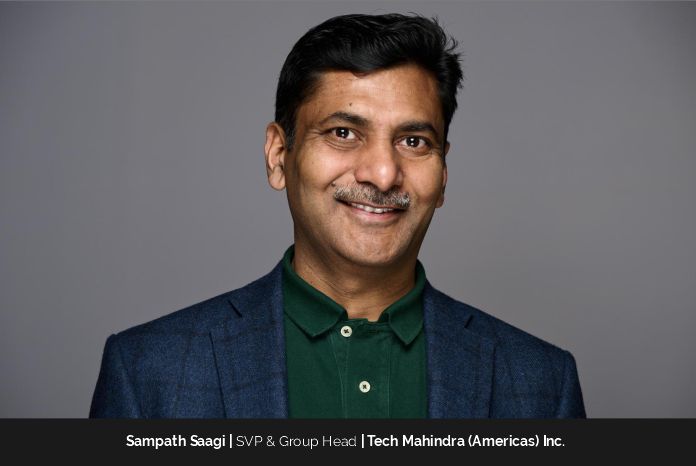
The technology landscape has undergone wave after wave of disruptions, from the rise of the internet to cloud, automation, and now artificial intelligence (AI). Sampath Saagi has witnessed these shifts firsthand over a three-decade career. As AI triggers a seismic shift across industries, Sampath, SVP and Group Head for the Americas at Tech Mahindra, leads the diverse industry verticals business across retail, consumer goods, transportation, logistics, hospitality, energy, utilities, and professional services in the Americas. He is driving profitable growth across the region.
Sampath began his career as a software engineer and steadily moved up the ladder, taking on roles in project management, strategic relationships, and business leadership. He considers his current position at Tech Mahindra a natural extension of a journey that has moved from technology delivery to enterprise transformation and business leadership.
From Writing Codes to Business Transformation Leadership
Sampath’s leadership vision was shaped during one of the most transformative periods in technology. When he began his career as a software engineer in 1996, the industry was on the cusp of a new era. Enterprises were moving beyond legacy systems and embracing distributed computing, client-server architectures, and the emerging internet. These were the technologies that would eventually lay the foundation for today’s digital economy.
Technology is never static, and that is precisely what appealed to Sampath. According to him, he saw it constantly disrupting how businesses operated, how teams collaborated, and how enterprises served their customers.
During the initial phase of his career, he worked across application development, design, and enterprise technologies, gaining a firsthand understanding of how technology could be applied to solve real business problems. Over time, he realized that the larger opportunity was not just in writing code or delivering projects, but in connecting technology to business outcomes.
“And that is what drew me towards leadership,” he says. “I wanted to work at the intersection of engineering, industry context, client trust, and transformation.”
Career Built Across Multiple Roles and Fields
Sampath’s professional journey has been built across multiple roles, industries, and markets. As a software engineer, he worked with financial services and technology clients on application development and design using mainframe, C, C++, and Java technologies. He later moved into project management, strategic relationships, business unit leadership, and large client ownership.
“A very important part of my journey was manufacturing,” Sampath says. From 2017 to 2023, he led manufacturing and private equity for the US, where the focus was on profitable growth, digital manufacturing, automation, IT, OT, engineering, operations, IT carve-outs, and technology transformation for value creation. This experience showed him how deeply technology is tied to productivity, resilience, and competitiveness in physical industries.
Today, Sampath brings his combined experience across Manufacturing, Retail, CPG, Transportation, Logistics, Hospitality, Energy, Utilities, and Professional Services into his role as SVP and Group Head for the Americas.
Lessons Learned Over the Years
At the beginning of his career, Sampath learned a key lesson that has stayed with him throughout his journey. “Technologies change, business models evolve, and industries transform, but the ability to learn, adapt, and lead people through change remains constant,” he says.
His experience has also taught him that leadership is not about having all the answers. It is about providing direction when the future is uncertain and creating confidence when the ground is shifting beneath one’s feet. “Leadership is not about predicting every shift,” he says. “It is about building teams and businesses that can adapt with confidence.”
Sampath also believes that leadership is about changing the trajectory of outcomes.
He had the privilege of beginning his career in Hyderabad, India, at a time when the city was emerging as a global technology destination. He recalls that there was a palpable sense of ambition all across the ecosystem. Sampath and his colleagues were not merely witnessing change; they were participating in the creation of a new industry. “That environment instilled in me a deep belief that transformation happens when vision, talent, and execution come together,” he says.
Overcoming Most Significant Challenges
Sampath has faced a number of challenges. “One of the most significant challenges has been leading through continuous change,” he points out.
Since he joined the industry, technology has moved from legacy modernization to digital, cloud, automation, and now AI-led transformation. Because of the innovations in technologies, industries have also changed dramatically. Manufacturing clients are rethinking operations, supply chains, and engineering. Retail and logistics clients are rethinking experience, speed, and fulfilment. And energy and utilities clients are dealing with resilience, regulation, and sustainability.
“The way I have approached this is by staying close to clients and focusing on business relevance,” Sampath says.
Technology for its own sake does not create value. Sampath notes that AI presents the same challenge at a much larger scale. The question is no longer whether organizations will adopt AI, but how quickly they can translate intelligence into business outcomes. According to Sampath, the leaders who succeed will be those who move beyond experimentation and create enterprise-wide impact.
“The real question is: does it make the enterprise more competitive, efficient, adaptive, and future-ready? That lens has helped me lead through disruption with clarity,” he adds.
Most Meaningful Milestones
Sampath has a string of accomplishments to his credit. For him, the achievement that stands out as the most meaningful milestones are those where teams come together to build something that lasts. He says that leading the Manufacturing and Private Equity business in the US was one such milestone because it helped him work deeply across digital, manufacturing, automation, engineering, operations, and transformation.
Another milestone Sampath talks about with great pride is helping shape the next phase of Tech Mahindra’s Diverse Industry Verticals business in the Americas. “In FY26, the growth in Retail, Travel, Transportation, and Logistics reflected the strength of focused execution, client intimacy, and industry-led transformation,” he says.
What Is Success for Him and Tech Mahindra
Sampath feels a sense of success when he is able to create lasting value for clients, for teams, and for the business. He does not devalue growth. It is important, he says, but quality of growth is even more important. This means solving the right problems, deepening client trust, creating measurable outcomes, and developing leaders who can carry the business forward.
Tech Mahindra Americas is an information technology and services company based out of 4965 PRESTON PARK BLVD, Plano, Texas. It is a technology subsidiary of the Mahindra Group, an Indian multinational conglomerate. For Tech Mahindra, Sampath says, success means being recognized as a strategic transformation partner across industries.
Critical Responsibility as SVP & Group Head
As SVP and Group Head, Sampath’s most critical responsibility is to drive profitable, sustainable growth while staying deeply relevant to clients. For that, he is building the right industry capabilities, investing in strong teams, developing ecosystem partnerships, and ensuring that every transformation conversation is tied to measurable business outcomes.
Sampath also sees his role as a connector: between industries, between technology and business, between global teams and local markets, and between strategy and execution.
“Whether the conversation is around adaptive manufacturing, supply chain resilience, AI-led operations, consumer experience or enterprise modernization,” Sampath points out, “the responsibility is to make transformation practical, scalable and outcome-driven.”
His source of motivation is the opportunity to create impact beyond a single program or client relationship. Global leadership gives leaders a wider lens. Sampath explains that one begins to see how challenges in one industry can inform another. For example, how manufacturing thinks about precision and resilience, how retail thinks about experience, how logistics thinks about movement and visibility, and how energy and utilities think about reliability and sustainability.
“At this scale, leadership is about connecting patterns, building strong teams and helping clients move from strategy to execution,” he adds. “It is also about staying close to the ground while thinking globally.”
Balancing Personal Commitments with Leadership Demands
Sampath notes that global leadership can be demanding, especially when leaders are working across clients, teams, geographies, and time zones, which requires them to travel a lot.
Despite his demanding work schedule, he strives to maintain a work-life balance. He does that by being intentional with time and very clear about priorities.
In his debut book, “Mastering Presence: 100-Day Transformation to Unlock Leadership Potential,” published in 2024, Sampath wrote about how prioritizing can help achieve this balance. “The book was my humble attempt to explore the art of mastering self, relationships, and influence through actionable micro habits, which are small, simple behaviors that one can easily incorporate into daily routine,” he says.
Sampath credits his family for keeping him grounded. His daughter, Anshika, is in high school, getting ready for college, while his son, Aryan, is in middle school. There are moments with them that he consciously protects and makes space for. He also considers himself blessed to have a supportive wife, Shivani, who helps him keep the personal and professional life in balance.
“Also, the balance is not always between work and family,” Sampath points out. “It is also about balancing within the family and playing to each other’s strengths.”
At the same time, he feels that he is fortunate to work with strong teams who take ownership. He believes that leadership at scale cannot be about being present everywhere. Sampath explains that it has to be about building trust, empowering people, and creating clarity so that decisions can move even when leaders are not in the room.
Industry Evolution in Three Distinct Phases
In his three-decade career, Sampath has seen the industry’s evolution in three distinct phases. “First came Cost Arbitrage, where scale and global delivery created advantage,” he says. “Then came Automation Arbitrage, where productivity and efficiency became the differentiator.”
Today, the industry has entered what he calls the Intelligence Arbitrage era. Sampath says that the competitive advantage will most likely depend on how effectively organizations apply AI to deliver cheaper, faster, and better outcomes, in addition to fundamentally reimagining how work gets done.
Future of Technology and Business Leadership
Sampath believes the next era of technology leadership will be defined by the ability to connect intelligence with action. Enterprises do not need more isolated pilots. According to him, they need platforms, data, AI, and engineering to work together in ways that improve decisions, productivity, and customer outcomes.
That is where Sampath’s cross-industry experience becomes important. While working in manufacturing, he learned the value of precision and resilience. Retail and CPG bring the urgency of customer experience and speed. Logistics brings the importance of visibility and orchestration, while energy and utilities bring the need for reliability and sustainability. Sampath expects the future to belong to those leaders who can connect these worlds and build businesses that are intelligent, adaptive, and human-centered.
He adds, “The next era will belong to leaders who can turn intelligence into advantage.”
What Next-Gen Should Carry Forward
Sampath hopes to see the next generation of leaders carry forward values such as humility, curiosity, and accountability. Humility enables leaders to stay connected to clients and teams, while curiosity keeps them learning and adapting in an industry evolving at breakneck speed. “You keep learning as technology changes,” Sampath says.
Accountability, he adds, is what turns ideas into outcomes and intentions into impact.
When it comes to innovation, Sampath wants future leaders to understand that AI, automation, and digital platforms must be applied with responsibility and purpose. “The goal is not to chase the newest technology,” he points out. “The goal is to use technology to solve meaningful problems and build enterprises that are more resilient, inclusive, and future-ready.”
Advice to Aspiring Tech Professionals
In the tech industry, most young professionals try to acquire skills in the hottest tech trends. Sampath advises them to build a career around problems, not just technologies. He explains that technologies will keep evolving and changing, but what stays valuable is the ability to understand a business challenge, bring people together, and deliver outcomes that matter.
He encourages them to build business judgment, along with building technical depth. They must learn how industries operate and understand clients beyond the technology brief.
“And most importantly, develop empathy,” Sampath says. “Leadership in technology is not only about knowing what is possible. It is about helping people believe it is possible and then making it real.”
Leadership Legacy at Tech Mahindra
Sampath has spent almost his entire career at Tech Mahindra. His spectacular rise from software engineer to the upper echelons of management is an inspiration to aspiring leaders. And he continues to be inspired by the values of the Mahindra Group, particularly its belief in “rising by enabling others to Rise.” He calls it a “powerful leadership principle.”
At this stage of his career, one question becomes inevitable: what legacy he wants to leave behind? Sampath wants his leadership legacy to rest on three pillars: trust, transformation, and people.
When others speak about his legacy, Sampath hopes they will remember how he built trust with clients, created measurable business value through transformation, and empowered people to lead with confidence.
“If my work can help clients become stronger, teams become more confident, and Tech Mahindra become even more respected as an industry transformation partner,” he says, “that would be a meaningful legacy.”