

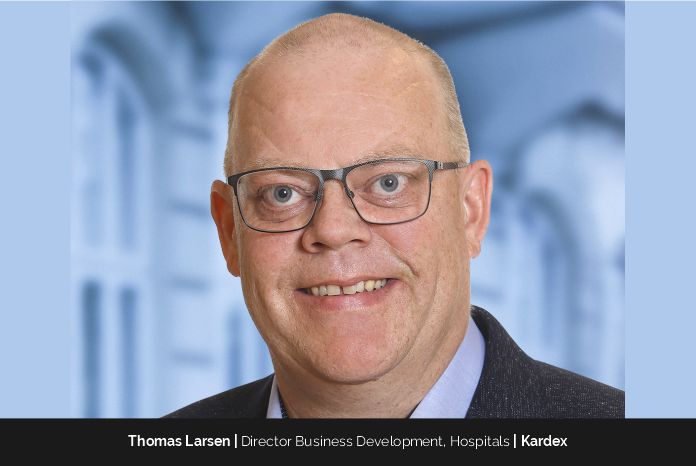
Once a young engineering graduate designing hospitals, Thomas Larsen, 55, is now the Director of Business Development, Hospitals, at Kardex, a global partner for intralogistics solutions.
Patient care is his utmost priority. He believes healthcare professionals should spend their time caring for patients, not searching for equipment, medicines, or supplies. Through his leadership at Kardex, he shows that more efficient logistics can transform hospital operations and give clinicians more time to be there for patients. He also recognises that this need is becoming increasingly urgent, with Europe expected to face a shortage of approximately four million key healthcare personnel by 2030, making supportive automated logistics solutions an essential part of the future healthcare ecosystem.
The best healthcare solutions, in his view, emerge when engineers, clinicians, pharmacists, logistics specialists, and technology experts work together.
In this exclusive interview, Thomas explains why logistics should be viewed as a strategic part of patient care, which ultimately improves, streamlines clinical workflows and makes better use of valuable hospital space.
Every Job Was a Piece of the Puzzle
Soon after graduating as an engineer in 1997, Thomas, who also holds an MBA from Aarhus University, took his first job designing hospitals. It did not take him long to realise that outstanding healthcare depends on far more than clinical excellence or state-of-the-art buildings. It depends on how efficiently a hospital functions behind the scenes.
Over a career spanning hospital planning, public procurement, medical technology, healthcare IT and healthcare logistics, Thomas noted the same challenge across different healthcare systems. “Clinicians were spending far too much time searching for equipment, medicines and supplies,” he says. When he saw the impact that had on efficiency and patient care, he knew he had to do something. He became passionate about healthcare innovation.
Every step he took added another piece to the puzzle. Designing hospitals taught him how healthcare facilities are planned, and from procurement, he learned how investment decisions are made. When he worked with medical technology and healthcare IT, he understood the importance of integrating clinical workflows with digital solutions. And his years in healthcare logistics demonstrated that logistics is a strategic function that directly influences patient care.
At Kardex, Thomas found a place where he could bring all his experiences together. Today, he works globally with healthcare providers to identify opportunities where intelligent logistics and automation can create measurable value.
Brief Introduction to Kardex
In healthcare, logistics, long seen as a support function, has become a strategic enabler of safer hospitals, greater operational efficiency, better use of space, and improved patient care. With more than 300 healthcare and pharmacy customers across the globe, Kardex has established itself as a trusted partner for hospitals, pharmacies, and organisations focused on life sciences. It offers a wide range of solutions, including stand-alone departmental solutions for pharmacies, pathology laboratories, refrigerated blood-bag handling, and sterile supply departments. It also provides highly integrated logistics ecosystems supporting entire hospital supply chains and large pharmaceutical distribution centres.
Among Kardex’s solutions is Kardex Megamat, or Vertical Carousel Module (VCM). It is designed for labs handling high volumes of sensitive materials. Thomas says that it brings efficiency and organisation to pathology slide and tissue block storage, in addition to supporting a wide range of lab inventories. With Kardex Megamat, labs can stay audit-ready and patient-safe.
Whether supporting the design of a new hospital or the transformation of an existing healthcare facility, Kardex helps customers unlock additional capacity, improve operational performance, and create more resilient supply chains through intelligent logistics solutions.
“At Kardex, we believe the future of healthcare is not defined by individual technologies but by connected logistics solutions that support the entire patient journey,” Thomas says. “Our ambition is to help healthcare professionals spend less time managing logistics and more time caring for patients.”
Driving Healthcare Business Development Globally
Kardex’s highly skilled teams work across many countries. Each individual in the team brings valuable local market knowledge and customer relationships. In his role, Thomas supports those teams by sharing his experience and industry-specific know-how from similar healthcare projects around the world. He also engages directly with hospitals on strategic opportunities.
Business development is another key responsibility. He identifies successful solutions developed in one country and makes them visible and available to healthcare providers in other markets. “Many hospitals face similar challenges, and there is tremendous value in sharing proven concepts and best practices globally,” Thomas says.
He also ensures that the full breadth of the Kardex portfolio is considered wherever it creates value, an approach the company refers to as “One Kardex”. Rather than focusing on individual technologies, he and his team help hospitals identify the combination of solutions that best supports their operational goals. Whether the need is pharmacy automation, pathology storage, sterile supplies, bed logistics, warehouse automation, or software, Thomas’s objective is always to recommend the solution that delivers the greatest benefit to the customer.
“Ultimately, my priorities are to identify strategic opportunities, build trusted relationships and demonstrate how Kardex can create sustainable value,” he says.
Changing the Mindset on Logistics
Most healthcare organisations still see logistics as a support function, and for Thomas, changing that mindset has proven to be one of his greatest challenges. Helping healthcare organisations rethink traditional logistics processes, and recognise logistics as a strategic part of patient care, is no small task.
He notes that the COVID-19 pandemic fundamentally changed how hospitals think about resilience. Healthcare systems around the world experienced unprecedented pressure, and many hospitals realised they needed to increase inventory levels of critical supplies to ensure continuity of care during future disruptions. “This improved resilience,” Thomas says, “but it also created significant challenges in terms of storage capacity, workflow efficiency and space utilisation.”
Transformation requires trust. So, Thomas doesn’t start with technology. He starts with the clinical and operational outcomes hospitals want to achieve. According to him, once people understand how better logistics can improve patient safety, create more resilient supply chains, and free valuable time for caregivers, change becomes much easier to embrace.
“This is one of the reasons I am particularly proud of what we do at Kardex,” Thomas adds. The company’s solutions help hospitals increase storage capacity without proportionally increasing their footprint. They also ensure fast, reliable access to medicines, sterile supplies, pathology samples, beds and other critical equipment.
Meaningful Innovation Is Measured by Outcomes
For Thomas, innovation is not about introducing more technology. It is about using technology intelligently to improve patient safety, optimise resources, and free healthcare professionals to spend more time caring for patients. He also believes healthcare innovation should not be measured by how much automation is installed. “It should be measured by the outcomes we create,” he says. “That is how I define meaningful innovation.” Thomas often sums up his philosophy with a simple statement: “Innovation is creativity that works.”
At Kardex, they help hospitals optimise valuable space, improve inventory visibility, strengthen traceability, reduce unnecessary movement, provide faster access to critical equipment and supplies, and ultimately increase the time healthcare professionals can dedicate to patients.
Milestones Linked to Improvements in Logistics
Over the years, Thomas has seen first-hand how improvements in logistics can directly enhance patient safety, workflow efficiency, and the overall hospital experience. “One example that has stayed with me came from a hospital in Sweden,” he says. At this hospital, studies showed that nurses were spending almost 50% of their working time searching for equipment, medications, and medical supplies.
When the hospital implemented intelligent logistics solutions, that time was significantly reduced. This allowed healthcare professionals to spend substantially more time where they create the greatest value: with their patients. For Thomas, that perfectly illustrates why healthcare logistics matters.
Another example is hospital transportation. Most people have experienced waiting for an elevator in a hospital. And in some hospitals, porters have reported spending up to an hour every day waiting for elevators to become available. By introducing vertical shuttle solutions for beds, sterile supplies, consumables and other wheeled equipment, hospitals can move logistics away from passenger elevators. Thomas says that this not only improves operational efficiency but also frees up elevators for patients, visitors and clinical staff. Porters can use their time more productively.
These are exactly the types of projects that make Thomas proud to be part of Kardex. “Our solutions are not just about automation,” he says, “they solve real operational challenges, optimise valuable hospital space and, most importantly, give healthcare professionals more time to focus on patient care.”
Two Case Studies: Smart Logistics in Action
Kardex’s approach to healthcare and life sciences is best illustrated through two real-world implementations, where Thomas’ colleagues succeeded in understanding the customer’s needs and transforming those insights into supportive, practical solutions that delivered meaningful operational improvements. One is at Darmstadt, Germany-based Merck Healthcare KGaA, a leading provider of healthcare and life science solutions. To expand its warehouse and material flow processes, Merck partnered with Kardex to deliver an integrated intralogistics solution. The project included the implementation of a new high-bay warehouse, the deployment and customer-specific enhancement of Kardex Control Center (KCC), and the integration of interfaces with Merck’s systems.
The project was implemented in two phases. Between 2017 and 2019, Kardex deployed the high-bay warehouse and its associated software. A second phase, executed between 2023 and 2025, focused on a comprehensive software upgrade with customer-specific enhancements to automated and manual processes. These enhancements included inventory management, mobile applications to support manual warehouse operations, goods receipt and put-away functions, and processes that ensure the continuous 24/7 supply of production materials.
The project brought together a high-bay warehouse with 3,800 storage locations; a manual storage area with 2,800 storage locations; a conveyor system with 139 reporting points; Kardex Control Center (KCC), including material flow control (MFC), visualisation and warehouse management system (WMS); SAP integration; and customer-specific warehouse management and production processes.
As the main contractor, Kardex assumed overall responsibility for design, system integration, implementation and commissioning of the warehouse solution, including requirements analysis, hardware delivery, software development, testing and final handover.
The successful implementation enabled Merck to sustainably modernise and future-proof its warehouse and material flow processes. Thomas says that the solution combines automated and manual warehouse operations within a single system landscape. In addition, it ensured seamless integration with production. And the new high-bay warehouse, followed by the integration of manual storage areas, significantly increased overall warehouse capacity and improved the availability of materials for production. Integration with the existing SAP system ensured end-to-end process transparency, optimised material flow and increased operational efficiency across all warehouse areas.
A second example is Belgium’s University Hospitals Leuven (UZ Leuven), where Kardex helped transform the hospital’s logistics operations through integrated automation.
Before Kardex stepped in, the hospital’s supply processes were spread across multiple locations, causing unnecessary internal transport, inconsistent workflows, and limited capacity utilisation. The goal was to establish a centralised, future-proof logistics solution with a high degree of automation, improved ergonomics, reliable deliveries, and more efficient handling of medications and other hospital supplies.
Kardex delivered a complete automation solution comprising automated storage systems, buffer technology, software integration, and internal transport systems. The delivery included the design, installation, integration, testing, and commissioning of these main components: 4 Kardex Compact Buffer Extended (26 segments, 8 meters high); 4 Kardex Shuttle XP500 automated storage systems; conveyor and transport systems; turntables and automatic access stations; fire doors and gas-based fire suppression system; Power Pick Global (PPG) software; and integration with SAP, PeopleSoft, and existing hospital processes.
The solution encompassed more than 5,500 storage locations and supported inbound processes, order fulfilment, batch picking, internal transport, and inventory management within a single integrated system. The conveyor solution was delivered in collaboration with a specialised partner.
Kardex had overall responsibility for the university hospital’s project implementation, including solution design, equipment delivery, software configuration, integration, coordination with partners, testing, commissioning, and handover. Operating in a hospital and pharmacy environment required stringent standards for quality, traceability, documentation, and operational stability. The implemented solution ensures digital inventory tracking and end-to-end traceability through integration with the hospital’s existing systems.
Thomas points out that the project has created a centralised and highly automated logistics platform for UZ Leuven. As a result, the hospital has achieved improved warehouse utilisation, reduced internal transport, faster order processing, and more standardised workflows. At the same time, a robust foundation has been established for future growth and increased activity levels.
Life Outside of Work
When he is not working, Thomas likes to spend time with his wife and their two sons. He is incredibly proud of their sons, aged 22 and 25, who have grown into responsible, independent, and caring young men. “Seeing them pursue their own paths with confidence gives me great satisfaction,” he says.
Thomas also enjoys travelling, discovering new places, and spending time at their summer house, where he can slow down, recharge, and enjoy nature. “Maintaining a healthy balance between work and personal life helps me stay focused and brings fresh perspectives to my professional role,” he says.
Future and The Legacy
Thomas believes Kardex will continue to bring decades of industrial logistics expertise into healthcare. As hospitals become more digital and connected, he notes, logistics will become an increasingly strategic capability. He foresees Kardex’s role as helping healthcare organisations build resilient, efficient and future-ready supply chains.
“If my work helps hospitals become safer, more efficient, and gives healthcare professionals more time to care for patients,” Thomas says, “I will consider that a meaningful legacy.” He also hopes to help position healthcare logistics as a strategic discipline, deserving the same attention as clinical innovation.
Advice for Aspiring Leaders
Thomas advises young professionals to stay curious. He encourages them to spend time with clinicians and understand workflows before proposing solutions. “Technology,” he says, “should always serve people, not the other way around.”