

When Žydrūnė Vitaitė first started working at technology companies in Lithuania’s telco and security sectors, she noticed the absence of women leaders and peers. She was often the only woman in the room. With no women mentors to learn from and no women co-workers to offer support, she felt lonely. This motivated her to change things. If the support women needed did not exist, Žydrūnė decided, she would help build it.
Women Go Tech emerged from that decision, co-founded together with Paulius Vertelka, who was leading Lithuania’s IT association “Infobalt”. What began as a shared vision became an initiative shaped as an impact project to change how women see their place in tech and how the industry sees women.
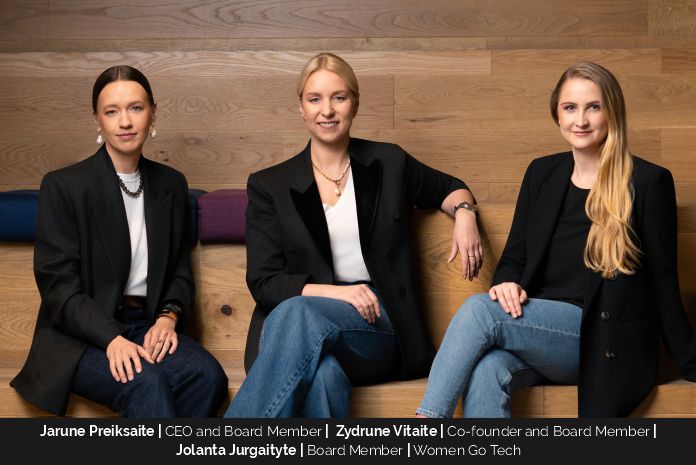
Žydrūnė began her journey in tech without many women around her, but today she shares leadership responsibilities with two experienced professionals: Jolanta Jurgaitytė and Jarūnė Preikšaitė, who serves as CEO. All three sit on the board as members. They have built Women Go Tech into a movement to empower women in tech. To date, more than 50,000 women have participated in their programs, and more than 1,000 have started careers in tech thanks to Women Go Tech.
Žydrūnė: Co-Founder and Board Member
Early in her career, when she was still a junior professional, Žydrūnė did not encounter women in technical positions at the companies where she worked prior to co-founding Women Go Tech. Without women around her in those roles, it was difficult to see clear examples to learn from or to envision her own path forward. “It raised really important questions,” she says, “Who do I learn from? Who do I look up to?” The male-dominated workplace left her feeling isolated. And she was not the only one in her family experiencing that.
Around the same time, Žydrūnė’s younger sister became the first female construction engineer at a leading company in Lithuania. “We both faced similar challenges,” Žydrūnė recalls. “We were breaking into male-dominated industries without access to mentorship or support networks, which made us feel pretty lonely.”
Fortunately, Žydrūnė’s male tech leaders were supportive. “They supported me early in my career and showed me what allyship looks like,” she says. That experience shaped her conviction: for lasting change in tech, men and women must co-create the path forward. She and Paulius started Women Go Tech as a volunteer-led movement. It stemmed from this simple truth: talent needs opportunity, and mentorship bridges that gap. Although they had no funding, they moved ahead with a shared belief in the power of mentorship and community.
Over the years, Žydrūnė’s role has evolved, especially as Women Go Tech grew. She focuses on where she can bring the most value, whether that is strategic partnerships, storytelling, or shaping long-term vision. She has also grown more comfortable stepping back from day-to-day operations and trusting the team. Žydrūnė credits the support of dedicated people like Jolanta and Jarūnė for turning their vision into a real, scalable initiative for systemic change in tech.
Women Go Tech celebrates 10 years of impact this year. “What began as a local initiative has grown into a regional movement that’s actively shaping how upskilling and requalification are approached in Europe,” Žydrūnė says.
“What’s most exciting now is the shift. We’re in a stage where we can dream bigger and shape the strategy for the next 5 years,” she adds. “That’s a rare and rewarding position to be in.”
Jarūnė: CEO and Board Member
Žydrūnė invited Jarūnė to work on communications, primarily to help attract mentors and mentees. “At the time, it felt more like a passion project than a formal role,” Jarūnė says. “None of us fully realized what kind of ‘beast’ we were building.”
As the initiative grew, so did its complexity. For Jarūnė, balancing a full-time marketing career with Women Go Tech on the side became unsustainable. “Stepping into the CEO role was a natural shift,” she says, “driven both by necessity and by a growing sense of purpose.” The more she saw the real-world impact they were creating, the more she felt responsible for strengthening it. She knew she could bring the clarity, structure, and strategic focus the organization needed to scale. “That’s how a side project became a long-term commitment,” she says.
Jarūnė didn’t grow up dreaming about the corner office. But her home and school environments encouraged her to be curious, take initiative, and try different things, which shaped her early mindset. That instilled a strong sense of responsibility and a natural tendency to step in when something needed to be organized, improved, or built from scratch.
This is not the first time Jarūnė has held the CEO position. The difference is that she is now leading a mission-driven organization, which poses its own unique challenges. In the impact space, she says, a leader is constantly balancing ambition with limited resources, partner expectations, and long-term systemic goals. “It requires a different level of discipline and prioritization,” she adds.
One thing that has remained constant throughout her career is the motivation to work where real-world impact meets operational complexity. “Women Go Tech sits exactly at that intersection,” Jarūnė says. “It’s not only about vision, but about building systems that deliver measurable change.” That combination is what naturally led her to this role, along with her own experience with great mentors.
Jarūnė was fortunate to work in environments that encouraged growth, but she was not immune to being labeled “too young” or “inexperienced.” Establishing presence as the youngest person in the senior leadership room was a significant hurdle. “Early in my career, having a mentor helped me navigate those power dynamics,” Jarūnė says. “That experience is exactly why I’m so committed to Women Go Tech.
“I want to shorten the distance between ‘talent’ and ‘influence’ for all women,” she adds.
Jolanta: Board Member
If one were to ask Jolanta’s parents about her, they would probably say, with a gleam of pride in their eyes, that their daughter was an “ambitious overachiever” from day one.
“Whether it was middle-child syndrome — that innate drive to prove one’s worth — or a natural curiosity,” Jolanta says. “I’ve always been drawn to high-stakes environments.” The real foundation, however, was laid during her study years with AIESEC, a global youth organization. It was there that she transitioned from having raw ambition to understanding the mechanics of business and the power of a purpose-driven network.
“Surrounding myself with people who didn’t just want to work, but wanted to build organizations and create a positive impact on society, redefined my view of what a leader should be,” she says.
Žydrūnė was part of that amazing circle of people Jolanta met in AIESEC. When Žydrūnė approached her to help run the first admissions and mentoring matching process, Jolanta agreed without any hesitation. As a Head of HR in a tech company, she says, she had a front-row seat to the diversity struggles within technical teams. She knew Žydrūnė’s idea wasn’t just a nice-to-have initiative; it was a systemic necessity. “I believed in her vision and knew she would curate a team that made the journey not only impactful, rewarding, but also fun,” Jolanta says.
Navigating the macroeconomic shifts of the past decade has required organisational agility from Women Go Tech, but she points out that the most meaningful impact continues to come from the organisation’s mentoring program. She has helped evolve this from a small local pilot into a scalable, regional engine for change. “While strategic pivots are necessary and we’ve made a few in recent years, the mentoring program is our most tangible systemic change enabler,” Jolanta says.
Dealing with Challenges
Žydrūnė points out that each stage of growth came with new challenges, whether it was securing funding, building a brand, or expanding into new markets. But the most ongoing and difficult one, she says, has been attracting and retaining the right talent at the right time. “It’s a constant challenge to find people who not only share the mission but are also ready to work at the pace and scale required to make a real impact,” she adds.
According to her, working in the impact space is deeply rewarding as well as emotionally demanding. Maintaining healthy boundaries while pushing for change is something she is still learning. “As a founder, it often feels like walking a thin line between passion and burnout,” Žydrūnė says.
Additionally, she has encountered many situations where gender-focused initiatives were challenged- often by men. But instead of seeing it as opposition, she sees it as an opportunity for dialogue. She believes that real change doesn’t come from polarization or staying in one’s own bubbles, instead it comes from engaging, especially in conversations that are uncomfortable.
She does not believe in “us vs. them” thinking. She says that to shift mindsets, one needs to listen, understand where others are coming from, and find shared ground. “That’s where creativity comes in, adapting your message, choosing the right moment, and speaking to the values people already hold,” according to Žydrūnė.
Jarūnė remembers the challenge they faced during COVID-19, which shook their foundation. At the time, Women Go Tech was still operating locally, rooted in Lithuania, with physical events and a community that thrived on in-person connection. Meanwhile, the tech sector was facing a sudden surge in demand for ICT specialists, and talent gaps needed to be filled fast. “But the crisis had another layer: women were disproportionately affected by job losses, especially those in service-based roles,” Jarūnė says. In addition to accelerating digital transformation, the pandemic also exposed the fragility of women’s employment in non-digital sectors.
Jarūnė and her team responded on two levels. First, they moved their entire model online, ensuring uninterrupted support and continuity. Second, they launched a new program designed to help women to see the career options in the digital sector fast.
“What began as a crisis response evolved into a strategic turning point,” Jarūnė says. “If we could build and deliver impact remotely – why limit ourselves to one geography?”
That moment challenged her as a leader to balance immediate response with long-term thinking. Along with digitizing their operations, they expanded their mission. “It marked the beginning of our regional trajectory,” she says, “grounded in the belief that access to tech careers should not depend on location, gender, or economic status.”
Jolanta says that in a purpose-led organization, it is easy to get distracted by vanity impact: projects that look good on paper but don’t scale. She evaluates opportunities by asking: Does this move the needle on systemic change (Mission)? Is it operationally sustainable (Margin)? And does it energize our community (Momentum)?
The Legacy: Structural Shift
Jarūnė is not seeking to build something permanent. She wants their legacy to be about contributing to a structural shift in how the tech ecosystem functions. This will create conditions where diverse talent pathways are not the exception but the norm, and where mentorship, requalification, and inclusive leadership development are built into the system.
“What I truly hope,” Jarūnė says, “is one day, an organization like Women Go Tech won’t need to exist at all.”
Next-Gen Women Leaders in Tech
Žydrūnė believes women leaders are still an untapped force in Europe’s tech ecosystem. “And that needs to change, fast,” she says.
Europe needs speed, bold decisions, and long-term vision to stay globally competitive, she notes, adding, women bring exactly that, along with adaptability, empathy, and a broader societal lens that modern innovation demands. “The more diverse talent we bring into tech, the stronger and more future-proof our ecosystem becomes,” she says. Žydrūnė expects the next generation of women to lead the shift toward a more inclusive, agile, and resilient tech future in Europe.
To thrive in this future, Jolanta says, the most important skill set women leaders will need is Adaptive Intelligence (AQ): specifically, the ability to unlearn at the speed of the market. She makes this point based on the strategic shifts discussed at Davos 2026. She also notes that it is now the start of the “Leader as a Multi-Modal Translator” era. “As the reasoning economy matures, the workforce doesn’t just need people who can use AI,” she says, “it needs leaders who can bridge the gap between autonomous technical capabilities, human ethics, and long-term business value.”
Jolanta highlights that there is a distinct competitive advantage here for women leaders. She explains that the Davos trends highlight a growing governance gap in tech, and women have historically excelled in contextual and systemic thinking. They possess the ability to see how a single decision ripples across an entire ecosystem. “In the coming years, the most successful women won’t just be managing tools,” she points out, “they will be the principled decision-makers who ensure that as we scale efficiency, we don’t lose the human common sense and ethical oversight that define a sustainable business.”
“The goal is to move from being a user to being the person who defines the intent behind the technology,” Jolanta adds.
Jarūnė says that while more women are entering tech, the structural impact is still limited. That is largely because the overall demand for ICT specialists is growing faster than supply, and demographic trends like aging workforces mean they are losing talent as fast as they are training it. “In this context, women remain one of the most underutilized talent pools in Europe,” she says.
The diversity challenge is also moving up the ladder, and entry-level gains are not translating into mid-level or leadership representation. Jarūnė expects the next decade to require stronger career progression systems, more intentional mentorship at senior levels, and leadership pipelines designed to retain and promote diverse talent, not just attract it.
Message for Aspiring Women Leaders
Often, aspiring women leaders hesitate to take the plunge, doubting their readiness or capability, or waiting for an opportune time. Žydrūnė, Jarūnė, and Jolanta’s message to them is: don’t wait.
“Don’t wait until you feel completely ready, as that moment rarely comes,” Jarūnė says. “Many women tend to over-prepare and underestimate their capabilities.” She points out that leadership is about being able to learn fast, not about knowing everything.
Žydrūnė agrees. “You’ll learn by doing,” she says. She admits that it can be challenging, but also says that it is one of the most rewarding things one can do. She encourages young women professionals to build something that creates real impact at scale. “More women should trust their abilities and stop waiting until they feel ‘ready’,” she says.
Jolanta tells them not to wait for a mandate or a title. “If you wait for permission to lead, you’ve already missed the opportunity,” she says. “Influence is a series of consistent actions, not a designation on business cards or your LinkedIn profile.”
The best place to begin, she adds, is wherever the pain point is most obvious. It is usually where a woman professional’s unique perspective will be most valuable. She also advises them not to be paralyzed by the scale of the problem. “Start small, build a proof of concept, and iterate. “Once you show even a small result, you will naturally find your allies,” she says. “Eventually, the momentum you create will outpace your uncertainty.”
Jolanta underscores that many aspiring women leaders are far more capable than they give themselves credit for. “So, begin. Test. Adapt. Keep going,” she says.