
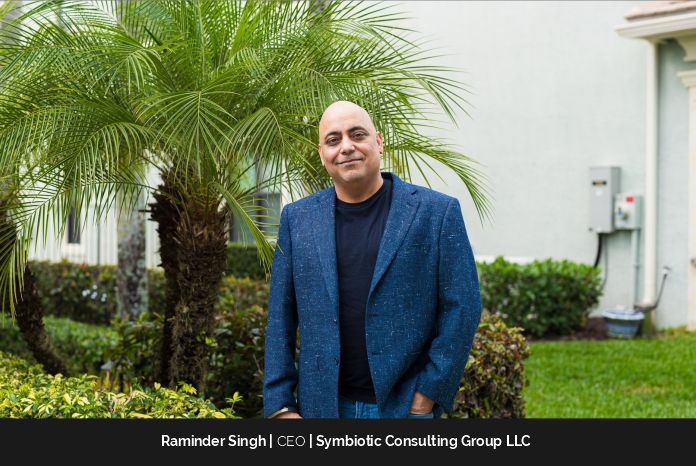
Raminder Singh, CEO of Symbiotic Consulting Group LLC, walks into a room with a calm demeanor and a clear sense of purpose. For him, his clients’ pain points are his own, and delivering outstanding results to them is what he strives for every time. He is known for achieving “symbiotic triumphs” through empathetic emotional intelligence.
Raminder’s values-driven, people-centric approach has built long-term, win-win partnerships with both clients and employees. To achieve mutual success, he is always goes the extra mile.
Leadership Ethos Shaped by Parent’s Values
Raminder’s leadership philosophy was not shaped overnight. Its genesis can be traced back to his childhood years in India. The youngest of four siblings, he had a humble upbringing. His father, a proud Sikh man who quit college due to family responsibilities, made his living driving an auto-rickshaw (a small, self-owned enterprise). Despite many limitations, he provided for Raminder and his siblings with quiet determination. His mother, a dedicated homemaker, managed the home with incredible resourcefulness and love.
Raminder remembers that they couldn’t afford lavish birthday parties, fancy cakes, expensive clothes, or toys. “What my parents gave us was far more valuable,” he says. “An unwavering commitment to our education and growth.”
Raminder’s father would often tell them, “I may not be able to buy you expensive clothes or gifts, but I will always provide you with books for study or anything you need for your studies in your life.” And he kept that promise without fail, no matter how hard things got. If they needed textbooks, reference materials, or even extra tutoring resources, Raminder recalls, his father made it happen. That commitment taught him the true meaning of priorities, sacrifice, and investing in people’s potential over material things.
“Sadly, my father passed away in August 2025 at the age of 85, but his words and example continue to echo in everything I do,” Raminder says. “They shaped my deep belief in emotional intelligence, empathy, and genuine care for others, whether it’s team members, clients, or partners.”
In business, he has carried that forward by always striving to understand people’s real-life contexts; for example, the pressures employees face balancing work and family, the challenges clients encounter in their industries, or the personal stakes behind every project. “It’s why at Symbiotic, we don’t just deliver IT solutions or consulting,” Raminder says, “we build relationships rooted in trust, listening, and going the extra mile, much like how my parents prioritized our futures over fleeting comforts.”
From those early lessons, he also learned that leadership is about resourcefulness, consistency, and empowering others to thrive, not just about having all the resources or being the flashiest presence in the room.
“I now live by principles like hiring people with character and values who are smarter than I am and delegating with trust, always delivering and often exceeding expectations, and focusing on long-term, win-win partnerships,” Raminder says.
Most Defining Challenge
In 1994, Raminder completed his engineering degree in Mechanical Engineering, with additional specialization in Industrial Engineering and IT training from the National Institute of Information Technology. Soon after, he joined Timex Watches Ltd. (now Timex Group India) as a Production Supervisor in the manufacturing plant. It is here that he faced the most defining challenge of his career.
Raminder recalls that at the time, the production team relied on timely MIS reports, covering material inventory, daily outputs, and overtime forecasting, to make critical weekend and shift decisions. However, the MIS department was undergoing internal transitions and lacked the bandwidth to deliver these essential dashboards consistently.
“My director, aware of my IT background from the interview process, asked if I could step in during weekends and late evenings to help build those reports,” Raminder recalls. He agreed to do that. He leveraged his knowledge of FoxPro RDBMS, and over just three intense weekends, plus after-hours work, he delivered interactive dashboards with drill-down capabilities, quarterly roll-ups, and even laid the groundwork for future forecasting models. According to Raminder, the impact was immediate: the production leadership gained real visibility and control.
At the time, the company was also prioritizing a major migration from FoxPro to Oracle for better scalability and enterprise-grade capabilities. Impressed by Raminder’s capabilities, senior management transferred him from Production to the MIS team as a key developer on this high-visibility project. However, just a few months in, the project hit a crisis. Most of the senior developers and architects resigned abruptly for better opportunities elsewhere.
With only 1.5 years of total professional experience and less than one year in core IT, Raminder found himself suddenly thrust into an expanded role. In addition to delivering his own module on time, he had to hire MCA interns and college trainees to rebuild the team. He also had to train them, assign deliverables, manage their performance, and ensure the overall program stayed on track. Raminder says that the pressure was immense: super-long nights, endless weekends, covering every department’s functionality during the FoxPro-to-Oracle transition, all while learning the full SDLC spectrum on the fly.
However, this period proved to be truly defining for him. He had no choice but to quickly develop people-leadership skills under fire and build resilience through sustained high-stakes execution. He also mastered end-to-end IT delivery and transitioned from a junior contributor role to a team leadership position that directly influenced a company-wide system upgrade.
“Despite the steep learning curve and exhaustion,” Raminder says, “I embraced it as a rare first-job opportunity to gain broad exposure that most engineers take years to achieve.” The successful delivery of the Oracle migration, not just his module but with a stabilized, trained team contributing, became a foundational stepping stone.
Balancing: Operational Demands with Strategic Vision
Raminder notes that in the IT consulting world, there is constant struggle between putting out today’s fires for clients and charting out where the industry and their firm will be in 3 to 5 years.
He balances day‑to‑day operational demands with the strategic vision in an authentic way. First, he protects non-negotiable time blocks for strategic thinking, usually late nights or a few dedicated “no-meeting” hours each week. “In our fast-moving space, especially with AI integration for virtually every program at Symbiotic,” he says, “if I’m only reacting to daily delivery escalations or resource allocation, I miss spotting the next wave, like how we’re now proactively building GenAI advisory capabilities before most mid-market clients even know they need it.” During his non-negotiable quiet hours, he reads analyst reports, discusses with emerging tech partners, and refines their three-year roadmap.
Second, Raminder leans heavily on empowerment and structure, so operations don’t constantly pull him in. He says that they have strong delivery leaders and account managers who own client success day-to-day. “I stay in the loop through concise weekly dashboards rather than attending every status call,” he adds. “This frees me to focus on the bigger levers: talent strategy, service portfolio evolution, and go-to-market positioning.” When he does step in operationally, it is usually because of a teachable moment or a high-stakes client situation.
“Third, I tie every operational decision back to the vision,” Raminder says. “This is probably the most personal part.”
Symbiotic’s mission is to “empower clients through technology and business processes.” So, Raminder asks himself constantly: Does solving this immediate delivery issue move them closer to being the go-to partner for transformative IT and AI integration work? He says that if a client needs urgent support on legacy modernization, they deliver flawlessly. They also use it as an entry point to discuss their three-year digital roadmap. “That turns firefighting into strategic relationship-building,” Raminder says.
Finally, he reminds himself and the team that sustained competitiveness comes from rhythm, not heroics. “We run quarterly off-sites when I visit our New Delhi offshore office with all, where the leadership team steps back from ops to pressure-test the vision against market shifts,” he says.
Raminder says that it can be exhausting to juggle operational demands and strategic vision. However, he is able to manage it because his vision is clear and he trusts his team to handle operations.
About Symbiotic Consulting Group
Founded in Florida, U.S., in 2012, Symbiotic, an information technology consulting firm, has grown into a truly global operation with offices in India and Romania. Raminder says that they always strive to make a positive contribution to those they serve and believe in building long-term, win-win relationships for mutual success.
Unlike generic providers, the company has a symbiotic partnership model that extends to clients, technology vendors, employees, and nearshore allies. Raminder explains that this allows for a blend of local expertise and offshore efficiency to deliver tailored outcomes. The company’s key offerings include:
- IT Strategy: Delivering enterprise-level tech services tailored for small and medium-sized businesses, ensuring scalable and accessible innovation.
- Software Development: Building web-based, client-server, enterprise, and mobile applications with full AI enablement and usage, designed to optimize operations.
- Project Management: Overseeing web and client-server projects with a focus on execution and results.
- Strategic Staffing: Supplying qualified talent and workforce solutions to meet evolving needs efficiently.
Cultivating Company Culture
“In a business where success depends on sharp expertise, flawless delivery, and genuine teamwork across time zones and cultures,” Raminder says, “our culture isn’t just a nice-to-have, it’s our biggest competitive edge.”
To build their culture, the practical, high-leverage approaches they prioritize are:
- Living a Handful of Core Values
At Symbiotic, the four non-negotiable values are excellence in every deliverable; ownership without excuses; one Symbiotic team, comprising global and local; and candor with respect and trust. “I personally ran cross-location workshops to refine these along with my leadership team,” Raminder says. “Now they’re everywhere: in our onboarding stories, weekly project stand-ups, performance conversations, and even our ‘Symbiotic Spotlight’ shout-outs.”
- Leading from the Front
Raminder believes that nothing builds trust faster than seeing leaders walk the talk. So, they jump into cross-branch project reviews and give direct, constructive feedback live and share their own mistakes. Raminder says that they visit their New Delhi and Baia Mare teams at least once or twice a year for “go-and-see” sessions. “These sessions create bonds that emails and Zoom/Teams calls never can,” Raminder says. “Our people see that accountability starts at the top.”
- Building Crystal-Clear Systems
At Symbiotic, common goals are defined for individuals and teams, and standards are set for deliverables, client communication, and internal handoffs, according to Raminder. Additionally, clear areas of responsibility (AOR) are assigned so there is no confusion about tasks.
Raminder says that they run lightweight 360 feedback twice a year plus regular 1:1s, using a simple framework including skip-level meetings to determine what went well, what to improve, and how they can support. And promotions and recognition are transparently linked to results. “It satisfies the merit-driven mindset common in the U.S., reduces hierarchy-related uncertainty in India, and aligns with the structured professionalism we see in Romania,” Raminder says.
- Hiring, Onboarding, and Growing for Global Mindset
During the interview process, candidates are screened for technical skills, curiosity, humility, and emotional intelligence. Raminder says that new joiners get proper training and coaching from HR and their designated mentors. They also invest in internal development.
“Every six months, I and our leadership team review what is landing and what needs a refresh,” Raminder says. “Culture is never done,”
According to him, the payoff at Symbiotic from this culture-building is higher client impact and margins, fewer escalations, faster innovation from shared knowledge, and people who stay because they feel part of something meaningful.
A Recreational Tournament Poker Player
Raminder has always been passionate about sports and strategy. When he was in India and Barbados, he balanced his studies and career roles with recreational cricket. However, he initially could not do that in the U.S. due to a demanding work schedule.
After a decade of big-5 management consulting experience and growing into a consulting leader (Ernst & Young) from 1996, in 2006, his boss (Jack Sumner) at his first Florida-based corporate job at ADT introduced him to tournament poker. “What started as a casual suggestion quickly became a rewarding passion,” Raminder says. “I immediately saw parallels between poker, business, and life: managing variance, navigating ups and downs, calculating risk vs. reward, identifying the critical path, and mounting comebacks when the chips are down.”
He now participates in tournament poker over weekends and during free evenings as a hobby along with his clients and close friends. Over the years, he has had success in major events, earning a #3 world ranking among all tournament players across the world on number of major tournaments won.
“When I won at poker and brought home a new trophy,” Raminder says, “it often inspired our children, Sonya and Shawn, to push themselves in their own pursuits.” He shares that his wife, Delia, has “fostered a spirit of healthy competition” in their family. It is grounded in the pursuit of excellence and the practice of core values.
Advice for Emerging Leaders
Raminder advises emerging leaders in consulting to align their work with meaningful impact. He encourages them to clarify their purpose early by reflecting on what drives them and articulating a mission statement that guides career choices. “This ensures your consulting gigs or ventures aren’t just profitable but contribute to broader goals, helping you attract like-minded clients, partners, and talent,” he says.
Additionally, he advises emerging leaders to master core competencies, build and leverage networks, embrace lifelong learning and adaptability, and seek work-life integration. And Raminder reminds them that “true leadership inspires others to pursue meaningful work too.”