
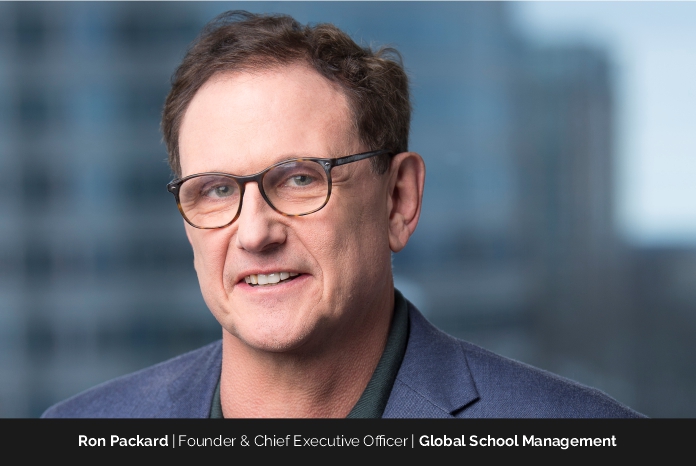
Ron Packard drew the blueprint for online learning before the world knew it needed one. Now, with GSM operating online & brick-and-mortar schools across three continents and AI threatening to rewrite the classroom itself, he is doing it again, only this time at warp speed.
Ron Packard remembers the math problem.
His daughter was three, maybe four. He sat beside her at the kitchen table, working through the first small abstractions a child ever confronts, ones, tens, and the curious trick of carrying. For most parents, such a moment registers as a passing domestic tenderness. For Packard, it registered as an argument against the status quo.
“It became clear to me at that time,” he says, “not only how important education was, but that technology would be able to deliver education in a way we never could have imagined even 10 or 20 years before.”
From that kitchen table, Packard walked into a career that has, by any reasonable measure, reshaped the architecture of modern schooling. He founded K12 Inc., the online learning platform that spread across 40 American states and, in his own telling, “was almost like a beacon on a hill” for every country watching to see whether full-time online school could actually work. He previously founded Knowledge Learning Corporation, an early-childhood learning company. And he most recently founded GSM, Global School Management, which now operates online and brick-and-mortar schools across the USA, Africa, the Middle East, and Europe, with a stated ambition to reach six of the seven continents within the decade.
Offer Packard an accolade and he will politely refuse it. He speaks, almost reflexively, in systems.
A SYSTEM, THAT PUTS STUDENTS FIRST
Chief executives in every industry like to say they “put the customer first.” Packard says “students first” so often it begins to sound less like a slogan and more like a filter. He applies it with a rare ruthlessness.
“We don’t look at how much money we’re going to make,” he says. “We look at, can we do a better job than the current options? And if so, let’s construct a model that’ll do that, and hopefully it economically makes sense.”
This is an unusual order of operations in modern education; a sector crowded with well-meaning programs that consistently fail at the thing that matters most: actually, educating children at scale. Packard is allergic to excuses. “If you looked at what we do for instruction in Uganda,” he says, “it wouldn’t be that different than what we do in the United States.” A good education, in his telling, is not a function of zip code, currency, or cultural context. It is a matter of disciplined execution.
That conviction is why GSM, underneath the branding, operates like an operating system. A regional management layer. A shared instructional framework. A data regime that takes standardized testing seriously rather than rolling its eyes at it. “We look at it as a good measurement,” Packard says, flatly, before most school districts would finish clearing their throats. Continuous assessment. Field leaders who visit schools constantly. A U.K.-born teaching framework, now being imported into American schools because, as Packard observes without sentimentality, “we’ve done an amazing job in the U.K. with that, and now we’re taking it to the U.S. and elevating our game even more.”
The result is something rare in education: a portable model. “There are lots of one-offs and great schools,” Packard says. “But being able to do it across hundreds of schools or thousands of schools is what we’re trying to achieve here.”
THE AI QUESTION
For all of Packard’s systems orientation, the conversation inside CIO-level rooms today is not really about systems. It is about artificial intelligence. Packard arrived at that conversation early, and with uncommonly clear eyes.
“The internet 25 or 30 years ago was a huge innovation,” he says. “AI is going to have an even bigger impact.”
Ask him what that impact looks like, and he resists the glossy answer. GSM is already using AI to generate more, and better, curriculum. He believes the discipline of education itself will be rewritten as large models gain the ability to reason. But he refuses to treat that future as uncomplicated. His next sentence is one every chief information officer working on AI policy should read twice.
“AI is soulless. It doesn’t have a moral compass. If it goes out there and searches large language models and decides the Earth is in jeopardy, and the best way is to kill all human beings, it wouldn’t know there’s anything wrong with that.”
This is not a man hedging on AI. Packard is a technologist who has spent his career betting on scalable technology in classrooms. It is, rather, a CEO who understands what many of his peers do not: that the children his schools are educating in today will live in a world where the loudest voices in the room may not be human. The most durable competitive advantage a school can cultivate in the 2030s, he argues, will not be math skill. It will be judgment.
“We have to raise kids with reasoning, communication, but also values,” he says. “Humanity.”
It is a CIO-era idea that sounds, deliberately, like a PTA meeting. That is precisely the point.
THE LEBRON THEORY OF SCHOOL CHOICE
Packard’s theory of educational quality has a sports metaphor, and it is a good one.
“If LeBron James played basketball against me every day, he would not be nearly as good,” Packard says. “He couldn’t practice at all.”
LeBron gets better, in Packard’s reading, because Kobe Bryant was in the league. Competition raises the ceiling. “There’s not a single example in the history of mankind,” he says, “where competition has been anything other than giving the customer a better product or better price. Education is no different.”
This is the intellectual scaffolding beneath his advocacy for school choice, and beneath his willingness to spend political capital opening new markets in charter and online schooling. He knows the forces arrayed against him, the institutional interests that, as he puts it, “work not for educational outcomes, but for protection of the status quo”, and he has spent a career demonstrating, with data, that parents and students will choose alternatives when genuinely better alternatives exist.
THE PANDEMIC PROOF POINT
When Packard is asked to defend the private sector’s role in delivering public goods, he does not cite ideology. He cites the pandemic.
“Government did what it did best, purchase a social good,” he says. “Pfizer, Moderna, they delivered.”
Operation Warp Speed, in his reading, was a procurement miracle. But the vaccines themselves were delivered by commercial enterprises operating with capital, talent, and speed that no public lab could match. The lesson Packard draws is not that government fails. It is that the interface between public mission and private execution, when calibrated properly, is one of the great productivity engines of the modern era. Education, in his telling, is ready for the same treatment.
THE QUIET LEADER
For a man who has built three companies and operates across continents, Packard is conspicuously unsentimental about his own persona. He talks about hiring good people the way some CEOs talk about moonshots. He talks about his now-adult children the way some CEOs talk about acquisitions, “my best friends.” He collects mentors without ego. From the financier Michael Milken, an early K12 investor, he learned that “no vision is too big.” From the former U.S. Secretary of Education Dr. William J. Bennett, he absorbed a curriculum philosophy rooted in virtue and character.
“Everyone has something they can teach you,” Packard says. “You just have to be listening.”
That last line, he notes with a half-grin, he may have just invented.
It is, on reflection, the most Ron Packard sentence imaginable. Unscripted. Useful. Portable. The kind of thing you could print on a wall in a school in Kampala, Riyadh, or Cleveland, and have it mean exactly the same thing. Which is, of course, the whole idea.
THE NEXT DECADE
Packard has a number in mind for GSM’s next decade: six continents, millions of students. He has the system to pursue it. He has the team, many of whom have followed him from company to company, which is its own quiet endorsement. And he has, increasingly, an AI layer that he believes will let those teams do what no generation of educators has ever been able to do: deliver a consistent, rigorous, character-formed education to any child, anywhere, at scale.
“There’s no reason,” he says, “why we can’t elevate education to a whole other level.”
Coming from most executives, that sentence would register as ambition. Coming from Ron Packard, who has already done it once when the conventional wisdom said it could not be done, it registers as a forecast.