

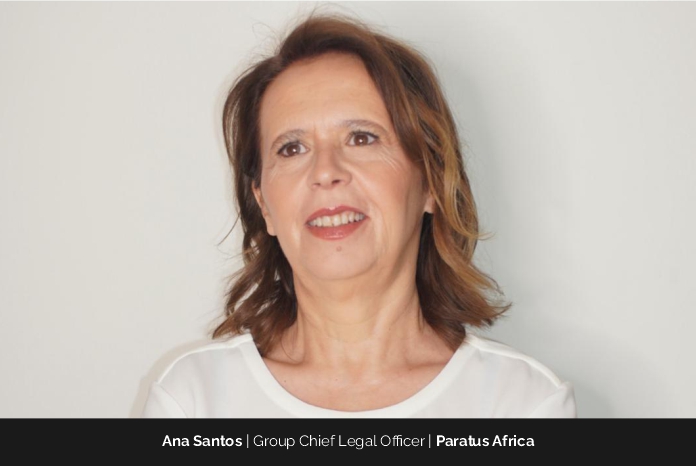
Success means different things at different stages of life. For Ana Santos, Group Chief Legal Officer at Paratus Africa, it has been a journey from chasing titles to finding daily happiness in the growth of others. With a master’s in law from the Catholic University of Lisbon, a postgraduate diploma in securities law, and an LLM in digital economy from the Global School of Law, she has built a career as in-house legal counsel for international banking and telecommunications companies, directly advising CEOs and senior executives.
Since joining Paratus in 2016, Ana has led the legal restructuring of the Group, including the consolidation of subsidiary shares and the entry of a major investor in 2019. She has also facilitated Paratus’ expansion into eight new countries and managed transactions with Big Tech giants, including Google, Starlink, Oneweb, and Meta, enabling new services like the Equiano Cable and LEO technologies. Her multilingual fluency and strategic legal oversight continue to support Paratus’ mission of being Africa’s quality network.
From her childhood call to justice in Portugal to the evolving landscape of law, the challenges of balancing career and family, and her philosophy of leading by serving for over 30 years in the legal industry, Ana redefines what it means to be a self-aware, refreshingly honest leader in law today.
The Evolution of a Legal Career
For Ana, success is a feeling of happiness and achievement daily. And that involves not only her but also the people she works with. “If the people I work with are coming in willing to work, willing to do things, in a good disposition, and we have an office environment where we are willing to take on new challenges, I feel I’ve succeeded,” she explains.
When Ana was younger, she was very ambitious in terms of having a title and a higher position in the company. In her 30s and even into her 40s, she thought happiness meant becoming head of the department or director. “I really wanted to achieve that level, and thought I wouldn’t be happy to report to somebody and never reach that level myself. Throughout a person’s career, they work with older people and heads, and at some point, we feel, “I can also do this,” and if we don’t manage to get there, it’s a bit frustrating,” she reflects.
But now, having achieved that stage, she’s looking to go beyond and is not too worried if she no longer has a directorship role or head of department, because she loves to see people grow. “I love to see a good environment in the office. I really like to see people fight—that eagerness to do things and to go for it and to ultimately achieve things. That’s where I am now, and I’m almost ready to pass everything on,” she says.
Discovering the Law: A Childhood Calling
Ana recalls that very early on, when she was still in primary school, she used to tell everybody that she wanted to be a lawyer. People laughed because she was very shy and quiet. Her parents, friends, and family told her that she would never be a lawyer because she didn’t speak up, ever, and lawyers need to talk a lot.
But Ana was convinced that was what she wanted to do. She was very disturbed and frustrated when she saw injustice, even at school, whether it was the teacher being unjust with the pupils, friends being unjust with each other, or just something unfair. “I thought that if I were a lawyer, I could resolve it. I remember feeling powerless to do anything about it because I was not an adult. In my head, I thought that lawyers could make everything right,” she recalls.
Ana’s conviction only grew, and at the beginning of secondary school, she chose history, philosophy, and languages because she knew she would need them to go to law school. At university, she was challenged by a big gap in terms of schooling, having moved from English education in the UK to studying the law in Portugal.
“But I loved the subject. I loved the learning, the principles, and what it was about. I’m still fascinated by the principles of law, the ultimate standards, what we are trying to achieve as agents of the law, and what our role and fair legal system can do to achieve a better society. I still think that I would not have changed my profession, even if given the choice now,” she admits.
The Changing Landscape of Law
After over 30 years in the industry, Ana recalls that lawyers used to be a much more close-knit community, but people were not very willing to share knowledge or experience. Only big companies, like banks or multinationals, had in-house legal departments, and most legal services were provided by law firms that were very selective with their clients and employees. “You had to know people to get into that kind of community or work in a law firm. Now it’s much more open, also because of technology,” she observes.
Ana notes that there are now many more fields of law, and the new generation tends to specialize in one area of law. “I find that younger people sometimes can’t discuss other areas of Law because they’re so centered and so focused on that one area, or sometimes even on one type of contract. When you want to have a broader discussion, they just don’t want to do it, or they don’t know how,” she says.
She recalls that her generation seemed to enjoy argumentative exchanges on differing points of view and lived their profession with greater passion. In general, young legal professionals like to focus on one type of contract, showing little willingness to go beyond their job. Ana also misses the critical, philosophical discussions they used to have about “why a rule exists, what the legislator is trying to achieve, and whether it’s right or wrong” – rather than simply applying the law to finish the task.
Beyond the Letter of the Law
Ana notes that her personal values and beliefs impact her role significantly. Raised in a Catholic family and Catholic schools, she feels that some people consider law the minimum moral, the baseline one cannot forego. However, she often goes beyond the rules, because “sticking to the minimum is not enough.” In law, the rules apply to all, hence Justice having a blindfold, but fairness means a different approach to each specific case, specific individual, and specific situation.
“Purely applying a rule can be unfair because the circumstances can be different even though they might seem similar. People wonder how a lawyer can defend a murderer, but not all of them are the same. Even though they might look the same, because they’re all murderers, they’re all different. The person is different. The circumstances are different. The reason is different,” she observes.
This is where Ana’s upbringing, religion, principles, and conscience come in. She believes in bringing both her physical mind and spiritual being to every solution, which compels her to go beyond the rules. “Even though I’m a professional who practices law and lives by rules, I feel the need to go beyond that and send that message,” she insists.
Leading by Serving
Ana defines herself as a little bit of both “a leader and a server.” She has certain things she will not forego. “If I ask that something be done in a certain way, then it needs to be done in a certain way,” she affirms. However, there are times when she feels compelled to give back to her team.
Offering an example, she recalls a single team member, with no family, who struggled with even the basics of law but considered the legal department a dream job. She was diligent, hardworking, and learned by repetition. After mastering one type of contract through repeated practice, she asked for more challenging work in her appraisal.
Ana gave her new contracts that required independent thinking—figuring out the process, locating the necessary information, and building the work from scratch. She even stayed with her until late evening to help her complete one. “In that sense, maybe I’m a server,” she says. “She’s been a very good team member, so she also deserves something back.”
Career, Children, and Double Standards
In terms of balancing her personal and professional life, Ana admits that it’s much easier now that all her children are grown up. “The two oldest are working, and the youngest is at university. So, I can travel and stay at the office later,” she shares, recalling that when her children were growing up, her career did not progress much because of a stigma regarding mothers with children and maternity leave.
Sharing an example of double standards in the workplace, Ana notes that in Portugal, men love football. “They’re absolutely crazy about football and their clubs. If I had to ask to leave a little bit earlier to pick up my child because he was sick, it was a problem. Obviously, they’d let me go reluctantly. But when the World Cup was on, they would leave the office at two or three in the afternoon to watch the games, and that wasn’t an issue,” she says.
However, now that Ana is in a different role and level, she admits she doesn’t feel that way anymore. “I think it’s improved a bit. I don’t know if it’s improved the way it should. But I did feel that for ten years or so, I didn’t progress. I did have some people tell me that, and my head even said, “You’ve now had the third child, so forget about your career,” she recalls.
Today, unlike other leaders who measure their success in terms of ambition, resilience, or determination, Ana defines herself with a single, unexpected word: “happy.” She is grateful to have reached where she is and doesn’t regret anything because she considers the time she spent with her children and bringing up a family essential to her path.
Ana regards her children as her greatest achievement. “I’m still amazed. Sometimes I look at them and wonder how I managed to do this. I think it’s wonderful, and I’m very proud of them, because irrespective of what they achieve in their profession or their lives, they are honorable and good people,” she states with pride.
From Corporate Law to Community Politics
Ana’s personal and professional plans for the future include traveling more and enjoying the things she likes most. She’s now at a stage where she can spend a long weekend away without worrying about home and can even afford it. She can also do the things she loves, like going to music concerts and traveling to countries she hasn’t visited in a long time.
“I feel nostalgic. I’d like to go back. I’d like to see those things again,” she muses, adding, “I think as you grow older, time becomes more important—to have more time for myself. I don’t have grandchildren. I don’t know if I will, but my children now don’t need me. I don’t feel the need to take time away from the office to be with them. But, if I have a grandchild in the future, obviously, I would not like to give up that time in order to be at the office or working. So very much a more balanced personal time and perhaps a little bit less professional time.”
In terms of her professional goals, Ana has aspirations that make her children laugh and say, “Mommy, no, please don’t.” She muses that she might still try politics. “I like to organize community things. When I see something that can be done better for the community, I really want to try and go for it. So either that or more charity—to get involved in improving the community,” she shares.
Despite having the desire to get involved in community service, Ana admits that she’s unable to do it at the moment because her professional life grabs all of her time and attention. “I like social community projects. Those projects also need time and attention. Maybe even run for a municipality leadership role…. Obviously not big politics, but more community-based. I’d like to do that,” she adds.
Conclusion
Ana Santos’ story is one of quiet determination, graceful evolution, and unexpected joy. Having achieved the director-level roles she once craved, she now measures success not by position but by the atmosphere in her office and the growth of her team.
She overcame the doubters who said a shy child could never be a lawyer, navigated the challenge of returning to Portuguese education after years in English schools, and endured the stigma that working mothers should “forget about their careers” after a third child. Yet she harbors no regret, only pride in the honorable children she raised and the career she built on her own terms.
Ana observes a changing legal landscape with a touch of nostalgia for broader discussions and deeper passion. She leads not from above but alongside, helping struggling team members master new skills. She dreams of community service, local politics, and more time for music and grandchildren. And when asked to sum up where she has finally arrived, after more than three decades in law, after the titles, the struggles, and the sacrifices, one word says it all: HAPPY.