
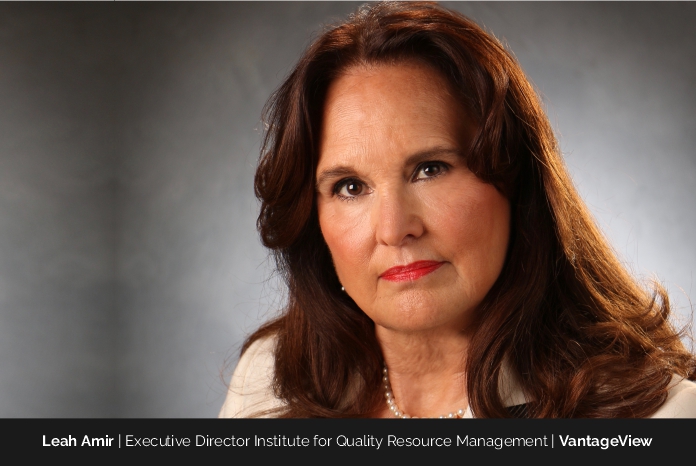
A restless need to understand how things work and the discipline to follow that curiosity wherever it led set Leah Amir on her path into healthcare. Even as a little girl, she was intrigued with the magic of my environment. This nurtured by curiosity leading into the study of science. Wonder let to investigation. To learn how crickets make sound, she lay still in the grass, patient and intent, until the answer revealed itself. She watched closely as their wings moved. One wing carries a serrated vein that works like a comb, while the other has a hardened edge that scrapes against it, producing that familiar sound.
That instinct to observe, question, uncover, and report never left. The richness of the natural world, its intricate systems of flora and fauna, and the urge to help others experience and benefit from it influenced her thinking in the early stages. It pushed her toward solving problems before they fully surface. This lifelong commitment to the process of discovery echoes Harry Chapin’s philosophy on life and travel: “It’s got to be the going, not the getting there, that’s good.” For Leah, the “going” meant embracing the journey of open-ended scientific inquiry rather than a predetermined destination. Though she once stood on the verge of committing to medical school, ready to sign, she picked a different route. Research offered scale, impact, and reach. It allowed her to influence not just individual results but entire populations. The choice speaks for itself, reflected in a career grounded in inquiry, challenging assumptions, and building methods that turn insight into real solutions.
Now serving as Executive Director, Institute for Quality Resource Management at VantageView, Leah leads work on a prognostic biomarker test to identify which patients with uncertain chest pain are at risk of a cardiac event within the following 2 days to 6 months with 98 percent certainty. Prospective randomized controlled trials collected patient samples and analyzed their effects over 6 months. Among those with elevated biomarkers, this near-perfect probability of a fatal event held, even in cases where standard indicators like cardiac troponin showed no risk at all. Her team combines protein chemistry with predictive algorithms to further refine the test as it moves toward launch as a laboratory-developed test.
These biomarkers reveal risk where traditional markers stay silent. They detect coronary artery plaque rupture with a low-cost, highly accurate blood test. Validated across multiple randomized controlled clinical trials, their relevance is immediate and undeniable, meeting a critical need in modern cardiac care. Their result informs the physician and patient as to their immediate cardiac condition yet within time to take action. Knowledge leads to adoption of effective treatment or lifestyle changes to avert a heart attack.
Driving Outcomes at Scale
In her current role, Leah operates at the intersection of science, strategy, and execution, leading a multidisciplinary team of scientists, software developers, engineers, statisticians, and regulatory experts focused on FDA and CMS frameworks. This group builds and delivers actionable solutions aligned with the needs of VantageView clients, enabling medical industry decision makers to navigate a shifting regulatory environment and move confidently toward commercialization.
Her responsibilities extend far beyond product pathways into real-world healthcare delivery. VantageView partners with medical professionals and hospital administrators to integrate new technologies into daily practice while strengthening internal teams to improve revenue management and ensure compliance. This work yields measurable results by reducing days of morbidity and allowing patients to remain active, independent, and clear of inpatient or long-term care settings.
Securing these systemic changes requires constant engagement at the highest levels of governance. Leah and her team work directly with healthcare policy leaders across Medicare, Medicaid, and commercial payer networks, negotiating pathways that align clinical innovation with patient access, financial reimbursement, and long-term sustainability.
Where Purpose Meets Access
We ask Leah what motivates her most about working in the healthcare sector, and she points to a system filled with life-saving potential that still fails to reach everyone it is built to serve. Her career path echoes Robert Frost’s famous poem ‘The Road Not Taken,’ which states that taking the road less traveled makes all the difference.
The lines go:
“I shall be telling this with a sigh.
Somewhere ages and ages hence:
Two roads diverged in a wood, and I—
I took the one less traveled by,
And that has made all the difference.”
Choosing that untraditional road meant bypassing clinical practice to bridge the massive gap between cutting-edge medical innovation and everyday human access. While technology continues to push boundaries, the distribution of care remains uneven, leaving large segments of the population out of reach. Closing that divide is what drives her daily.
Turning that drive into an actual impact requires a shift from theory to execution. Leah and the VantageView team step in to build solutions that move beyond promises of progress. They measure and prove real-world recovery rates while defining medical necessity for every new technology they guide. Such a clear-cut purpose earned Leah a reputable spot among “The 5 Most Influential Women Leaders in Healthcare to Follow, 2026.” And we stand by it.
Overcoming Barriers and Defining Excellence
The path to success is rarely straightforward. Leah’s journey follows that truth closely. Gender bias remains a constant presence. Not as an abstract issue but as a lived reality that tests credibility, access, and recognition. Far from deterring her, she let that pressure sharpen her focus. Her leadership style comes straight from that experience. It’s practical, results-oriented, and rooted in the belief that hard work should speak for itself. She navigates spaces that were not built with her in mind and still claims her place within them. As Leah proudly puts it, “It is quite an accomplishment to be a trusted member of the ‘boys’ club.”
Championing Evidence-Based Patient Care
To keep progress aligned with genuine care, Leah collaborates with exceptional physicians who want to see the system work better. Together, they gather the clinical proof needed to demonstrate real-world recovery rates. By establishing this clear path to market access, they can responsibly integrate new technologies while streamlining daily hospital operations. For doctors with both the skill and the drive, VantageView provides the coaching necessary to elevate them into trusted industry thought leaders.
Shifting Currents in Healthcare
Leah observes several concerning shifts across the modern healthcare scene. Tightening medical research budgets slows the pace of discovery just when innovation matters most. Concurrently, non-science-driven narratives gain mainstream traction, creating unnecessary noise that competes with evidence-based progress and informed decision-making.
Conducting high-quality clinical trials has also become increasingly complex as structural barriers threaten the basic rigor and reliability of study results. This friction extends into policy circles, where a pervasive belief that fraud and abuse drive most healthcare spending has taken hold. Such a narrow viewpoint risks weakening institutional support for legitimate breakthroughs and undermining the systems built to advance patient care.
These collective pressures frequently obscure the true value of new medical technologies. Even when the positive impact is both measurable and profound, solutions that directly reduce patient morbidity and suffering still struggle to gain the market attention they warrant.
Where Collaboration Gets Tested
Collaboration among healthcare stakeholders is absolutely critical for driving meaningful improvements across the industry. However, managing these multifaceted partnerships has its own distinct set of challenges. Leah notes that identifying stakeholders who can genuinely prioritize broad patient benefit over competitive or political interests is incredibly difficult. Finding true alignment remains a tough nut to crack because too often, intense market competition drives corporate decisions that either fail to serve patients or create friction with policymakers.
Turning Rejection Into Revenue
As a woman in a top leadership role in healthcare, Leah leads by the data, and the data rarely lies. Early in her healthcare career, she analyzed MedisGroup records and uncovered a stark, uncomfortable reality: patient results tracked more closely to insurance status than to actual clinical treatment. The finding was too controversial for print at the time, but it instantly cemented her professional mission. Ever since that moment, she has pushed insurers to invest in quality-driven care rather than arbitrary metrics that leave patients behind. Her ultimate target is to overhaul the American healthcare system from the inside out, keeping people healthy, active, and entirely out of the hospital. Challenging an entrenched system for the sake of patients often brings intense professional friction. This reality mirrors the spirit of the verse: “Blessed are those who are persecuted for righteousness’ sake, for theirs is the kingdom of heaven.” (Matthew 5:10). To Leah, fighting for scientific and ethical righteousness meant facing a corporate structure that frequently penalized systemic truth.
Industry prejudice is a reality, but a healthy dose of tunnel vision keeps her moving so fast she doesn’t notice it. When she walks into a boardroom, men are occasionally caught off guard because they assumed Leah was a man’s name. That hesitation never slows her down. She walks into every room armed with meticulous preparation, letting sheer objective competence drive the meeting and win the day. High-level confidence dominates her interactions, leaving absolutely no room for overt bias to take root.
When venture capital investors refused to back her patented cardiac breakthrough test. Choosing instead to sink over $20 million into inferior devices that eventually failed, Leah did not miss a step. She built and scaled 3 separate companies from scratch to self-fund her technology. That initial rejection forced her to innovate her service models and generate higher revenue, allowing her to ultimately outperform the very investors who chose to look the other way.
Anchoring Strategy in Verifiable Proof
Executing strategic decision-making in a field where findings directly affect patient lives is not a matter of guesswork. Leah takes a rigorous, evidence-driven approach to every project she touches. She collaborates closely with her team to design clinical trials that measure outcomes with precision for defined populations. When randomized controlled trials already exist, she dissects the data and applies economic models to quantify real-world value. This process ensures decisions rest on both clinical validity and economic relevance. Her strength as a persuasive speaker helps carry those conclusions through.
Balance by Design
Maintaining balance remains a challenge for this seasoned executive, one that requires intent rather than assumption. She sets aside dedicated time for friends and family, protecting those moments within a demanding schedule. Exercise is not treated as an afterthought. She integrates it into travel and social routines to keep pace with her professional commitments.
It is not a perfect system, and she does not claim it to be. What holds steady is her focus on staying connected to the people and activities that bring her happiness and sustain her energy, ensuring that the demands of leadership do not come at the cost of what keeps her grounded.
Achievements: Where It All Comes Together
Her biggest source of pride lies in her children and the lives they are building. Their success is not about titles. It shows in how they challenge her thinking, deepen her perspective, and bring a sense of completeness no professional milestone can match. Through them, she finds both grounding and growth, a reminder of what truly holds value.
At the dinner table, that impression becomes real. Seated with Leah are an exercise physiologist, a physician, a marine biologist, and an environmental and evolutionary biologist. Conversations move quickly; ideas take shape. And by the time dessert arrives, the world’s problems have been examined, debated, and, in their own way, solved.
Influence That Sticks
She hopes her work will influence the next generation of healthcare leaders in a lasting and practical way, shaping how they think, decide, and act within a complex system. Leah sees early signs of that impact already taking hold. Her work has helped educate others, not in theory but in practice, through presentations on healthcare economics and direct engagements with major payers that have informed professionals now carrying on similar efforts.
Her track record says it all. She has secured coverage and payment for many life-saving and life-sustaining medical drugs and devices, ensuring that innovation does not stall at the point of access. What resonates most is seeing her ideas take on a life of their own, gaining traction, evolving, and subtly becoming part of the industry’s foundation. It is a testament to Victor Hugo’s observation that “in every human question, there is something more powerful than strength, than courage, than genius itself: it is the idea whose time has come.” Through Leah’s work, those ideas are finally here, creating a ripple effect that continues to push things forward long after the initial work is done.
Message Future Healthcare Pioneers
To aspiring professionals who want to build a meaningful career in healthcare leadership, Leah’s advice is precise and unvarnished. She asks them to be clear about why they want to enter this field. It is complex, demanding, and often requires sustained effort under challenging conditions. She explicitly warns them that it is not for those who are unwilling to fully commit their intellectual power, physical energy, and time commitment.
Leah urges these aspirants to jump in with both feet rather than merely testing the waters. She emphasizes, “Develop a strong foundation in science and data management, and learn how to accurately measure clinical findings, including their relevance to the patient, their family, the economic, and hence U.S. healthcare delivery.” She concludes by telling them to be prepared to persevere in driving meaningful change in policy and practice.