
Business success is defined in terms of growth, profitability, and influence. However, those leaders who leave their legacy are those whose effect goes beyond the results achieved and influences other people and organizations as well. In this era of technological disruption, economic uncertainties, and transformation processes, leadership requires much more than skills. It needs integrity, good judgment and implementation of vision.
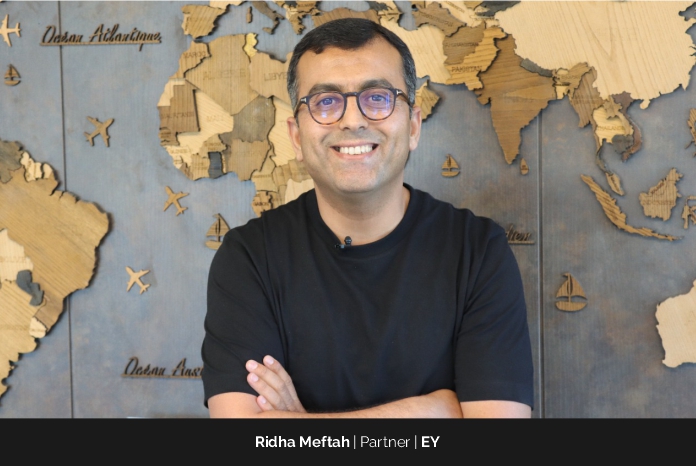
Ridha Meftah, Partner at EY, is a leader who is guided by all these principles in his professional practice. After working with financial institutions, regulatory bodies, and organizations in Africa and emerging markets, he came to understand that transformation is created not only with the help of strategy but also with integrity, cooperation, and resilience. Throughout his professional practice, Ridha strives to assist organizations in managing the complexity of situations while enabling people to grow, develop and lead confidently.
“Think big to inspire people, start small to learn fast, and scale with purpose to shape the future.”
Building a Career on Purpose and Responsibility
According to Ridha, the concept of leadership does not lie in the title but in the sense of responsibility that one gains through actions and accomplishments. He has learned that at the early stage of his consultancy career, organizations don’t hire consultants merely on the basis of their knowledge; rather, they need someone to guide them at uncertain moments when they need to take tough decisions with a lack of clarity.
The values that have influenced me the most are integrity, resilience, humility, and service. Integrity, because trust is the very basic of any advisory relationship.
Resilience because transformation is bound to take place within a setting of volatility and ambiguity. Humility because no leader has all the answers. And service because real leadership consists in helping clients, teams, organizations, and communities grow beyond their current state.
Leadership lessons from his time spent working throughout Africa solidified these principles even further. Instead of transplanting prepackaged solutions, he firmly believes that leaders should tailor global best practices to local conditions, using challenges as catalysts for innovations. Driven by such principles, Ridha developed profound expertise in finance, governance, risk management, and organizational transformation before moving on to strategically important projects related to financial institutions and regulators.
Eventually, he came to understand that clients appreciate judgment as much as knowledge. The journey to becoming a Partner involved many years of dedication, resilience, and teamwork, but Ridha sees it more as a step forward in taking up even greater responsibilities. “It is an honor,” he says, “but it is first of all a commitment.”
Being a partner for Ridha means being accountable not only for business results, but also for people development, building stronger client relationships, and maintaining the firm’s reputation.
“The next era of leadership will belong to those who can combine artificial intelligence with human wisdom, technological power with ethical responsibility, and ambition with purpose.”
Creating Meaningful Impact Through People and Transformation
Central to Ridha’s approach is the clear goal of building up organizations and empowering individuals to achieve their full potential. Not only does he advise organizations but also helps them transform digitally, improve governance, modernize their financial services, design their operational models, and build for sustainable growth. In today’s increasingly complex world, he helps clients take steps from idea conception to implementation through sound decision making and risk management techniques.
Notably, Ridha is passionate about building the next generation of leaders. According to him, the consulting business is not just about having knowledge but also being curious, collaborative, ethical, and eager to learn continuously. Coaching young professionals and helping them mature into leaders is what he enjoys doing most. Moreover, apart from working with individual organizations, Ridha has also been committed to building business eco-systems in Africa and other emerging economies through strong institutions and innovations.
In contrast, Ridha believes that success goes way beyond just the bottom line. For Ridha, “success equals impact, trust and continuity.” Impact entails making sure that the organization becomes stronger because of good decision-making and empowerment. Trust, which is the basis of any successful relationship, involves integrity and consistency. Continuity entails measuring the effect of an individual on an organization in terms of building strong institutions, setting higher standards or grooming the next generation of leaders to add value.
Leading with Balance Through Uncertainty
Leading at an advanced level comes with many responsibilities, such as managing client relationships and leading change management in teams. To Ridha, personal balance is not about achieving perfection but about choice. “Personal balance is not a luxury; it is a leadership responsibility,” according to him. He thinks that leaders will make sound choices if they are healthy and present in both the office and their family circles, which give them a broader picture of success.
The modern world is full of uncertainties for leaders. There are uncertainties regarding economic changes, regulatory changes, technological disruptions, and customer expectations. In such situations, according to Ridha, there are three main elements a leader needs: clarity, cooperation, and courage. The leaders need to make things clear and cooperate among each other to take responsible decisions.
As he says, “Waiting for perfect certainty can be inaction in disguise.” The main task of effective leadership is to create confidence and structure in the organizations.
“Africa will not be defined by the challenges it faces, but by the opportunities its leaders choose to create.”
Preparing Leaders for a Changing Future
Moving forward, Ridha sees the future of consulting as entering into a very pivotal stage of its existence. Advancements in artificial intelligence, data analytics, cybersecurity, sustainability, and the changing nature of geopolitics have radically altered how businesses work and compete. While technology will continue to revolutionize the way industries conduct business, Ridha sees that future belongs to those individuals who have the judgment and ethical compass to go along with innovation.
“The pace of change will be unprecedented, but pace won’t be enough,” says Ridha. “It will take judgment, ethics, agility, and execution capability.”
That means that consultants are going to have to change too. Businesses today do not just need consultants to give them recommendations, but they need partners to help them bring their strategies to life, integrate technologies into their plans, manage risks while creating innovations and navigate the ever-growing web of challenges. Successful consultancy in the future will need to encompass a wider viewpoint, incorporating people, process, governance, regulation and technology.
Leadership in the world of business is experiencing the same kind of evolution. Future leaders need to be both technology-oriented and very much human. They have to accept innovation but not at the cost of their credibility; grow and become resilient at the same time; be global but still be grounded in local considerations. Ridha believes that Africa and other developing markets can play an important role in this vision, contributing to the realms of financial inclusion, entrepreneurship, innovations, and sustainable development.
This is what Ridha wishes to keep doing for organizations in those regions as they go from ambition to implementation.
“In a world overwhelmed by information, the greatest value a consultant can bring is not more answers, but better questions.”
Creating Leaders Who Empower Others
Among many achievements that marked his professional journey, the one of becoming a Partner is exceptionally valuable since it embodies trust, determination, and collective success. However, Ridha is convinced that some of the best achievements one can make are impossible to measure by titles and recognition.
The ability to assist organizations in transforming themselves, guide clients through a period of strategic changes, and see young people become successful leaders is among those experiences that have a profound meaning. These experiences reinforce his conviction that leadership is never purely about personal success, but rather about helping other people succeed.
These ideas have defined Ridha’s leadership approach over the years. At the beginning of his career, the emphasis was placed exclusively on perfectionism, analytical thinking, and results. Such qualities are still important for him, yet experience has taught him more about effective leadership.
“In other words, leadership does not have to be problem-solving,” says Ridha. “It has to be about increasing the capacity of others to solve more complex problems.”
In the present day, he values setting high standards, yet fostering a positive atmosphere in which people feel respected, encouraged, and motivated to excel.
Performance and accountability still matter, yet sustainable success is possible only through empathy, collaboration, and constant learning.
“The best leaders do not make followers,” he says. “They make other leaders.”
It is reflected in the way he inspires consultants and business strategists to become true leaders. He tells young professionals to focus on acquiring the basics first, to work on gaining the knowledge in finance, economics, technology, regulation, and industry specifics. It is crucial, as the world of business changes too fast for us to be able to rely on our experience alone.
The same is true about building trustworthy relationships and reputation. Professional relationships should be established through consistent behavior and communication rather than through personal visibility and publicity. Finally, one more advice is to give back to people. To inspire and motivate others to learn and succeed. To share your knowledge and help people to succeed. That is how leadership can actually be beneficial.
“The greatest investment any leader can make is not in technology, strategy, or capital. It is in people.”
A Legacy Built on Trust and Lasting Impact
Resilience has played an important role in Ridha Meftah’s career throughout his leadership journey. It has been possible because of three key traits, purpose, perspective, and discipline, which enable a leader to be focused in uncertain times and differentiate between what is a temporary challenge and a long-term opportunity. At the same time, resilience is not created by one person. Family, mentors, colleagues, clients, and teams offer perspectives on change, while values like integrity, humility, responsibility, and courage are solid anchors.
These principles form the foundation of the legacy that Ridha would like to create. For his work in EY, Ridha plans to create great teams, develop future leaders, and contribute to a culture of excellence, collaboration, and integrity. Beyond the company, Ridha would like to create resilient business ecosystems and help organizations realize their ambitions and make progress.
Ultimately, what Ridha wants to be remembered for is not the various positions he has had, but for the trust he has earned, for the opportunities he has provided, and the trust he has built up along the way. In an era when everything is changing all the time, his leadership philosophy acts as a constant reminder that true success comes from maintaining your integrity and being constantly learning as well as having a passion for making other people succeed.