
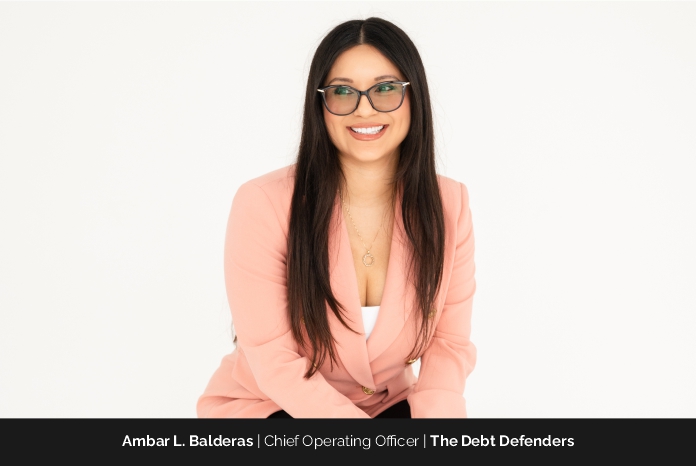
A primary force shaping the leadership philosophy of Ambar L. Balderas, Chief Operating Officer at The Debt Defenders, was adversity early in life. She grew up in a home where safety was inconsistent, marked by financial instability and frequent volatility. When she was twelve, the FBI raided her home. As the only bilingual child present, she translated for her mother while agents explained the allegations. One of them looked directly at her and asked, “Do you feel safe at home?” She answered, “Yes.”
After her father was sentenced to eight years in prison, the family’s challenges were exacerbated. Although the youngest of four, Ambar stepped into a leadership role long before she held a formal designation, supporting the household by cooking, cleaning, and working through high school while caring for her mother, who struggled with depression. Many evenings were spent listening to her mother’s grief, forcing Ambar to offer stability before she fully understood it herself.
Despite these circumstances, she maintained a 4.0 GPA, graduated second in her class, and became the commanding officer of her Naval Junior ROTC unit. Under her leadership, the unit won its annual military inspection, earning her an appointment to the United States Naval Academy.
As a first-generation Mexican-American, she was surrounded by people who considered survival as the end goal. Ambar chose to see it as a starting point. She was determined to break generational patterns and build a different future defined by possibility.
The Naval Academy and New Horizons
The Naval Academy was the first time Ambar was surrounded by relentless ambition, placing her among top performers from every background imaginable. For someone shaped by her upbringing, the experience was both inspiring and intimidating. It quickly exposed gaps in her exposure to the world because she had never even learned how to swim, just because access had never been available. Rather than discouraging her, the environment humbled her, honing her self-awareness and making it clear that growth would have to be pursued intentionally.
The experience also redefined her understanding of leadership. Watching both exceptional and ineffective leaders up close taught her that authority alone does not inspire people, but empathy, accountability, and clear communication do. Her work as a Sexual Assault Response Guide and Peer Educator deepened her ability to handle sensitive situations with care. At the same time, exposure to the military’s focus on technology sparked a lasting interest in operational strategy.
These experiences taught her that the most effective leaders do not choose between people and systems. They build both.
Professional Evolution
Ambar’s professional journey was not conventional. While attending the Academy, she became unexpectedly pregnant and faced a decision that altered the course of her life. A brief public service announcement she often shares is that young women should always ask whether medications can affect their birth control, something she learned the hard way. She chose motherhood over the future she had envisioned, leaving the Academy to embark on an uncertain journey as a young single parent.
That period was one of the most difficult chapters of her life. She was grieving her expected future while trying to build a new one from scratch. While raising her daughter, working full-time, and pursuing her education, she adopted a simple philosophy where, as long as she completed at least one class each semester, she was making progress. Some semesters, life became overwhelming, and she had to withdraw entirely. But she never stopped trying. Reflecting on those years, Ambar remarks, “Your dreams are achievable, no matter how long they’ve been waiting for you to believe in them again.”
Professionally, she started in retail and customer service before moving into administrative support and the legal industry, naturally gravitating toward operations, process improvement, and organizational strategy. Ironically, her career outpaced her education. Before earning her Bachelor’s degree in Management Information Systems, she had already helped transform a consumer law firm from a startup into a multi-state practice operating in more than 25 states, advancing from Legal Operations Manager to Vice President of Operations. By the time she encountered many operational concepts in the classroom, she had already spent years applying them in the real world. What could have been a disadvantage became an asset, giving her a practical perspective that continues to shape how she leads today.
Eventually, she joined The Debt Defenders as Director of Operations and later became Chief Operating Officer after engineering a dramatic profit turnaround, strengthening operational infrastructure, and driving unprecedented growth. She also completed her Master of Science in Information Science because she believes that if she expects her team to embrace continuous improvement, she must model it herself.
Balancing Vision and Execution
As a senior executive, Ambar operates at the intersection of strategy, culture, and problem-solving. She believes sustainable growth requires what she calls radical accountability and innovation, balancing long-term vision with disciplined execution.
At The Debt Defenders, the organization built a highly customized technology ecosystem tailored to a high-volume consumer law practice. Yet for Ambar, technology is effective only when people understand and trust it. This belief led her to create Debt Defenders University, an internal training platform that centralizes policies, procedures, and institutional knowledge to reduce reliance on informal information sharing.
The firm expanded this approach by developing a custom AI-powered learning agent within the platform so team members can clarify processes and troubleshoot issues in real time. Building on that success, the organization is extending the concept into a client-facing education platform supported by an AI agent designed with clear guardrails and strong data governance. For Ambar, innovation should expand access to knowledge and remove unnecessary barriers.
Equally important is radical accountability. The firm uses performance scorecards, structured decision frameworks, and transparent expectations so every team member understands both their goals and their authority. Employees are encouraged to develop expertise beyond their immediate roles in areas like automation and workflow optimization. This combination of clarity and ownership allows individuals to operate independently, freeing leadership to focus on strategy. True operational scale comes from creating an environment where both innovation and accountability coexist. As she explains, “Leadership is less about carrying the raid and more about teaching the team how to clear it without you.”
Integrating Personal Priorities
Growing up in an environment defined by survival mode, Ambar saw firsthand how unaddressed trauma, chronic stress, and emotional exhaustion affect families. Those experiences molded her foundational view that mental health, physical health, and personal fulfillment are not separate from professional success; they are prerequisites for it.
Ambar finds balance by investing heavily in the things that energize her outside of work. She is a fitness enthusiast, a gamer, and a raver. While strength training taught her discipline, gaming introduced her to her partner and helped her build the family she cherishes today. Music festivals offer her a rare opportunity to disconnect from daily responsibilities and be present. For Ambar, “PLUR isn’t just for raves. Peace, Love, Unity, and Respect turn good organizations into extraordinary ones.”
She strongly rejects the outdated belief that success requires constant burnout. If an organization consistently depends on people sacrificing their health and personal lives to achieve results, she views that as a symptom of ineffective systems rather than exceptional performance. By intentionally building environments where people can excel professionally without neglecting their personal lives, she ensures her team shows up stronger and more invested.
Ultimately, she works so hard to create opportunities, healing, stability, and freedom for the people she loves. She wants her children to inherit possibilities, a strong foundation, and the time to build lives they genuinely enjoy.
Team Motivation Strategies
A recurring mistake organizations make is assuming everyone is motivated by the same things. In reality, drive comes from different sources: recognition, ownership, competition, purpose, or connection.
At The Debt Defenders, motivation starts with understanding the individual. The company builds systems to reward different styles, utilizing transparent KPI scorecards for competitive spirits, and client-experience initiatives for purpose-driven employees. A peer-driven recognition program also allows team members to publicly reward coworkers organically.
Furthermore, Ambar shares that approach also incorporates the Enneagram, using personality insights during coaching, evaluations, and conflict resolution. To Ambar, effective communication is about whether the other person can receive it in a way that resonates with them. Understanding how different people process feedback and stress allows leaders to communicate with greater empathy.
She also believes it is vital to celebrate employees who are exceptional individual contributors but do not seek leadership titles or the spotlight. When people feel seen, understood, and rewarded in ways that align with who they are, engagement becomes authentic and high performance becomes sustainable.
Overcoming Career Challenges
One of the most challenging moments in Ambar’s career came after five years spent helping to scale a consumer law firm into a multi-state practice. She had invested an enormous amount of herself in the organization, helping launch secondary business ventures and becoming deeply integrated with the founders’ personal finances.
The true test began when the firm pursued an expansion opportunity involving a potential third partner, bringing in an outside individual to evaluate the organization. Initially, Ambar welcomed the support to help prepare for the next stage of growth. Instead, it quickly spiraled into a deeply disappointing leadership experience as the workplace culture shifted.
Over a short period, she witnessed behavior that crossed serious ethical lines, including discriminatory treatment toward employees, manipulation, and an environment driven by fear and division. Feeling a responsibility to protect her team, Ambar carefully documented and formally escalated these issues. Looking back, she realizes she relied too heavily on her history with the firm, assuming the facts would speak for themselves.
They did not. Instead, the response became a masterclass in how powerfully greed can influence decision-making. The subsequent investigation felt entirely performative, conducted by an attorney who maintained an active business relationship with the firm. The concerns were dismissed, an employee who reported discriminatory remarks was terminated, and Ambar was offered a path to quietly step away from the conflict, remaining financially secure by continuing to oversee the partners’ side ventures.
For Ambar, this was the moment of truth. As she reflects: “Culture is the sum of the decisions leaders make when money, growth, politics, and principles come into conflict. Anyone can talk about integrity when it is convenient. The real test comes when integrity becomes expensive.”
Because the easy, lucrative path directly conflicted with her values, she chose to walk away entirely. While leaving was one of the hardest professional decisions of her career, it was the easiest from a moral standpoint. If success requires compromising your values, the cost is too high.
Watching the aftermath unfold was heartbreaking, but it ultimately reaffirmed her belief that culture always matters. Many of the original team members left, the ethical issues escalated, and the resulting fallout crippled the stability of the business, proving that shortcuts in integrity always come due.
Defining Success and Industry Trends
Ambar defines success by impact more than titles or traditional business metrics. Nothing resets her perspective more than seeing a member of her team achieve a milestone like buying their first car, purchasing a home, or reaching a level of stability where they can finally exhale. Because she grew up in survival mode, she views success as creating freedom and peace for others. When she thinks about wealth, she thinks about having the time to be present with family and live without fear or scarcity. One of her proudest accomplishments is breaking generational cycles for her own children.
As she considers her goals, she notes that “Performance answers the question, ‘What did you achieve?’ Impact answers the question, ‘How many lives, teams, and futures are better because you were here?'”
This focus on impact shapes her view of future industry trends. Over the next decade, she foresees a continued movement within the debt management sector toward consumer-centered solutions, transparency, and education. Financial hardship is incredibly stressful, and consumers are frequently presented with conflicting advice or predatory practices.
While many debt settlement companies and credit providers offer legitimate value, the challenge lies in ensuring consumers have access to trustworthy, tailored solutions rather than a one-size-fits-all approach. This philosophy is why The Debt Defenders built their model around three objectives: Resolve Your Debts, Protect Your Rights, and Help You Rebuild Your Credit. Their internal Standards of Excellence, which are Validate, Empower, and Provide Relief, reflect this belief.
Looking ahead, she hopes the industry continues moving away from transactional thinking and toward a holistic approach that recognizes the human realities behind financial hardship. The organizations that will have the greatest impact over the next decade will be the ones that stop seeing people as accounts and start seeing them as individuals.
Leading Global Teams
Leading globally taught The Debt Defenders that while businesses operate internationally, leadership must remain human-centered. Too often, companies treat global talent as a transactional assembly line, isolating roles into narrow tasks. Ambar’s team rejected that model. They rebuilt their international training from the ground up, moving away from rote tasks to teach the foundational “why” behind the work. By helping global team members gain a profound understanding of U.S. debt structures and their clients’ emotional experiences, the quality of decision-making and communication improved dramatically.
Ultimately, leading globally has proven that when you invest deeply in people, they rise to the occasion, regardless of where they are in the world.
Legacy and Authenticity
Among her proudest achievements at The Debt Defenders are eliminating approximately $31 million in debt for consumers across Texas in 2025 alone and expanding operations into Georgia. Behind those numbers are families who can finally sleep at night.
As a first-generation Mexican-American woman, Ambar is aware that statistically, her journey is uncommon. One of the biggest impacts she hopes her leadership has is very precise: “Sí se puede.” She wants other Latinos and Latinas who grew up in difficult environments to see someone like them and realize that their starting point does not define their ceiling.
She hopes her journey challenges the outdated belief that empathy and operational excellence cannot coexist, proving that leadership need not look cold, transactional, or robotic to be effective. Her advice to aspiring leaders is to preserve their authenticity. Newer generations of professionals value connection, transparency, and personality over a hyper-polished facade.
Authenticity alone, however, is not enough. Vision without execution is just a good idea, and culture without accountability is just a slogan. She stresses, “Great leaders must build the systems, processes, and operational infrastructure necessary to turn ideas into sustainable results.”
The legacy Ambar hopes to leave is proof that high-performing organizations do not have to sacrifice humanity to succeed, measuring an enterprise’s ultimate value by the transformation of the individuals who pour their labor into it. As Ambar concludes thoughtfully, “The most powerful thing you can build is not a company; it is the people who discover what they are capable of while building it with you.”