
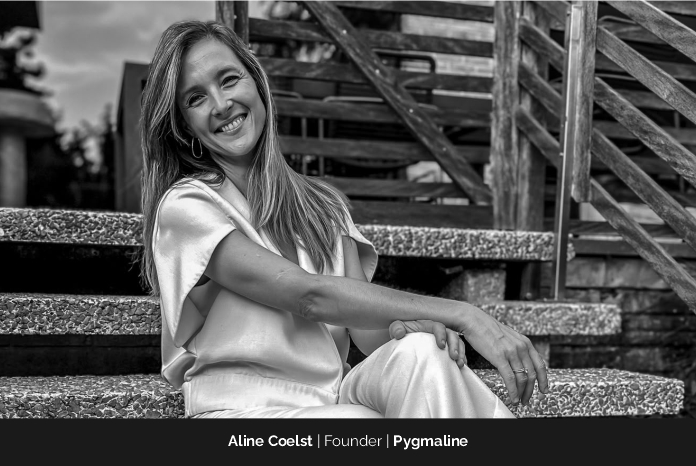
Aline Coelst didn’t build Pygmaline to make lawyers smarter, but to make businesses less dependent on them without compromising on quality of the legal output. Most organizations view legal as the department that reviews contracts, mitigates risk, and steps in when something has already gone wrong. It is often perceived as a necessary, valuable function, but separate from the pace at which businesses operate. Aline perceives it differently.
“The best legal teams don’t create dependency; they create capability,” Aline says. As she sees it, the greatest contribution a legal professional can make isn’t solving every problem that comes across their desk. She feels that legal excellence isn’t measured by how indispensable the lawyer becomes. It is gauged by how capable the organization becomes. That philosophy sits at the heart of Pygmaline, the legal advisory practice she founded to support fast-moving technology companies, scale-ups, and innovation-driven businesses.
Technology as a Catalyst: A Turning Point That Changed Everything
In Aline’s life, technology worked as a catalyst of change and reshaped her understanding of legal services. To this, she shares, “More than a decade ago, tech businesses crossed my path as a legal professional, and I was struck by how agile and multidisciplinary that world was compared to the traditional lawyer’s world.”
So she committed to it fully. She learned how tech companies actually operate, and shaped her legal services around what they need, rather than the other way around.
Aline notes, “My vision has always come from one belief: the power of technology can make human lives better, so to care about technology is to care about people.” That belief has since guided her work with technology start-ups and innovation-led businesses tackling some of society’s most pressing challenges, from climate change to the global energy transition.
Before founding Pygmaline, Aline launched an earlier venture called LegalFreaks. She designed a legal program for scale-ups, assessing their needs while serving several start-ups simultaneously. On paper, it worked exactly as intended. As time passed, she realized that she wasn’t investing in the people behind those companies. But she was spreading herself across accounts rather than embedding in any one of them. Recognizing that worked as the turning point. That shift in perspective led directly to her next brainchild.
In her words: “I founded Pygmaline with a completely different approach: fewer, deeper relationships, built on genuinely investing in the people I work with, not just the contracts.” Today, that conviction influences every engagement the firm undertakes.
More Than a Name: The Philosophy Behind Pygmaline
Pygmaline is more than a brand identity. It reflects the philosophy upon which the entire organization is built. At its core lies the Pygmalion Effect, a psychological principle suggesting that people often rise to the expectations placed upon them.
Founder Aline believes people don’t develop sound judgment merely because someone explains another policy or teaches another legal framework. They grow because someone genuinely believes they are capable of exercising that judgment themselves. “The real innovation isn’t the legal solution itself,” Aline clarifies, “it’s the approach to the stakeholders around it.”
Pygmaline optimizes the people the lawyer works with. She adds, “That’s the Pygmalion effect in practice. When you genuinely believe your internal stakeholders (sales teams, operations managers, founders) can develop real legal judgment, and you set high expectations paired with the right proxies and frameworks, they rise to meet them.”
She continues that they start flagging issues early, thinking ahead, and taking ownership. The best legal teams create capability, not dependency. The difference may appear subtle. In reality, it completely changes where value is created.
Meeting Businesses Where They Already Work
For Aline, innovation is rarely about introducing another piece of technology. She has high respect for legaltech and appreciates the genuinely good tools. But it isn’t the ultimate solution. She elaborates, “The Pygmalion effect only starts to work when you use the tentacles of your stakeholders: meeting people where they already are.”
That perspective explains why Pygmaline integrates its legal support into collaboration platforms such as Slack, Microsoft Teams, and Dropbox rather than creating separate legal ecosystems. Technology is never the destination for Aline. It is the bridge.
In her words, “The moment legal becomes its own island, you risk losing the very stakeholders you’re trying to empower.” It is important to ensure that innovation aligns with compliance and ethical standards in the legal sector. How does she achieve it?“Innovation,” she remarks, “has very little to do with the substance of the law itself. The law doesn’t change because you’re innovative.”
The fundamental principles remain unchanged, and compliance standards stay exactly where they need to be. Instead, the real transformation happens in the approach and the delivery speed.
Legal advice only creates value when it helps people move forward with confidence. Legal guidance must be accessible enough for people to naturally include it in everyday business conversations.
Sustainability, Built Into the Work
Aline integrates sustainability and corporate responsibility directly into the core operations of Pygmaline. For her, sustainability is not a policy added after the fact. Instead, it is reflected in how quickly a deal closes, how few obstacles a founder encounters, and how much time is saved for building a cleaner future. This practical alignment of legal strategy with global impact is precisely why she stands out among ‘The Most Influential People in Legal Services to Watch in 2026.’ She proves that accelerating purpose-driven businesses is a consequential way to support the broader energy transition.
Building Trust Through Consistency
While technology improves efficiency and processes increase speed, neither can replace human trust. Working alongside multiple technology companies has shown Aline that while every organization appears unique on the surface, the underlying legal hurdles are remarkably similar. Real expertise lies in the ability to isolate those common principles and apply them consistently across different contexts.
Consistency should not be confused with rigidity. It simply signifies clients always know what to expect. They know the advice will remain practical, difficult conversations will be transparent, and choices will be guided by integrity rather than convenience.
“Trust isn’t built by staying neutral; it’s built by being consistent and honest,” Aline emphasizes. Ultimately, long-term partnerships flourish on credibility and the confidence that both successes and challenges will be approached with the same professional standards.
Creating Legal Teams That Eventually Outgrow Their Lawyer
Aline ensures that her organization promotes a healthy culture. She opines that collaboration and growth come from investing in relationships; it can’t stem from just transactions. In practice, that means building easy processes around tools the team already uses. It means spotting “legal-sales” profiles, people on the business side with a natural instinct for legal judgment, and developing them. It implies setting up clear proxies so decisions don’t bottleneck on me. “The goal is raising the legal maturity of the whole team rather than holding onto the knowledge myself,” she explains.
While many consultants measure success by how indispensable they become, she wants to leave behind a legacy: a business that has genuinely absorbed legal understanding into how it operates, whether she’s still involved or not.. The milestone she values most has nothing to do with high-profile transactions, major funding rounds, or landmark legal victories. Instead, true success means leaving a scale-up with clear operational standards that allow another legal professional to take over seamlessly. “That’s the real proof the model works: the value doesn’t leave when I do,” Aline states.
The Future of Legal Is Still HUMAN!
Aline aims to ensure that the next generation of legal professionals does not get stuck in a rut of traditional, purely advisory habits. The European legal sector moves faster and serves growing companies better when professionals step inside the business instead of operating at arm’s length.
This forward-thinking mindset is particularly crucial as artificial intelligence rapidly transforms the industry. Aline stresses that “innovation across every industry is accelerating, and legal has to keep pace rather than lag behind.” While she recognizes the massive potential for automation tools to assist with first drafts, clause libraries, and flagging deviations, she emphasizes that the true value of the profession rests outside document production, maintaining that “judgment and context stay firmly human.”
Her guidance for upcoming legal innovators centers heavily on cultural change, challenging them to “let go of tradition and habit.” Outdated industry standards such as billable hours, gatekeeping, and long response times persist purely due to historical inertia. The future belongs to entrepreneurs who actively reject these habits, study how modern companies operate, and rebuild legal frameworks around the actual needs of the people they serve.