
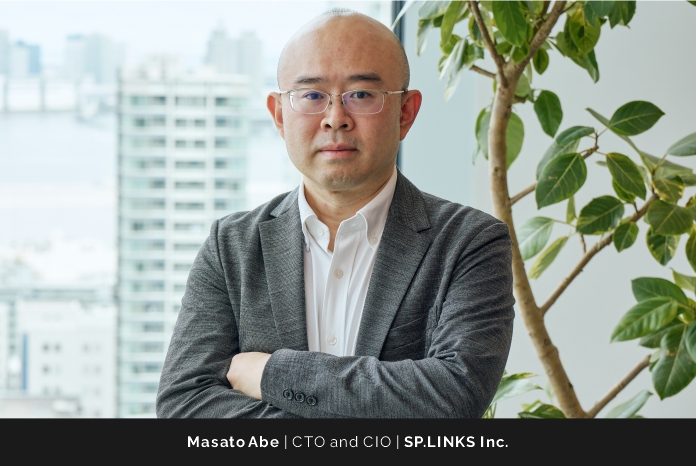
For a boy in elementary school, a computer was a luxury. Masato Abe saved his allowance, delivered newspapers, and finally bought one. He taught himself to program on it, wrote his own games, and handed them to his friends to play. He sent his work to programming magazines. Long before most of the world had heard of the internet, he already knew the particular pleasure of making something with his own hands.
Decades later, that pleasure has not gone anywhere. Abe is now CTO and CIO of SP.LINKS Inc., the company once known as Sony Payment Services and one of the quiet engines behind Japan’s payment infrastructure. The scale of the work bears no resemblance to those early games. What sits underneath it is the same. The joy of building, and an unwillingness to stop.
“Never become satisfied, and never become complacent.” It is the line Abe has held himself to for years. Technology moves. Society moves. A leader who stands still falls behind. His career reads as a long, deliberate refusal to stand still.
At the Center of the Business, Not the Edge of It
Abe started out managing systems for a transportation company. The pull toward larger systems and databases came quickly, and it carried him to one of Japan’s leading database firms. But the technology itself was never the whole point for him. He did not want to build systems on contract from the outside as an SIer. He wanted to stand on the side that grows the business itself.
That instinct took him to Groupon Japan. The company was an early adopter of big data, and Abe learned to scale digital platforms in real conditions, work that fed directly into revenue. His results earned him executive responsibility, equity, and eventually the CTO and CIO seat.
He moved next to EPARK Gourmet, a pioneer in restaurant queue and reservation systems in Japan. The hardest and most rewarding part there had little to do with code. It was building the organization. He grew the technology team from almost nothing to more than a hundred people, delivered on major government projects, and shipped services that ran on national television day after day.
Offers came from Europe and the United States. Abe chose something else. Through an introduction from Blackstone, he entered the world of payments and joined SP.LINKS. He was convinced the company was a place where his experience could push real growth, and through that growth, do something genuinely useful for society.
When the Work Stops Being Your Own
Ask Abe to name the turning point of his career and he points to the move into management at Groupon Japan. Until then his work had been his own. Solve the problem, ship the product, deliver the result through his own effort.
Leadership pulled the ground out from under that. Suddenly he was responsible not for output but for people, for the culture of a team, for the growth of an organization. “A leader’s job is not to maximize your own performance,” he says. “It is to build an environment where the whole team can perform at its best.”
The shift was not comfortable. Developing people, handing them opportunities, advising when needed, pulling a group toward a shared goal, none of it resembled the work of an individual contributor. Through a long run of trial and error, Abe reshaped how he led. The man who once ran on his own results became a leader who builds organizations that can run without him.
The Moment People Decide the Work Is Theirs
Asked about the most significant change he has driven at SP.LINKS, Abe does not hesitate. It was a change in how people thought. When he arrived, much of the work was routine. Many employees focused on finishing their assigned tasks rather than asking who their work actually served.
So he asked them. What does your work mean? Who, in the end, does it help? At the same time, he began pulling work back in-house that had long been handed to outside vendors.
“People get serious the moment they decide the work is their own,” he says. The responsibility is theirs, the response is theirs, and that changes everything. Abe made pride and ownership the starting point of the transformation. New challenges did the rest, because nothing pulls people in like work they find genuinely interesting. He held the balance between steady improvement and fresh challenge, and the organization came alive.
The experience confirmed something for him. Leadership is not only about building systems or rolling out technology. It is about creating the moment when a person takes pride in their work and starts moving on their own. “Watching that change happen in one person after another,” he says, “has been one of the most rewarding things I have done as a leader.”
Writing Down the Rules of Offense and Defense
In an industry that moves this fast, Abe does not chase every new tool simply because it is new. His view is plain. Where the risk of disruption is real, he chooses proven, stable products and mature versions. Where new technology can create genuine value, he moves on it, whether that means bringing in AI or building secure infrastructure along the lines firms such as Gartner advocate.
What holds the two together is a rule he insists on. Every new initiative gets a built-in mechanism to check it. “You can be bold and still keep your discipline,” he says. “That is why we put the standards for offense and defense in writing.” Once those standards are written, decisions stop depending on any one person’s gut and become something the organization can own.
As the executive holding both technology and information strategy, what Abe protects is the balance between the nerve to push change through and the caution to keep the organization’s trust intact.
A Philosophy of Mentorship, From a Man Who Never Had One
Abe never had a mentor. The absence taught him to think for himself, to keep searching for answers alone, to treat both success and failure as material to learn from. That self-direction became the root of how he leads.
He is the first to name its limit. “Very few people can grow on self-direction alone,” he says. “An organization cannot be built on that.” So he does the opposite of what was done for him. He places the right mentors around people, gives them a range of experiences, and trusts them with real responsibility instead of shielding them from it. When trouble is coming, he steps in before it overwhelms them.
The same thinking shapes how he develops the next generation. Whatever the problem, he has people work it through themselves first. Then he reviews it, points out where usability is thin, and when the direction is off, explains why rather than simply correcting it. The point is never the fix. It is to turn the work into something the person learns from on their own.
Mentorship, in his hands, runs both ways. Handing responsibility to someone and supporting them sharpens the mentor too. When both sides understand the weight of their role and grow together, the organization gets stronger. He saw it firsthand on those government projects, where the results came from the team pulling as one and refusing to quit. A leader who only gives orders is no good, and neither is one who manages every detail. “It is not about who can get it done fastest,” he says. “It is about combining your strength to make something bigger.”
Why He Travels to Empty His Mind
When the work has Abe’s attention, he gives it everything and loses track of the hours. He finds it deeply enjoyable. Even at home, his mind keeps turning the problems over. He also knows that running like that without a break does not last, so when it is time to rest, he rests.
His way of resting is travel. He has been to more than twenty countries and has covered a great deal of Japan besides. Doing something outside the ordinary pulls his full attention onto it, and the unfamiliar clears his head in a way nothing at home can. For a man who throws himself entirely into his work, it is how he keeps going for the long haul.
The Quiet Foundation Beneath Every Purchase
SP.LINKS is a payments company, and at its foundation sits something larger than payments. Infrastructure that holds up everyday life. The company looks past the transaction to the experience around it. Its vision is to bring more of the excitement of buying to the world, to use payments to make the act of purchasing richer and more enjoyable rather than merely functional.
“Finance is a service that must never stop,” Abe says. As the country goes cashless, payments only become more essential. For merchants, the difficulty is keeping up with an expanding range of payment methods while holding the line on security and stability. SP.LINKS gives them a stable payments foundation and the flexibility to adapt, so they can adopt and run payments without worrying about what sits underneath. What does sit underneath is the information systems function, watching constantly for new technology and new threats, never allowed to stop evolving.
The company’s own history is a story of evolution. SP.LINKS has been in payments for more than thirty years. Founded in 2006 within the Sony Financial Group, it built the payment infrastructure for e-commerce in Japan when buying things online was still a novelty, including the systems that sold Sony products like AIBO and PlayStation. Its proprietary payment network, the only one of its kind in the Japanese industry, supports highly secure environments across credit card and code payments, alongside its own identity verification offering, the Authentication Assist Service. It is one of the companies that carried Japanese e-commerce through its earliest days.
The turning point came in 2023, with Blackstone’s capital partnership. With access to global investment expertise and resources, SP.LINKS turned away from extending the old model and toward what Abe calls discontinuous growth. He joined through Blackstone to help drive that change. An organization that still had real room to transform began to move, in how it worked, in how it handled technology, in its mindset. The results show in strong EBITDA and in a company increasingly seen across the industry as a technology business worth watching.
Abe does not measure success in numbers alone. “When a service becomes so natural that people use it without thinking,” he says, “that is a real achievement.” For payments to sit inside daily life, trusted and unnoticed, is something he finds deeply meaningful. Beyond that he sees the next stage clearly. Evolving from a platform that simply moves transactions into infrastructure that makes the whole experience of buying smoother, safer, and more enjoyable.
Companies That Stop Evolving Disappear
What will leadership in technology look like over the next decade? Abe’s answer turns on a paradox. “The essence does not change,” he says. A leader has to keep evolving, keep learning, keep moving ahead of the change. That duty holds no matter how fast the tools advance.
What changes is the speed and the scale. Sorting real innovation from passing fashion, and deciding how to bring the valuable parts into the company, is a problem that never ends. In finance and payments the stakes run higher, because stability, trust, and security are not optional. You cannot grab at new technology for the sake of speed. The job is to strengthen the foundation people depend on every day rather than disrupt it, holding innovation and reliability together. “Keep moving forward, and keep changing in the right way,” he says. “Companies that neglect that are simply weeded out.”
So what does Abe want to leave behind? Not the technology, and not the services. “What I want to leave is not the technology or the services themselves,” he says. “It is a team that keeps growing, and the mindset that goes with it.” He has built things he is proud of. He has no intention of stopping. Never satisfied, never complacent, he keeps moving to put value in front of more people, and he does it with others rather than alone. The boy who bought that first computer with a paper route has not let go of what he found there. The joy of building, still unfinished.