
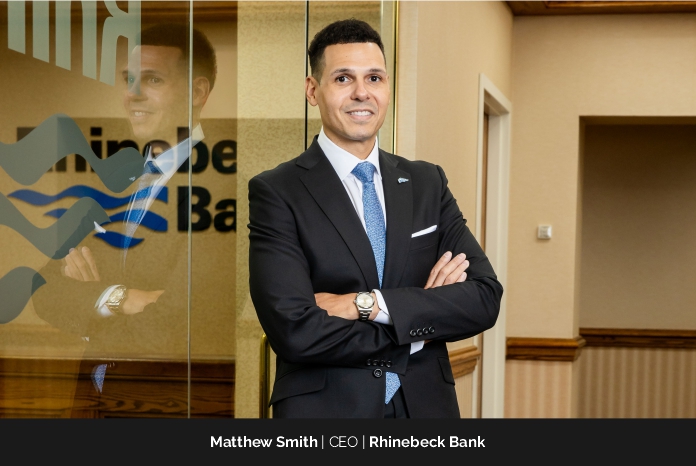
Matthew Smith is the President and Chief Executive Officer (CEO) of Rhinebeck Bank. He also serves on the board of directors for the bank and its holding company. Before this role, he acquired extensive P&L and functional leadership experience having held senior roles at Webster Bank, Bridgewater Associates, and GE Capital.
Matthew holds an MBA in Corporate Finance and Risk Management from Iona University and a Bachelor’s in Finance from La Salle University. His leadership focuses on a tech-forward approach to community banking, relationship-driven services, and digital transformation, including fintech partnerships.
Reinventing Community Banking For a Modern Era
Matthew realized early in his career that financial services sit at the center of everything, from business formation to community development to personal wealth creation. Having built a diverse career across institutions like Columbia Bank, Webster Bank, Sterling National Bank, Bridgewater Associates, and GE Capital, he was drawn to the idea that the work they do has a real, tangible impact on people and businesses, and he gravitated toward environments where performance, discipline, and thoughtful decision-making mattered.
“Whether it was at Webster Bank, GE Capital, or Bridgewater, those experiences shaped how I think about accountability and outcomes. Banking, when done well, is a powerful combination of relationships and rigorous execution. It was these experiences that taught me that strategy is important, but execution is what ultimately defines success,” he reflects.
Having worked most of his career in Finance, Matthew began to see himself as a cross-functional leader rather than a specialist when he realized that real impact doesn’t come from optimizing a single function, but from connecting them. “You can have the best product, but if operations can’t deliver it or the client experience isn’t there, it doesn’t matter,” he observes.
As he moved into broader roles, Matthew became much more focused on how the pieces fit together and on driving execution across the organization. “In my opinion, great leadership is less about functional expertise and more about the ability to assemble the best team and align people, priorities, and execution,” he notes.
He saw Rhinebeck Bank as the perfect opportunity for a bank executive because the Bank had been in existence for over a century and had deep roots, trusted relationships, and a loyal client base. He was inspired by this combination of a strong community franchise and the opportunity to transform and scale it into something much more dynamic.
What excited Matthew most was the opportunity to reinvent the traditional community bank model and evolve it into a modern, high-performing institution that delivers exceptional client experiences across both physical and digital channels. “Staying true to our identity and expanding our client and community-first mindset gives us a solid foundation for growth, while modernizing our products and delivery platforms to meet the evolving needs of current and future clients,” he says.
Priorities For Transforming Community Banking
Among Matthew’s top strategic priorities in his first phase as CEO, culture was a critical factor in the company’s ability to meet its strategic objectives. “Since I started in the role, we’ve worked hard to clearly define the type of organization we want to be, construct a strategic plan which outlines a path to achieve our goals, and reshape our values and performance standards to ensure success,” he says.
In addition to this shift in culture and organizational realignment, Matthew has set three clear objectives for the first phase of the bank’s transformation:
- First, repositioning retail banking as its primary engine for core deposit growth. That means delivering a best-in-class omnichannel experience and focusing on relationship-based funding rather than promotional pricing.
- Second, geographic expansion of its commercial banking business while maintaining credit discipline that drives asset growth, and deepening client relationships, particularly through Treasury Management Services and operating accounts.
- Third, investing in infrastructure (technology, data, and talent) to support long-term scalability, enhance client experience, and enable alternative funding and income opportunities. This includes embedded banking, user experience enhancements, partnership banking, and a more modern operating model.
“Underlying all of this is a cultural shift toward collaboration and accountability. Strategy only works if the organization is aligned to execute,” Matthew insists.
Leadership Lessons From A Cross-Functional Career
Over the course of Matthew’s career, his leadership style has evolved, particularly as he moved into enterprise-wide roles. Earlier on, he recalls being heavily focused on execution within his areas of responsibility by driving results, solving problems, and moving quickly. As he took on broader roles, his perspective has evolved. “I’ve come to see that leadership is less about control and more about alignment by setting clear priorities, establishing accountability, and ensuring teams are working toward shared outcomes,” he reflects.
Matthew also learned that results alone aren’t enough, and that it’s equally important to understand how those results are achieved. Sustainable performance comes from consistently evaluating both outcomes and the behaviors that drive them. “That’s what ultimately creates repeatability and long-term success. As a result, I tend to invest a lot of time in examining performance to consistently improve our results,” he adds.
Matthew lists three factors – clarity, accountability, and adaptability – that define effective leadership in today’s rapidly changing financial landscape. He notes that leaders need to be very clear about where the organization is going and what matters most. They need to create real accountability by not just focusing on activity, but requiring measurable outcomes.
“Leaders also need to remain flexible because the environment is constantly changing. The biggest mistake I see is organizations trying to do too much at once without clearly defining goals and prioritizing. Effective leadership is as much about what you choose not to do as it is what you choose to do,” he explains.
Technology as a Core Driver of Community Banking
Matthew notes that technology no longer plays a supporting function in shaping the future of community and regional banks like Rhinebeck, but is a core driver of competitiveness and revenue generation. He explains that, for community banks, the goal is to use technology to deliver capabilities that historically only large banks could offer, while maintaining the relationship model that differentiates them.
“It used to be that banks could not be all things to all people, but through the invention of open API architecture, banks can now deliver the experience that today’s clients expect at an affordable cost. This includes digital onboarding, full-service mobile platforms, embedded banking partnerships, and data-driven insights. The goal isn’t to become a tech company, but to use technology to enhance the client experience and operate more efficiently,” he affirms.
Building strong teams is essential in fostering a culture that embraces transformation, change, innovation, and accountability. Matthew notes that a critical part of his role in achieving this is getting people to believe that they can do great things, and that starts with alignment and transparency. He observes that people need to understand where the bank is going and how their role contributes to that.
“From there, you build accountability through clear metrics and ownership. We’re very focused on creating a culture where collaboration is expected, and accountability is required. Innovation doesn’t come from isolated teams; it comes from cross-functional execution. It’s also important that we reinforce behaviors through incentives. What you measure and reward ultimately shapes the culture,” he elaborates.
Building a Unified Bank for the Next Decade
In his plan to drive Rhinebeck Bank’s next phase of growth, Matthew believes that alignment of technology, operations, and customer experience comes from starting with the client and working backward. They define the experience they want to deliver, then ensure operations and technology are designed to support that experience seamlessly. “That’s how you avoid fragmentation,” he observes.
Rhinebeck Bank is investing in API-driven infrastructure, digital servicing capabilities, and data platforms that allow it to connect those functions more effectively. The goal is a unified experience where the client doesn’t feel the complexity behind the scenes.
Another key part of alignment is having shared objectives that are reviewed cross-functionally. The bank has established a process where it sets corporate goals that then translate to department goals, and then individual goals. Department heads are encouraged to review each other’s goals to ensure alignment of objectives and timing. This ensures that they’re all operating under the same set of expected outcomes.
Of all the standout trends that Matthew believes will most significantly reshape the banking industry over the next decade, the first is evolving client expectations, which will force banks to shift toward digital and embedded banking solutions. “Clients will expect financial services to be integrated into their daily lives, not separate from them,” he predicts.
The second, he notes, is the importance of data and AI in driving personalization, efficiency, and risk management. The third is increased competition, not just from banks, but from fintechs and non-traditional players. And finally, he notes that funding will become more strategic, and the banks that win will be the ones that build stable, relationship-based deposit franchises.
Having been recognized for growth and innovation throughout his career, Matthew shares that the achievements he values most are the ones where he helped build something sustainable, including organizations or platforms that continued to perform beyond any one individual. “Transformation isn’t about short-term results. It’s about building capabilities, teams, and culture that drive long-term performance. Being part of that kind of impact is what I’m most proud of,” he reflects.
Understand Why You Do What You Do
Matthew offers the following words of advice to emerging leaders aiming to build impactful careers in financial services: Focus on learning how the business really works, not just your function, but the entire organization. Early in our careers, we’re often placed into task-based roles. The individuals who stand out are the ones who take the time to understand why they’re doing the things they’re being asked to do.
Anyone can blindly perform a task, but understanding the why behind the action will help lead to improvements and better outcomes. Take on roles that expand your perspective, even if they’re uncomfortable. That’s where growth happens. Build a reputation for execution. Ideas matter, but results matter more. The people who consistently deliver are the ones who earn opportunities over time.
Conclusion
Matthew Smith’s legacy at Rhinebeck Bank is about building something sustainable: a modern community bank that stays true to its identity while delivering exceptional client experiences. He proves that great leadership is less about control and more about alignment and accountability. His lasting impact is the culture, capabilities, and teams he has built to drive long-term performance beyond any one individual.