
There exists an invisible, yet trillion-dollar crisis for the modern enterprise information technology environment. Over many years, enterprises have increased their IT capabilities by creating or purchasing application software to solve specific business problems. Consequently, there emerges an environment that consists of many disparate data silos and rising costs of IT management. Traditional IT consulting regards such complexity as a necessary evil while another approach to managing enterprise information sees the problem in putting application ahead of the data.
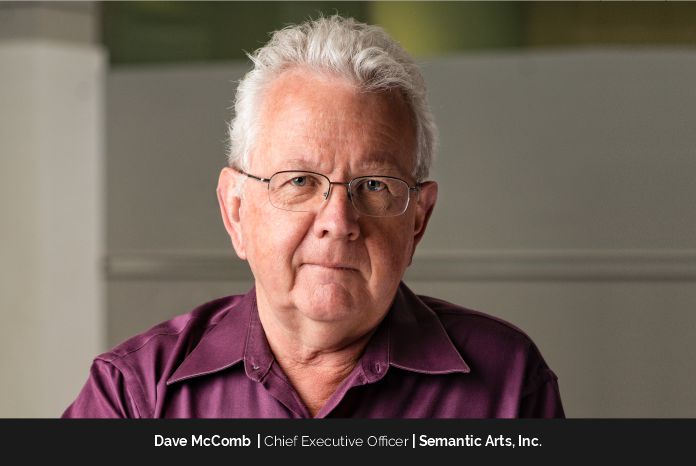
Leading this new approach is Dave McComb, CEO of Semantic Arts, Inc. Since establishing the firm in the wake of the dot-com crash in 2000, Dave has championed data-centricity, an approach that treats shared, standardized data models as the permanent core of an enterprise, reducing software applications to transient interfaces.
By grounding system design in the real-world concepts of a business domain rather than the arbitrary structures of vendor-supplied software, Dave and his team are pioneering a path for organizations to simplify their technology stacks and take direct control of their digital architecture.
The Architecture of Simplicity: Origins of a Data-Centric Vision
The foundational concepts behind Semantic Arts originated nearly a decade before the company was established. During his tenure in management consulting at Andersen Consulting (now Accenture), Dave observed a recurring pattern in enterprise software projects. Every time an organization implemented a new application to address an operational need, it inadvertently created another data silo.
Dave realized that traditional database design lacked an objective baseline. While database normalization provided mathematical rules for structuring data, two designers working on the same domain would routinely produce completely incompatible models. This inconsistency occurred because developers accepted superficial descriptions of business processes provided by subject matter experts, rather than analyzing the underlying reality of the business environment.
“The epiphany was that the reason so many data models were so arbitrarily different was that designers accepted simplistic representations of the domain,” says Dave. “By grounding a design in the deeper, real-world concepts that the system is attempting to implement, almost all the arbitrariness melts away.”
Recognizing the immense inefficiency inherent in application-centric IT, Dave envisioned a paradigm shift. If an organization models its core domain concepts once, using formal semantics, the resulting data structure becomes stable. Applications can then be built or replaced around this unified data core without requiring constant, expensive re-engineering of the underlying information.
Navigating the Adoption Curve: A Quarter-Century of Incremental Progress
Transitioning an industry away from legacy application architectures is a long-term endeavor. When Semantic Arts was founded in 2000, the firm’s primary focus was navigating the immediate economic fallout of the dotcom bust. Over the subsequent decades, the company established its position in the market through a steady sequence of strategic pivots, educational initiatives, and published works.
In 2001, the emergence of the Semantic Web framework highlighted the technical viability of graph-based, semantic data models. To help bridge the gap between academic concepts and enterprise implementation, Dave authored Semantics in Business Systems in 2002 and co-founded the annual Semantic Technology Conference in 2007, running it alongside Dataversity for ten years.
A major operational inflection point occurred around 2012, when Semantic Arts expanded its scope from a pure design and architecture firm into a full-service design-and-build practice. This shift enabled the team to directly construct and deploy data-centric environments for clients, demonstrating the practical value of semantic technology in production settings.
“The world doesn’t care if you survive and thrive unless you are relevant and necessary,” notes Dave. “There are not thousands of firms providing data-centric transformational shepherding.”
The publication of Dave McComb’s books, Software Wasteland and The Data-Centric Revolution, further solidified the movement’s core tenets. Through these works and direct client engagements, Semantic Arts has demonstrated that organizations fully embracing data-centricity can drastically reduce long-term IT expenditure while improving the accuracy and speed of data-driven decision-making.
Sustainable Governance and Organizational Permanence
As Semantic Arts expands its impact, Dave is structuring the company to ensure its core mission outlasts any individual leader or ownership cycle. The firm has transitioned its ownership structure into a perpetual benefit trust, ensuring that Semantic Arts cannot be bought or sold.
By removing the traditional external pressure to maximize short-term profit at the expense of long-term purpose, the trust structure aligns the company’s operational goals directly with its founding mission: expanding the adoption of data-centric architecture across global enterprises.
To support this structure, internal leadership responsibilities are shifting toward employee self-governance. The company’s operational direction is managed by the President and COO, while Dave focuses on strategic objectives and a long-term program to tutor the new governance committee in the ability to craft strategic decisions in the long-term interest of the firm.
“The traditional impetus to maximize profit has been supplanted by the goal of maximizing the chance that there is a profit,” explains Dave. “The employees are taking on the mantle of leadership.”
Strategic Objectives and the Road Ahead
Looking toward the next decade, Semantic Arts is focused on addressing a primary practical challenge facing large-scale data transformation. While major multinational corporations recognize the theoretical value of data-centricity, implementing structural architectural changes across massive, legacy-bound enterprises requires an incremental, multi-year approach.
To accelerate proof of concept at scale, Semantic Arts has launched an initiative aimed at designing and building fully data-centric architecture within mid-sized enterprises. By establishing mid-sized organizations that operate entirely on semantic, data-centric foundations, the firm aims to create clear, operational blueprints for the broader industry.
Beyond operational software, Dave also envisions significant transformation in specialized business domains, including enterprise accounting and financial tracking. By replacing legacy ledger mechanics and multi-step closing processes with real-time, semantically modeled transaction networks, data-centric architecture offers a modern alternative to centuries-old financial record-keeping practices.
Personal Discipline and Strategic Leadership
Leading an organization dedicated to challenging established industry norms requires balancing intense focus with operational sustainability. To manage the competing demands of strategic writing, architectural design, and corporate management, Dave structures his workweek around a clear distinction between creative work and administrative oversight.
Drawing inspiration from classic management concepts regarding creative “makers” versus administrative “managers,” Dave separates his schedule into dedicated blocks. By dedicating specific days entirely to deep design and writing work, and allocating remaining time to administrative leadership, he maintains the mental focus necessary to drive complex technical strategy.
“To truly transform an industry, you need to master the glass bead game,” says Dave, referencing Hermann Hesse’s classic novel Magister Ludi. “To excel at the glass bead game, you have to bring all possible knowledge to bear at the point of a key decision. Simplistic bromides don’t cut it. You need the conviction of your truth, and the ability to articulate the reasons to not go down the well-worn paths.”
Leaders looking to build organizations that can create industry change must be aware that technical skills are not enough, according to Dave. What is needed is to develop advisers who not only have strong technical expertise but also an in-depth knowledge of the business domain and help the client move away from purchasing software and instead focus on sustainable and self-controlled digital infrastructure.
Through its consulting activities, literature, and data-centric philosophy, Semantic Arts lays the groundwork for a world where organizations will be in full control of their own data without any structural complexity.