
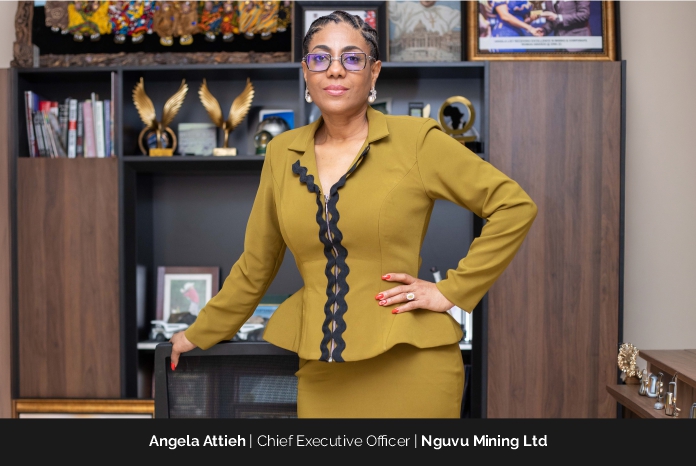
Long before the headlines, boardrooms, and operational pressures of mining leadership became part of her everyday life, Angela Attieh never imagined she would spend decades navigating one of Africa’s most demanding industries. Her entry into mining was not driven by ambition, strategy, or even personal interest. It began with a sense of responsibility, the kind that arrives unexpectedly and leaves no room to walk away.
Today, Angela serves as the Chief Executive Officer of Nguvu Mining Ltd, where she has spent years leading operations many believed could not survive. Her work has gone far beyond keeping a business afloat. It has been about protecting livelihoods, preserving communities, and proving that struggling mines can still create value when guided with patience, discipline, and long-term vision. What makes her journey particularly remarkable is not simply the scale of the responsibility she carries, but the steady determination with which she carries it.
Mining is often viewed through the lens of production targets, commodity prices, and corporate performance. Yet behind every operation are thousands of people whose futures depend on the decisions being made. Angela understands that reality deeply. Her leadership has been shaped not only by financial pressure and operational challenges, but by the awareness that entire communities can rise or fall depending on whether a business chooses to keep fighting or surrender when circumstances become difficult.
A Career That Was Never Part of the Plan
Angela’s path into mining was driven by her instinct to confront and solve difficult challenges head-on. At a critical point in her career at KPMG, she stepped away from the certainty of corporate life to help rescue and stabilize a struggling family business connected to mining support services. What began as a temporary six-month intervention quickly evolved into something far greater.
Life, however, had different plans. “One thing led to another, and before I knew it, 25 years had gone by,” she explains.
What initially felt temporary slowly became a long-term commitment. As Angela immersed herself in the realities of the industry, she began to understand how deeply mining operations influence the social and economic fabric of surrounding communities. Mines are not isolated businesses existing on their own. They support workers, contractors, local suppliers, schools, families, and entire towns that depend on economic activity generated by those operations.
Over time, Angela realized she was no longer simply helping a business survive. She was helping people maintain stability and opportunity in environments where alternatives were often limited.
That same sense of responsibility eventually shaped the creation of Nguvu Mining. The company emerged during a difficult moment when a multinational operator exited Ghana, leaving behind a mine that was expected to shut down within eighteen months. At the time, closure appeared inevitable. The remaining life of the mine was limited, and many believed continuing operations no longer made financial sense.
Angela saw the situation differently. “Once I saw how much rode on those decisions, jobs, families, entire communities, I couldn’t walk away,” she says.
Where others saw decline, she saw responsibility. She understood that closure would not simply affect balance sheets. It would disrupt lives on a massive scale. Families who had built their futures around the mine would suddenly face uncertainty. Local businesses dependent on mining activity would suffer. Entire communities could lose economic momentum overnight.
Rather than accepting closure as unavoidable, Angela and her team focused on exploration and metallurgical work to identify new opportunities within the operation. The process required persistence, technical problem-solving, and a willingness to continue investing effort and significant funds into a mine many had already given up on.
By the grace of God and the hard work of the team, the company succeeded in discovering additional ounces and extending the life of the operation well beyond expectations. Nine years later, the mine continues operating and supporting more than 1,200 jobs.
Leading with Stewardship Instead of Short-Term Thinking
For Angela, becoming CEO fundamentally changed the way she viewed business leadership. It forced her to move beyond traditional corporate thinking and focus more deeply on human impact.
“Running a mine at the end of its life taught me that business is stewardship,” she explains. “You’re managing for the people who depend on you, not just the next quarter.”
That philosophy sits at the center of everything she does. While profitability and operational efficiency remain essential, Angela believes leadership requires looking beyond immediate financial returns. Businesses, especially those operating in industries like mining, carry obligations that extend far beyond shareholders alone.
Her long-term thinking often contrasts with the short-term mentality that dominates many industries today. Angela believes companies should continue investing in solutions and future growth even during difficult periods rather than abandoning operations simply because circumstances become challenging.
“It seemed like an extremely optimistic plan at the time,” she recalls when discussing efforts to revive the mine. “Most people probably think I am too optimistic about business in general.”
Yet her optimism is grounded in practicality. She understands the risks and realities of mining, but she also believes resilience matters most when conditions become uncertain. Walking away may sometimes appear easier, but Angela believes leadership requires fighting for possibilities others no longer see.
“My long-term view is driven by the ecosystem that is supported by the business and not just the business on its own,” she explains.
That perspective has shaped the culture at Nguvu Mining. Decisions are not made solely around immediate gains. Instead, there is constant consideration of how operations affect employees, surrounding communities, and the long-term sustainability of the business itself.
Navigating Financial Pressure and Constant Uncertainty
Few industries operate under the same level of financial pressure as mining. Access to capital remains one of the greatest challenges Angela has faced throughout her leadership journey. Building and sustaining mining operations requires enormous investment, and companies operating in Africa often face expensive financing structures and limited access to affordable capital.
“We’ve persevered with expensive loans and by recycling revenue back into the business,” Angela explains. “You learn to prioritize ruthlessly when the stakes are that high.”
Every decision matters in such an environment. Resources must be allocated carefully, operational risks must be managed constantly, and there is little room for waste or complacency. Angela has learned that survival often depends on making disciplined decisions under pressure while continuing to focus on the bigger picture.
The challenges extend beyond finances alone. Angela also speaks openly about the personal scrutiny that comes with leadership. Public criticism and media attention in Ghana, she says, can sometimes become deeply aggressive and personal.
“The media in Ghana can be ruthless,” she says candidly. “I never expected that people would attack private business and personalities.”
As someone who naturally values privacy, she admits that public attention has been difficult to navigate. Yet over time, Angela has learned to separate external noise from the work itself. Her focus remains firmly on sustaining operations and protecting the people connected to the business.
Being a woman in a heavily male-dominated industry has created additional challenges as well. Angela acknowledges that leadership qualities admired in men are not always viewed the same way when displayed by women.
“I’m often seen as being too daring,” she says.
Still, she has never allowed those perceptions to change the way she leads. Instead of trying to fit expectations, Angela continues to focus on performance, resilience, and responsibility.
The Emotional Weight of Leadership
One of the most striking aspects of Angela’s leadership style is her honesty about the emotional burden leadership can carry. She does not present success as effortless or glamorous. Instead, she speaks openly about exhaustion, sacrifice, and the pressure of knowing so many people depend on the company’s survival.
Balancing work and personal life remains an ongoing challenge. “By being disciplined and delegating,” she says when asked how she manages balance. At the same time, she openly admits that maintaining equilibrium is not easy. “I cannot say it’s easy, or that I do either very well, but I try,” she says honestly.
The demands of the business often spill into family life, and Angela acknowledges that her loved ones sometimes carry part of the burden created by the pressures she faces professionally. Yet despite the exhaustion, she continues showing up each day because she understands what is at stake.
“Sometimes I feel like giving up, honestly,” she shares. “But I often wake up with a throbbing migraine and still show up because I understand how many people depend on me.”
Those words reveal a side of leadership that is rarely discussed publicly. Employees often look to leaders for confidence and reassurance, even during moments when leaders themselves feel uncertain or overwhelmed.
“When things are tough and they get worried, I know they look into my eyes for a sign that everything will be okay,” Angela says. “So I keep smiling through the storm so they can have hope in the future.”
That quiet resilience has become one of the defining qualities of her leadership.
Building Sustainability Beyond Profit
Angela’s definition of success in mining extends far beyond financial metrics or operational output. She believes the true measure of success is what remains after the mine eventually closes.
“When the mine closes with the land rehabilitated, the workforce upskilled, and the community better off than before, that is success,” she explains. This philosophy continues to influence the way Nguvu Mining approaches sustainability and community development. The company focuses not only on extending mine life responsibly, but also on creating opportunities that leave lasting value behind.
Training and workforce development remain key priorities because Angela believes employees should leave with skills that continue benefiting them long after mining operations end. She also emphasizes the importance of reinvesting revenue back into exploration and operational improvements rather than focusing solely on short-term returns.
For Angela, sustainability is not simply about environmental responsibility. It is also about ensuring communities remain stronger because of the business’s presence.
Innovation as a Tool for Survival
Innovation has played a critical role in keeping Nguvu Mining operational. Angela speaks about exploration and metallurgy not as abstract technical concepts, but as practical tools that helped create a path forward when closure seemed likely.
“It has kept us alive,” she says.
Today, innovation remains central to the company’s future. Efforts continue around improving recovery rates, reducing operational costs, and minimizing dependence on expensive debt structures. In challenging business environments, Angela believes innovation must focus on practical impact rather than trends or appearances.
For her, innovation is valuable only when it creates stability, efficiency, and long-term sustainability.
Encouraging Future Leaders to Embrace Difficult Challenges
Angela is deeply passionate about mentoring the next generation of leaders, especially women entering industries traditionally dominated by men. She believes leadership is demonstrated through action and consistency rather than motivational speeches alone.
“Perseverance is the only way out and giving up is not an option,” she says.
Her advice to young professionals across Africa is grounded in realism and experience. She encourages them to step into difficult situations rather than avoiding them and to become comfortable operating under uncertainty.
“Step into the messy problems others avoid,” she advises. “Learn the technical core, be comfortable with risk, and make better judgments when capital is scarce.”
Throughout her career, Angela has learned that some of the most meaningful opportunities emerge from difficult circumstances. Growth rarely happens in comfortable environments, and resilience is often developed during periods of pressure and instability.
Leaving Behind More Than a Business
When Angela speaks about legacy, she does not focus on recognition or personal success. Instead, she hopes her work changes how people think about distressed assets and struggling businesses across Africa.
“That distressed mines aren’t dead ends,” she says simply.
She wants to demonstrate that difficult operations can still create value when managed responsibly and with long-term commitment. Her hope is that others will continue building on this model, proving that businesses can survive while also strengthening the communities around them.
At its core, Angela Attieh’s story is not only about mining. It is about perseverance, responsibility, and the quiet strength required to keep moving forward when circumstances become overwhelming. Through years of financial pressure, operational uncertainty, public scrutiny, and personal sacrifice, she has remained committed to protecting livelihoods and creating hope where many expected decline.
Angela’s journey reminds us that leadership is not always defined by titles, visibility, or recognition. Sometimes, it is defined by the ability to continue showing up during difficult moments, to keep believing in possibilities others no longer see, and to carry responsibility with grace even when the weight feels overwhelming.