

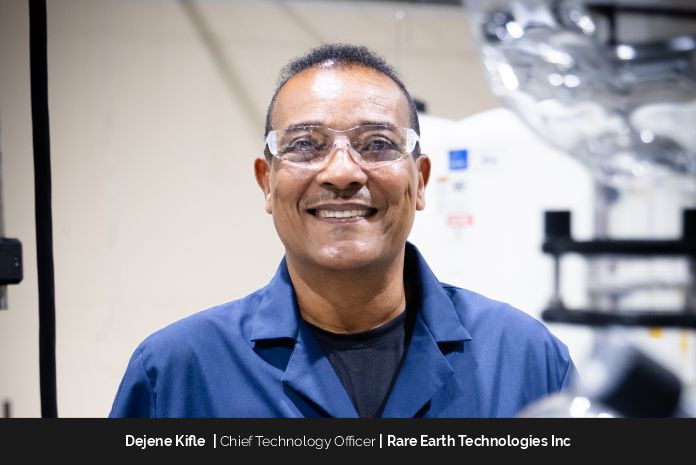
Dr. Dejene Kifle is the Chief Technology Officer and founder of Rare Earth Technologies Inc., and the inventor of HPLC and SPE technologies for the extraction and separation of rare earth elements. A globally recognized expert in critical metals chemistry, he holds six granted patents, three pending, and numerous peer-reviewed publications.
Dr. Kifle earned his Ph.D., M.Sc., and B.Sc. in separation and analytical chemistry from the University of Oslo. His industry experience includes R&D Manager at REEtec AS, consultant to K. A. Rasmussen AS on precious metals refining, and founder of NovaChem PLC, a consulting firm serving companies in rare earth and precious metals extraction and refining.
He combines deep academic training with proven industrial leadership to advance sustainable, scalable solutions for the critical materials supply chain.
From Lab Bench to Global Impact
Dr. Kifle’s journey began with a deep curiosity about the natural world and a desire to understand how we can extract value from it responsibly. Growing up, he witnessed the gap between resource abundance and technological capability, which planted the seed for his life’s work. His academic training at the University of Oslo – culminating in a Ph.D. in chemistry and extractive metallurgy – gave him the rigorous foundation to explore how chemistry could solve real-world problems.
“The challenge of separating rare earth elements (REEs) and platinum group metals (PGMs), which are chemically nearly identical yet critical for modern technology, became my intellectual passion. I saw an opportunity not just to advance science, but to build a bridge between laboratory innovation and industrial-scale impact,” he reflects.
Dr. Kifle’s path to Rare Earth Technologies was built step by step, from the lab bench to the executive suite. Starting as a PhD candidate and postdoctoral fellow at the University of Oslo, he developed the world’s first extraction chromatography technology for rare earth separation.
That breakthrough led him to REEtec AS in Norway, where, as a research scientist, he scaled the technology into a commercially viable business worth over $100 million. He then founded NovaChem LLC, gaining invaluable experience in entrepreneurship, investment, and commercialization. In 2021, he founded Rare Earth Technologies Inc. (RETI) in the United States, where his scientific achievements were recognised through the granting of an O-1 visa for individuals with extraordinary ability in the sciences. As RETI continued to grow, his status was adjusted to an EB-1 visa in 2026, granting him permanent U.S. residency in recognition of his internationally acknowledged contributions to science, innovation, and executive leadership.
The definitive milestone of Dr. Kifle’s professional life was developing the first-of-its-kind extraction chromatography method for the industrial separation of rare earth elements and successfully scaling it into a business worth over $100 million. It validated years of research and proved that green, efficient separation was not just a laboratory dream, but an industrial reality.
“The technology I pioneered at the University of Oslo became the cornerstone of a commercial operation, demonstrating that sustainable chemistry can compete with – and outperform – traditional solvent extraction methods. It also opened the door to my current work at Rare Earth Technologies, where we are pushing the boundaries even further,” he explains.
“Sustainability is not a constraint on innovation; it is the engine that drives the next generation of discovery.”
Building a Sustainable Domestic Rare Earth Supply Chain
In 2021, Dr. Kifle joined Rare Earth Technologies Inc. as Founder and CTO, bringing together his deep technical expertise and vision for a greener, more sustainable approach to critical metals production. He manages the technology team, overseeing the scaling of their novel column chromatography technology, and drives the development of low-cost, high-throughput stationary phases for rare earth separation.
He also leads efforts to extract rare earths from non-conventional sources like Nd-Fe-B magnet scrap and phosphogypsum. Beyond the lab, he represents their technology to partners, investors, and policymakers, ensuring that their mission – to build a sustainable, domestic rare earth supply chain – gains the support it deserves.
Dr. Kifle notes that Rare Earth Technologies brings a green, waste-free, and low-cost alternative to traditional rare earth separation. Their one-pass column chromatography technology eliminates the toxic waste, high energy consumption, and multiple steps typical of solvent extraction.
They also offer unparalleled flexibility, capable of processing diverse feedstocks – from mining ores to recycled magnets and industrial byproducts. “My contribution is the technical vision and the deep expertise to make this vision a reality. I’ve spent over a decade refining these methods, and am now leading the team that will bring them to commercial scale in the United States,” he shares.
Driving Forces Behind a Greener Future
Throughout Dr. Kifle’s career, three principles have been his compass: sustainability, innovation, and impact. Sustainability drives him to develop green, waste-free technologies – like their one-pass column chromatography method that eliminates toxic byproducts. Innovation means never accepting the status quo; he constantly asks how they can do better, faster, and cleaner.
Impact is about ensuring their work matters – not just for shareholders, but for the nation’s security, the environment, and future generations. “These values are reflected in everything from my patented stationary phases to my collaborations with national laboratories and universities,” he emphasizes. “My primary responsibility is to develop and implement the company’s technology strategy, ensuring that our innovations are not just scientifically sound, but commercially viable.”
“True innovation is not about doing things differently; it’s about doing things better, cleaner, and with lasting impact.”
Adapting to Change and Investing in People
Dr. Kifle cites the shift toward sustainability and the circular economy as the most significant industry development, noting that traditional rare earth separation relies heavily on solvent extraction, which generates large volumes of toxic waste. “I responded by developing extraction chromatography methods that are inherently greener, using less energy, fewer chemicals, and producing minimal waste,” he explains.
Another shift he highlights is the increasing focus on domestic supply chains. “With China controlling over 90% of global rare earth production, the U.S. needs alternatives. I’ve adapted by focusing our technology on U.S.-based feedstocks and building partnerships with domestic mines and recyclers,” he shares.
However, the accomplishment that holds the deepest personal meaning beyond the patents, publications, and business milestones is Dr. Kifle’s impact on people and communities. He has volunteered extensively in Ethiopia, co-supervising master’s and PhD students, and sharing his knowledge with government agencies and universities.
“Seeing young scientists develop their own passion for critical metals and sustainability is profoundly rewarding,” he says. “I also take pride in the collaborations we’ve built – with national laboratories, universities, and industry partners – because they represent a collective effort to solve a global challenge.”
Leadership, Culture, and Lessons from Scaling
Dr. Kifle notes that balancing his demanding role requires intentionality. He prioritizes by focusing on what truly moves the needle – whether it’s a critical technical decision, a strategic partnership, or mentoring a team member.
“I also believe in the power of delegation and trust: I’ve built teams of exceptional people who share our vision, and I empower them to take ownership. Personally, I make time for reflection and continuous learning, which keeps me grounded and inspired. My work is deeply meaningful, which makes the demands feel less like burdens and more like privileges,” he reflects.
Dr. Kifle fosters a culture of curiosity, collaboration, and courage. He believes that curiosity drives us to explore new ideas; collaboration ensures we build on each other’s strengths; and courage allows us to take calculated risks and learn from failures. He encourages his team to challenge assumptions and to question ‘how things have always been done.’
“I also prioritize mentorship, having supervised numerous master’s and PhD students, and bring that same commitment to developing talent within my company. By creating an environment where people feel safe to innovate, we consistently push the boundaries of what’s possible,” he observes.
Dr. Kifle’s most significant challenge was transitioning groundbreaking laboratory research into a commercially viable industrial process. At REEtec AS, scaling extraction chromatography from the bench to a pilot plant demanded not just technical ingenuity, but also the ability to lead a team through uncertainty, adapt to failures, and maintain morale.
“I learned that leadership is not about having all the answers but about creating an environment where the team can find them together. This experience taught me to embrace iterative problem-solving, to communicate transparently, and to trust my team’s expertise. Today, as we scale again at Rare Earth Technologies, these lessons are more relevant than ever,” he maintains.
“The rarest element that is not found in the earth is the courage to turn a laboratory breakthrough into an industrial reality.”
Vision for a Sustainable Future
Dr. Kifle notes that his work is about ensuring that future generations have access to the critical materials they need – without sacrificing the planet. Rare earths are essential for clean energy, defense, and electronics. By making their production greener and more sustainable, he is helping to build a future where technology and environmental stewardship go hand in hand.
“I also see my work as a blueprint for innovation in other fields: demonstrating deep science, when combined with entrepreneurial vision, can solve seemingly intractable problems. If we can separate rare earths cleanly and efficiently, we can apply similar principles to other critical materials,” he observes.
He offers these sage words of advice to aspiring leaders who want to make an impact in technology and innovation: First, master your craft. True innovation requires deep expertise. Spend years building your knowledge and skills before you try to change the world. Second, think long-term. The most impactful innovations take time – be patient and persistent.
Third, embrace sustainability. The technologies of the future must be green and responsible; anything less is not a solution, but a problem deferred. Fourth, build bridges. No one innovates alone. Collaborate across disciplines, sectors, and borders. Finally, stay curious. The moment you think you know everything is the moment you stop growing.
“We are not just separating elements; we are building bridges between science, industry, and a sustainable future.”
Conclusion
From his early academic work at the University of Oslo to his current leadership at Rare Earth Technologies, Dr. Kifle has remained steadfast in his mission to make critical metals production cleaner, more efficient, and more sustainable. His journey – from developing breakthrough chromatography methods to scaling them into commercially viable technologies – reflects a rare combination of scientific rigor, entrepreneurial vision, and a deep commitment to people and the planet.
With six patents, numerous publications, and a growing portfolio of industry partnerships, he continues to push the boundaries of what is possible in rare earth separation. Yet for Dr. Kifle, the true measure of success lies not in accolades alone, but in the legacy he builds: a greener supply chain, a stronger domestic industry, and a new generation of scientists inspired to carry the work forward.