
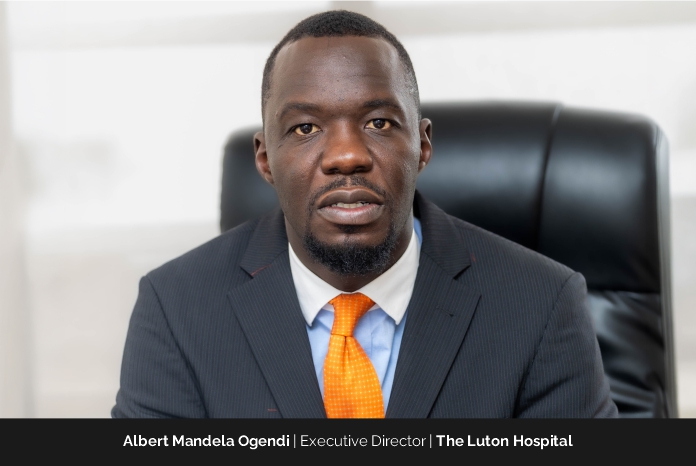
Long before he took charge of Luton Hospital, Albert Mandela Ogendi was already living the demanding reality of the medical world. Growing up as the son of a healthcare worker, Albert spent his early years helping look after neighbors and relatives who turned to his father for help. He saw early on how quiet dedication builds immovable trust.
Then life handed him the view from the hospital bed. Managing childhood convulsions until age 13, surviving a horrific car crash at age eight that cost him his spleen and broke his leg, and then fracturing that same leg at 11 doing backyard backflips, he logged serious time as a patient.
That dual upbringing gave Albert an outlook few hospital leaders possess. From his father, he learned that leading means serving. From his own hospital stays, he learned what true vulnerability feels like.
“For me, leadership in healthcare is therefore not simply about running a hospital. It is about creating an institution worthy of that trust.”
That belief sets the pace for how Albert directs operations today. For this industry leader running a hospital is about far more than managing beds and staff. It comes down to honoring the faith families place in his team, bringing back hope, and sending people home healthy.
Bedside Manner, Builder Mindset
According to Albert, choosing healthcare was never a single lightbulb moment. Enthused by a raw desire to make a difference and an innate knack for building businesses, he found a sweet spot where authentic human care meets scalable institution building.
Before founding Luton, Albert ran enterprises importing pharmaceuticals and medical supplies. When COVID-19 hit, supply chains stalled, freight prices skyrocketed, and deliveries turned unpredictable. Facing those bottlenecks head-on sparked a pivotal shift in his thinking. Instead of fighting supply delays, he realized it was time to step onto the front lines and deliver the care directly.
Yet stepping into executive leadership meant far more than expanding a business footprint. As he puts it, “Leadership gives you the ability to shape systems, culture, and standards that ultimately affect thousands of people’s lives.”
Pride at the family dinner table played its part, too. When his eldest son was five, the young boy could easily tell classmates his mother was a lawyer, but explaining his father’s complex import logistics left everyone confused. Today, his son has a single, crystal-clear line.
“My dad runs Luton Hospital,” Albert beams.
As the years passed, thoughts on long-term stability and lasting legacy took center stage. In the end, Albert’s calculus came down to a mix of childhood memories, entrepreneurship, market disruptions, and family pride, all converging to make Luton Hospital his ultimate build.
Spinning Plates Without Dropping Balls
Albert refuses to let an executive title swallow his whole identity. Guided by a friend’s reminder that “You can’t be one thing,” he actively protects the roles that make him human. Be it father, son, brother, friend, or lifelong student, he moves fluidly between them.
At home, the executive suite holds zero currency. His sons care about having a dad around, just as his parents focus on having their son present. Friends often tease that he somehow operates on a 48-hour day, but his secret comes down to strict intentionality.
“I don’t believe balance simply happens,” Albert notes, “you create it.” Carving out space for family, tennis, golf, yoga, travel, and continuous study demands discipline and the occasional firm no. It keeps him level-headed, focused, and ultimately competent at the helm of the hospital.
Balancing Care and Capital
“You cannot sacrifice patients for profit, but neither can you sustainably care for patients if the institution itself cannot survive.” Albert runs Luton right along that line. To him, winning in healthcare requires a steady grip on three specific fronts: patients, people, and the balance sheet.
For patients, the true metric lies in restored hope, reunited families, and smiles. Albert considers direct “Thank you, Luton,” notes from former patients the greatest win. His team tracks feedback, complaints, compliments, and step-by-step patient journeys to ensure reality matches the high standard Luton promises.
The second metric centres on their people. The healthcare workers and colleagues delivering that care. Albert and his team monitor employee engagement, retention rates, and general workplace culture.
Finally, the numbers must make sense. As a business leader and shareholder, Albert keeps a close eye on the balance sheet to confirm the hospital grows, builds value, and generates sufficient funds to reinvest in technology, infrastructure, and staff.
Learning on the Fly
Albert faced plenty of hurdles moving from investment banking to entrepreneurship. However, taking the reins at a hospital as an outsider was easily his biggest test. He had never worked inside a medical facility, lacked a clinical background, and had not climbed the standard corporate ladder. Suddenly he was responsible for starting a hospital, putting together a medical team, guarding shareholder capital, and calling the shots in a field where errors cost human lives.
Before stepping into that role, his healthcare background came down to his own stays as a patient, along with watching hours of TV shows like Scrubs and Grey’s Anatomy.
He had to catch up fast. Albert immersed himself in healthcare management, constantly picking the brains of doctors, nurses, administrative staff, patients, and industry leaders. He asked tough, uncomfortable questions and accepted that he needed to slow down before pushing full speed ahead.
That steep curve delivered a massive dose of humility. To him, leadership was never about claiming to have all the answers. It meant recognizing his own blind spots, bringing in experts who knew more than he did, listening closely to their input, and taking full ownership of the final decision.
The Three Non-Negotiables
Ask Albert what excellence in patient care really comes down to, and his answer is clear. Accountability, care, and patient safety. For him, these are not ideals to admire. They are criteria that have to hold up in everyday practice.
Accountability begins the moment a patient is placed in Luton’s hands. A shift ending or a patient moving between departments does not pass that responsibility elsewhere. Teams are expected to own what happens to the patient and go above and beyond when needed.
“Healthcare cannot become purely transactional.” That sentiment sits at the heart of Albert’s approach to care and Luton’s ICARE philosophy. Behind every patient number, claim, or medical file is a person, often with a family, placing their trust in the hospital during one of life’s most vulnerable moments.
Albert’s teams are encouraged to take ownership of problems, while caring remains everyone’s responsibility, not just that of doctors and nurses.
Patient safety is non-negotiable. Financial pressures, operational challenges or unexpected circumstances cannot come at its expense. When difficult decisions arise, Albert expects leaders to ask one question first. “Is the patient safe?” That is the standard he expects teams to uphold, even when he is not in the room.
Ideas Without Borders
“Luton is a product of its people.” As Albert sees it, that means giving those people a real voice in how the institution grows. He values committees because they bring departments together, loosen rigid seniority barriers and give people responsibility. They also help identify and nurture future leaders.
At least once a year, this healthcare steward makes a point of meeting departments directly, whether over breakfast, lunch or through spontaneous conversations with staff. He wants to hear what people are actually experiencing, not just what reaches him through formal channels.
Many of Luton’s best ideas, he believes, have come from people doing the work every day. His job is not to have every answer, but to create an environment where good ideas can come from anywhere, people feel heard, and they have the freedom to turn those ideas into action.
From Idea to Institution
There was no established culture, ready-made team, or decades of history when Luton began. Albert and his team had to put the pieces in place themselves, from people and systems to clinical relationships, infrastructure and reputation, all while tackling the risks that come with healthcare.
What stays with Albert most is the people he brought together. Doctors, nurses, administrators, technicians, support staff and business professionals, each bringing a different skill set, yet all buying into the idea that they could build something special together.
Today, Luton employs around 200 people, works with about 100 consulting doctors, and is approaching KES 1 billion in annual revenue. The numbers tell part of the story. The buy-in behind them tells the rest.
Patients count on Luton with their lives. Doctors rely on the institution to care for their referrals. Employees commit their careers and livelihoods to its walls. Partners and shareholders bet on its long-term stability with their investment.
That kind of trust cannot be bought or built overnight. Albert had to build it from scratch. And that is why, for him, “Luton itself is the achievement.” Not merely for how far it has come, but for what it now stands for.
Raising the Healthcare Bar
What if better healthcare did not have to come with a bigger price tag? That is the space Albert believes Luton can help redefine in Kenya. He sees one of the hospital’s most important contributions as showing that technology, quality and affordability can coexist in African healthcare.
Diagnostics has been a big part of that journey. Luton opened during COVID-19 and invested heavily in laboratory diagnostics when the country urgently needed testing capacity. At its peak, the hospital was conducting around 1,000 COVID tests a day and serving major institutional clients.
The hospital later made a deliberate investment in advanced imaging. Its imaging centre has since become a major part of Luton’s operations, with significant MRI and CT volumes.
“Technology only matters if patients can access it and doctors can use it to make better and faster clinical decisions,” Albert says. Luton has carried that thinking into how it invests, making sure advanced diagnostics translate into accessible, quality and efficient care. More hospitals investing means better access, greater competition and more room for innovation, with patients ultimately gaining the most.
The next step is cancer diagnosis and treatment, including investment in LINAC technology. Again, the objective is to bring more sophisticated healthcare capabilities closer to the people who need them.
Start Small, Build Strong
Healthcare leadership is not a fast track. Albert’s advice to young professionals is simple enough to remember and demanding enough to matter. Be patient, learn, be brave, and stay honest. The work starts with understanding the ecosystem from the foundations upward, including clinical operations, claims, finance, collections, insurance, patient experience, quality, regulation, and technology. He also encourages young professionals to study global healthcare trends and learn from the best-performing healthcare systems around the world.
“It is like going to the gym: you don’t begin with the heaviest weights. You start with what you can manage, develop the right technique, and progressively become stronger.” Albert sees healthcare leadership much the same way. He urges the aspirants to learn the fundamentals first, because sooner or later, leadership decisions can affect both people’s lives and the survival of an institution.
Slip, Rise, Lead and Repeat!
Albert does not see setbacks as detours from leadership. They are part of the road. A Swahili saying, “Kuteleza si kuanguka,” meaning to slip is not to fall, captures the way he has learned to deal with them.
That matters even more in leadership, where people tend to look to their leaders when things get difficult. Albert recognises that strength and steadiness have traditionally been expected of leaders in many African societies. Regardless, he does not equate resilience with pretending everything is fine.
He sees it differently. It means acknowledging what went wrong, learning from it, getting back up, and moving forward with greater wisdom.
“Every setback has taught me something about people, business, leadership, or myself. The objective is not to lead without falling; it is to make sure every time you get back up, you are a better leader than you were before.” That is the kind of stability Albert tries to carry into his own leadership.
The Fundamentals Hold
Some things in healthcare will keep changing. Albert expects technology, artificial intelligence, business models and medicine itself to move quickly. What he does not expect to change are the values that hold good leadership together.
He puts hard work, discipline, ambition, honesty and care at the centre. “But there is no AI version of discipline. There is no technological substitute for honesty, hard work, ambition or genuine care for another human being.” Albert considers that these qualities have produced good leaders for generations and will continue to do so.
He hopes that the leaders emerging from Luton will have enough ambition to transform African healthcare while staying grounded enough never to lose sight of the patient.
Leave the Door Wider
This seasoned professional focuses on scaling an African institution that pairs high-caliber treatment with real economic accessibility. Albert concludes, “I want us to demonstrate that quality and affordability can coexist; that healthcare can be compassionate while remaining commercially sustainable; and that African healthcare organizations can innovate, grow, and compete with the best institutions anywhere in the world.”
For Albert, success goes way beyond revenue milestones, campus sizes, or modern equipment. His true mark lies in the lives healed, the local professionals empowered, and proving that African healthcare can lead on the global stage.