
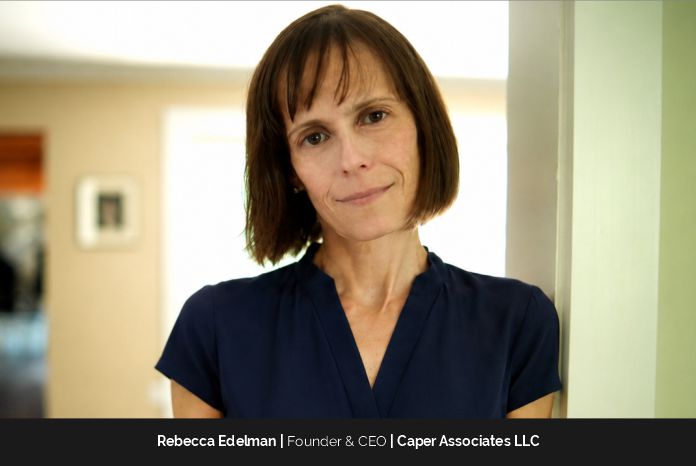
As artificial intelligence changes how people learn and work, Rebecca Edelman believes the qualities that foster human potential will become more valuable, not less.
Judgment, communication, adaptability, empathy, initiative, and curiosity are developed through experience – not information alone.
That belief is at the center of Caper, an experiential learning platform that helps older teens and young adults turn real-world experience into visible growth.
“Technology can provide information, accelerate work, and support better decisions,” Edelman says. “But it is the vehicle, not the outcome. Growth happens when people take action, reflect honestly, and use what they learn to decide what to do next.”
Her perspective was shaped by a career that began in news, continued through more than two decades in financial services, and eventually led to entrepreneurship and civic leadership. Although the path was not carefully planned, each chapter taught her how people, systems, information, and decisions influence one another.
The Human Advantage
As AI continues to automate routine work, synthesize information, and accelerate decision-making, Edelman believes adaptability, judgment, and the ability to build trust will matter even more.
“These capabilities are shaped through experience,” she says. “They grow when people act, make mistakes, receive feedback, and take the time to understand what happened.”
Traditional education provides essential knowledge, and coaching can offer guidance and perspective. Edelman saw an opportunity to help learners turn knowledge into action.
Caper builds on experiential exercises developed over more than four decades by Syracuse University professor and educational reformer Dr. William “Bill” Coplin, founder of the university’s Policy Studies program and a longtime advocate for practical, experience-based learning. Edelman licensed those exercises and expanded them into a broader curriculum and digital platform grounded in Caper’s Act, Reflect, Direct model.
Learners complete real-world experiences, reflect on what they learned, and apply those insights to what comes next. Over time, Caper helps make their growth and emerging strengths visible.
“Technology can provide information, accelerate work, and support better decisions,” Edelman says. “But it is the vehicle, not the outcome. Growth happens when people take action, reflect honestly, and use what they learn to decide what to do next.”
Rather than delivering content for learners to consume, Caper starts with experience. Learners act in the real world, reflect on what happened, and use those insights to decide what to do next. Its curriculum is organized around three dimensions of development: Do You, Do Well, and Do Good, helping learners understand themselves, strengthen how they work, and contribute meaningfully to others. Through repeated experience and reflection, growth becomes something they can see, articulate, and build upon.
“The purpose is not to tell people who they should become,” Edelman says. “It is to help them better understand what they are capable of and what they can do next.”
Learning to Lead Through Complexity
After graduating from Syracuse University with a dual degree in Policy Studies and Communications, Edelman began her career at the Manhattan headquarters of a major cable news network. The experience sharpened her understanding of how information is framed and communicated, including how those choices shape what people understand.
She later earned a Master of Public Administration from NYU Wagner and moved into financial services, where continual learning became a constant as she navigated complex traded products and markets. She went on to build a career spanning more than two decades at HSBC, Credit Suisse, and UBS.
Early in her financial-services career, Edelman served for one year as an adjunct professor at NYU Wagner, where she created and taught a graduate course on effective partnerships across the corporate, nonprofit, and public sectors.
“Financial services taught me how to operate within large, global organizations,” Edelman says. “I learned how to bring together different perspectives, simplify difficult problems, lead through uncertainty, and move people toward a shared outcome.”
She was often most effective when information was incomplete or stakeholders saw the same issue differently. By understanding how the parts of an organization affected one another, she could identify friction, create clarity, and coordinate action.
Over time, Edelman came to see that formal authority alone does not determine whether someone can lead. Influence is built through integrity, consistency, empathy, sound judgment, and the ability to help others move forward.
Leadership Beyond a Title
One of Edelman’s most instructive professional disappointments occurred when an anticipated promotion to Managing Director did not happen. At the time, it felt like a significant setback. Over time, the experience changed how she understood achievement and leadership.
“I had placed too much meaning on a title,” she says. “Not receiving it forced me to consider what leadership looks like without formal recognition.”
It also made her more attentive to strengths that can be evident long before they are formally recognized.
Her mother often told her she had common sense. Edelman did not initially view that observation as a significant strength. She eventually recognized that her ability to observe, ask questions, connect information, and identify a practical path forward had influenced nearly every role she held.
“She understood something about how I learned and operated before I fully understood it myself,” Edelman says.
That insight continues to shape how she views others. Credentials and titles can be useful indicators, but they do not always reveal resilience, initiative, reliability, empathy, judgment, or the ability to contribute in unexpected ways.
For Edelman, trust means giving people a meaningful opportunity to show what they can do.
Building Without a Blueprint
Founding Caper required Edelman to move from operating within established global institutions to building something without a predetermined blueprint.
“Building something from the ground up has been one of the most demanding and instructive experiences of my career,” she says. “It forces you to make decisions with incomplete information, listen closely, adapt quickly, and stay focused on what you are trying to accomplish.”
Those experiences shaped Edelman’s belief that some of the most important capabilities are developed when there is no clear playbook – when people have to exercise judgment, adapt in real time, and move others forward through uncertainty.
As Caper evolved from an idea into a working platform, she kept returning to one question: Does this genuinely help the learner?
That question guided decisions about the curriculum, technology, reflection process, and how the platform makes growth visible.
“The question is not simply whether we can add another feature,” she says. “It is whether what we are building will help someone learn from experience and use that insight to move forward.”
For Edelman, the platform becomes meaningful when a learner recognizes a strength or pattern and approaches the next situation differently because of that insight.
“Leadership is about creating clarity and giving other people the opportunity to grow,” she says.
That philosophy also shapes how she works with others. She values colleagues who challenge assumptions, identify gaps, ask difficult questions, and improve the work.
Relationships Remain an Anchor
Relationships have remained a constant throughout Edelman’s life, providing perspective and keeping her grounded.
She has maintained friendships and professional relationships from nearly every phase of her life and often introduces people who might benefit from knowing one another because she sees a shared interest or opportunity.
“For me, relationships do not end when a job, school, or chapter ends,” she says. “The people in my life continue to shape how I think, what I value, and what I build.”
Her commitment to community extends to her role as Chair of the Board of Five4Five Productions, where she helps guide the organization’s growth, partnerships, and youth-focused programming.
Zig. Zag. Net Up.
Edelman’s journey from news and public policy to financial services, entrepreneurship, and civic leadership did not follow an obvious sequence, but each experience contributed something important.
News sharpened her understanding of communication and how narratives are framed. Public policy taught her to examine how systems shape outcomes. Financial services taught her to manage complexity, align stakeholders, and execute under pressure. Entrepreneurship required her to bring those capabilities together in a new way.
Her advice to young professionals is simple: Do not become so attached to a perfect plan that you overlook an unexpected opportunity.
“A career rarely moves in a perfectly straight line,” she says. “You learn, you adjust, and you keep moving.”
She summarizes that philosophy simply: “Zig. Zag. Net Up.”
The phrase does not suggest that every setback is positive. It reflects her belief that progress often becomes clearer over time, as seemingly unrelated experiences begin to connect.
In an age increasingly shaped by artificial intelligence, the ability to learn, adapt, exercise judgment, and move forward may be among the most important human advantages.
For Edelman, the opportunity is not to compete with what technology can do, but to invest more intentionally in what people can become: how they understand themselves, perform, and contribute to others.
Today, 20 Capers are live on the platform as Caper begins onboarding partners across education, workforce development, college and career readiness, and corporate learning, while also expanding access for individual learners.
Across Edelman’s unconventional path, each chapter deepened her understanding of how people, ideas, systems, and experiences fit together and strengthened her commitment to creating opportunities that make human potential visible.