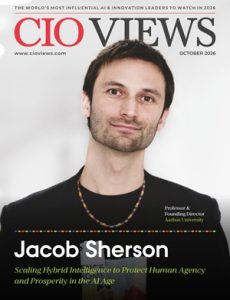

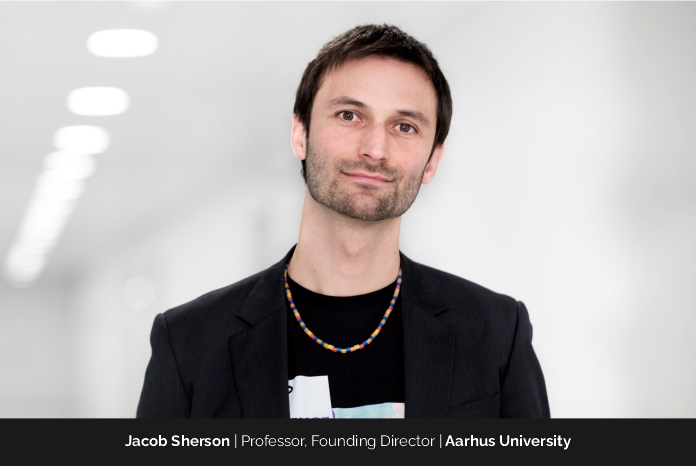
Nothing guarantees that the jobs AI removes will be replaced. New ones appear only if human skills evolve at close to the speed of the technology, and almost no company, school or government is organized for that. Jacob Sherson, Founding Director of Center for Hybrid Intelligence (https://hi-infinity.ai/), Aarhus University, argues that hybrid intelligence – prioritizing human expertise alongside AI rather than automating it away – is the only operational alternative that balances competitiveness with future desirability.
He urges leaders to choose their future before choosing their technology, to move at the speed of the transition rather than the planning cycle, and to build psychologically safe co-creation. Educational institutions, he argues, must radically rethink their role in this shift.
From Curiosity to Impact, Asking a Bigger Why
Jacob’s personal journey is about realizing what needs to be done and when. His curiosity spans physics, human minds, and society. “I’m especially interested in the mechanisms we’re seeing play out now, as AI is introduced into large-scale economic systems, and how those forces can lead us to either a much better world or a much worse one,” he says.
He defines success as a journey – making a dent, creating real impact along a pathway toward truly changing things for the better. Jacob has gradually pieced together what it would take for humanity to become hybrid intelligent, always stepping back to ask bigger “why” questions about what underlies technology development and societal impact. “Working in AI design, creativity and psychology, and organisational design and macroeconomics has given me pieces of the puzzle to answering some of the bigger questions for humanity,” he reflects.
Rethinking Expertise in the Age of AI
To understand hybrid intelligence, Jacob says one must first know what it is not. A society betting entirely on AI agents taking over workflows eliminates expertise. The more work an agent does independently, the harder it becomes for professionals to review or correct its output. Hybrid intelligence takes a different approach.
“What are the invariants, the foundations of a good society?” Jacob asks, noting that the root of a good society is that humans remain economically valuable through work. “We don’t believe that a future of universal basic income, where technology has taken over all work, is a good outcome for humanity. This is not only an ethical argument, but a strategic choice to strengthen human expertise and the collective agency of Humanity. We strive for our hybrid intelligence approach to outcompete AI-first organizations that rely on commoditized algorithms, offering no lasting advantage.”
Jacob explains that hybrid organizations have a deeper edge in competitiveness, revenue, employee happiness, and innovation. What’s difficult to replicate is building psychological safety where employees reveal vulnerabilities and potential and operationalizing that expertise as a foundation for better human-AI interactions. It is commonly stated that in an AI-saturated economy, Human Touch will become a scarce and thereby valuable resource. Hybrid Intelligence is constructed to ensure that it becomes substantial and not just a fringe niche, 1% of the economy.
The Speed of Change Is Deceiving Us All
Having trained thousands of business leaders and spoken with politicians, Jacob laments their lack of vision for what their company or society should look like five years from now. “They fail to recognize how fast this transformation is happening. Even the most radical reports, predicting twenty percent unemployment, are understated,” he cautions. “When change comes fast, society won’t have time to co-evolve. We urgently need to do something radically different.”
Jacob warns that an exponentially learning, recursively self-improving technology will accelerate the pace of transformation, with no guarantee of new jobs. “Those jobs can only exist if we evolve our skills at nearly the same speed as AI,” he argues, advocating for urgency and a mission-oriented mindset as market forces accelerate toward an agentic automation-first mindset that offers no long-term positive outcomes for employees, organizations, or nations.
Protecting Human Value in a Zero-Cost World
Jacob champions human-centered AI with both high automation and high human control. Hybrid intelligence harnesses the best of both worlds; the hybrid intelligence manifesto (https://hi-infinity.ai/) affirms it’s more than a technical exercise. It involves hundreds of researchers and practitioners from diverse fields such as computer science, creativity, psychology, organizational design, and macroeconomics to construct a holistic solution to the development of hybrid intelligent technical systems, organisational models and marketplaces.
“Creating deeply rooted human-AI interactions requires organizational psychological safety, so experts feel safe revealing insecurities, tricks, and tacit knowledge. However, much AI-research underappreciates how deeply this challenge is rooted in social sciences and management,” he observes.
Jacob is reframing hybrid intelligence from interface to impact, driven by co-creation across employees, leaders, and customers. “You’re building a marketplace where it’s best for everyone if that marketplace evolves.” Roughly fifty percent of the global economy is spent on things you could buy cheaper elsewhere. AI may lead to an abundant, zero-cost society, but in that race to the bottom – the “Ryanair economy” – price competition leaves no room for human distinction.
Jacob argues for market signaling where people buy for intangibles like relationships, innovation, and trust. “That marketplace has potential, but needs to be curated, protected, and grown. Otherwise, it may collapse into a Netflix-style model where production cost nears zero, and that dynamic plays out in every business,” he cautions.
The Coordination Challenge of Scaling Hybrid Intelligence
Jacob’s biggest challenge lies in the interconnectedness of his vision. Hybrid intelligence has to work at four levels at once, and each fails alone: interfaces where the expert learns more than the system does; organizations safe enough that experts share their tacit knowledge; markets that pay for visible judgment; and education that keeps the expertise pipeline full. Making all four move simultaneously, at a global scale and pace, is a coordination problem before it is a technical one.
It is also why, as a social entrepreneur, his hardest task is explaining hybrid intelligence in fifteen seconds. “A single-level answer is exactly the failure mode,” he says.
While AI makes workflows more efficient, competitiveness erodes when everyone does the same, and firing staff destroys trust with the remaining employees. AI-first businesses compete on price, hybrid intelligence builds competitive advantage through differentiation and allows leaders to see market entrants as co-creators of a shared reputation for quality. Compared to a cost leader, other companies can build a narrative of enhanced value together – like Rolex and Omega jointly sustaining the idea that a watch is worth more than the accurate timekeeping now available for almost nothing.
Beyond easier differentiation, adopters of hybrid intelligence benefit from cross-sector concept-validation. If it proves superior in marketing or emergency rooms, that trust carries over to other fields. “This is social entrepreneurship: scaling that approach so everyone benefits,” Jacob emphasizes.
Why AI-First Is a Brittle Business Model
For executives lured by the commercial gains of becoming AI-first, Jacob highlights the following scenario. “An AI-first company cuts costs by thirty percent and sees margins rise. Six months later, everyone else does the same. Prices drop, and they’re back to square one, earning no more but facing fiercer competition. That’s the subtlety of the AI-first model,” he explains.
Citing Klarna, which cut around 700 support roles and froze hiring after going AI-first, then brought human agents back when service quality fell, Jacob warns that cutting costs can sacrifice innovation. “When employees no longer see you as a leader who has their well-being in mind, every attempt to capitalize on human strengths becomes much harder.”
99% of the companies he works with are not cost leaders but have other reasons customers prefer them. “If you want to play-to-win, craft a strategy that amplifies those strengths and builds on differentiations, rather than stripping them away and betting on being the first mover in an AI-first business,” he advises.
As AI-first companies become more automatable, they become less distinguishable and more vulnerable to being outcompeted by tech giants. “It’s brittle logic to bet on AI agents and data as your main differentiator, because not many can be the biggest,” Jacob cautions. “The biggest risk is being swallowed by the tech giants that own the models that made your company successful. No matter how big you are, the tech giants are always bigger, and at some point they will want to verticalize: own their value chain – and that’s you!”
Bridging Disciplines, Inspiring Real-World Change
After an unconventional journey through physics, creativity research, cognitive science, innovation, and management, Jacob chose to try to combine these skills and insights as a societal entrepreneur. He counts among his biggest achievements the ability to surprise, scare, and inspire executives of major companies to pursue strategies that run counter to mainstream consultancy advice. “They put their trust in me, seeing the reason and the richness of our analysis and arguments. That’s something I’m truly proud of.”
Jacob engages with the world, not from an ivory tower, but with a different mindset, giving 100s of talks and workshops. Through his action research, he doesn’t just learn from the world; he inspires it and uses it as a lab to sharpen his ideas. He gains insights from organizations, but his main goal is to synthesize insights and guide change-makers across the globe.
He bridges disciplines to help leaders craft workflows that blend science and design, building psychological safety and enthusiasm in the workplace. He rapidly learns across macroeconomics, HR, and IS through expert dialogue to sharpen a framework for hybrid intelligence. The manifesto project consolidates these insights to pinpoint the challenges that stand in the way of a hybrid intelligent society.
Trust, Strategy, and the AI-First Cliff
Jacob links psychological safety to profitability. Empathetic leadership soothes employee concerns about the future, but a strategic case for preserving expertise creates more durable trust. “My company would be foolish to fully automate or throw away all our hard-earned expertise. That’s why you should trust that we’re not going to adopt an AI-first strategy.” When employees hear business logic, not just emotion, trust becomes more sustainable.
He applies the same logic to politics, noting that Europe must stop relying on regulation alone. “We need to formulate a vision of a competitive future,” he says, pointing to Denmark’s wind turbine revolution as a model. “We built wind turbines in the 1970s and made the whole world move toward a green economy. That’s exactly the kind of macro-innovation we need to see again, except that this time we need to succeed in two years rather than 40 years!”
Jacob’s job is to warn the world that it’s racing toward an AI-first cliff. “We’re not saying slow down. We’re saying speed up and go in another direction. Regulation alone will not save Europe if the rest of the world out-innovates it.”
Preparing Future Generations for an AI-Saturated Economy
Jacob’s work also focuses on what unions and educational institutions must do. Without change, entry-level hiring will decline because new graduates lack expertise. “AI can replace most textbook knowledge. That’s a future generation disaster waiting to happen, but it can be prevented.”
Educational institutions must create societal disruptors, faster movers, and innovators of hybrid intelligence. Students should spend their years practicing with state-of-the-art tools, simulating workflows, and developing innovation mindsets, graduating with experiential knowledge the marketplace needs and rewards.
“Where traditional organizations can be slow at adopting technology, learning institutions need to be much faster, bringing their students out ahead of the curve instead of behind it,” Jacob concludes.
One Vision, Many Hats
For Jacob, balancing his roles as researcher, innovator, and educator comes down to putting them all under one vision. “All the distinct projects I take on and the roles I have are pieces of the same puzzle: a better future for Humanity.”
This clarity extends to his family. He recently took his four children to a panel debate. “That was one of my proud moments, seeing them look up at me, realizing that the times I’m busy are for a reason – that I’m inspiring people to make a change.”
Jacob’s impact is most visible through the leaders he inspires, high-level CEOs who transform multi-million-dollar businesses affecting thousands of employees. “We do that ten times or a hundred times, and then their success in turn inspires another dozen each – that’s a huge impact, and we’re on track to achieving it.”
Defining the Future We Actually Want
Jacob’s long-term vision is not about predicting technology, but defining the kind of future we want. “What’s a good marketplace? What’s a good future?” he asks. “At its core, humans must have the power to decide their own destiny. Only when human expertise remains crucial for value generation do we preserve the link between labor, democracy, and voting rights.”
He argues that the future agency of humanity should not lie in the hands of a few tech companies, but with billions of workers who have jobs, vote, and have the power to organize. Universal basic income is not a solution. “If everyone’s on UBI, they’re living on charity from whoever has the power to give out the money, which would ultimately be the tech companies. That’s not a future we want.”
Instead, Jacob envisions companies generating their own profits through AI-driven innovation, while educational institutions produce students ready to innovate with a mindset of positive, chaotic disruption.
Embrace the Pace, Build the Vision
Jacob’s advice to aspiring leaders and researchers: Don’t abandon long-term plans or education, but assess realistically which forces will reshape your profession in six to eighteen months, rather than being an ostrich saying we can’t predict it, so let’s not discuss it.
Then get concrete. Map where judgment lives in your workflows before automating anything. Pair every automation with a decision about what the freed-up time is for, taken before it ships. Train experts to decompose problems rather than replacing them with orchestrators. Co-construct what your profession looks like in a future that is both economically viable and human-centered.
Once leaders agree on that profitable pathway, they can decide what AI to build and innovations to pursue, ensuring harmony between what’s good for employees, organizations, and society. If everyone starts moving in lockstep around that plan, we can together create a good society.
“The question is whether we want that AI-first society where everyone has lost their jobs. For most people, the answer would be no. Hybrid intelligence is the pathway to realize a different vision,” Jacob emphasizes.
Automate With Purpose, Not Fear
Hybrid intelligence is often mistaken for being anti-AI or anti-automation, but Jacob clarifies otherwise. A hybrid intelligent organization has become really good at automating, but in a very specific way. Automation is never run as a technology project; it’s always a co-creation project with employees. A conversational agent flags what could be automated, and domain experts verify and validate it before pushing the button.
Crucially, every automation is paired with a conversation about how freed-up time will be used, ensuring that the employee has pathways to create more value than before. “Every automation should deterministically push employees higher up the value chain,” Jacob insists. “Before starting, they envision whether the outcome is more desirable and more profitable.”
Conclusion
Jacob Sherson’s vision is clear: the future belongs not to those who automate the fastest, but to those who elevate human expertise alongside AI. By grounding his work in psychological safety, employee co-creation, and competitiveness through strategic differentiation, he offers a compelling alternative to the race toward full automation. His message is urgent but hopeful – speed up, change direction, and build a future where humans remain indispensable. Hybrid intelligence, as he sees it, is not just a business model; it’s a pathway to a better, more equitable society.