
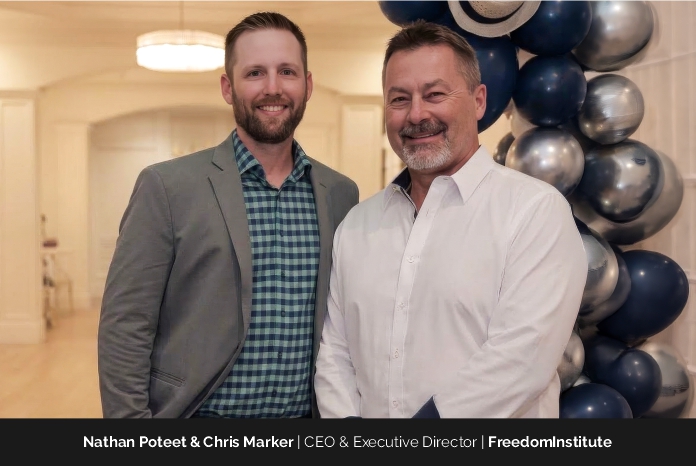
Often, bright, curious children enter classrooms with a spring in their step, only to become a pale shadow of themselves. Traditional schools can leave them half-convinced that they are the problem, when the real issue is that a rigid model cannot make room for who they are or how they learn. Chris Marker and Nathan Poteet built The Freedom Institute of Collier County on the belief that learning should set students free, not box them in.
As CEO and Executive Director, respectively, Chris and Nathan have created high school classes where students learn to use AI tools so that, when they enter the workforce, they are not replaced by those who do. They are ensuring that students can build their futures with greater economic freedom.
“If the education field remembers The Freedom Institute as a place that was bold about the future and honest in the present, and that put students ahead of everything else,” Chris and Nathan say, “we will have left exactly the mark we hoped to.”
Passion for Education and Innovation
Schools are supposed to nurture students’ curiosity. But as Chris and Nathan note, traditional, one-size-fits-all schooling too often extinguishes it. They witnessed this firsthand, and it ignited their passion for education and innovation.
Nathan and Chris believe it takes more than rigid structures to prepare young people for a fast-changing world. Preparing them requires real problem-solving, clear thinking, and the confidence to take creative risks and learn from them. This is the foundation of the Freedom Institute and its mission: to develop critical-thinking abilities that promote financial freedom and patriotic American citizenship upon graduation.
The Turning Point
Initially, Nathan and Chris tried to build a better version of a traditional high school. The turning point came when they stopped doing that, and instead, committed to building something different.
“We tried to measure the Freedom Institute against the schools we came from,” Nathan says. “The vision snapped into focus once we saw what AI could do in our classrooms.” It can help take routine work off teachers’ plates, build a real learning path around one student instead of thirty, and give young people fluency with the tools that will define their careers.
Chris and Nathan also realized that people who know how to use AI will replace those who do not. That led them to make sure their students would be the ones doing the replacing.
They developed their C5 model and the Freedom AI platform. They introduced dual enrollment, allowing freshmen to start earning free college credit. They also maintain a 30-to-1 student-to-success-coach ratio. According to the two leaders, recognition came faster than they expected, from being named a 2024 Yass Prize semifinalist to receiving the 2026 SWFL Inc. Innovation Award and a Global Recognition Award.
In 2026, the clearest proof of a tangible outcome came in the form of a $1 million matching grant from the Dekko Foundation. It helped Chris and Nathan open a second campus in Ave Maria. It is a 10,000-square-foot school built to serve well over a hundred students. This building signifies that Freedom Institute is no longer an experiment or a lucky break. It means that what Chris and Nathan believed in works well enough that more families want it and more communities are asking for it.
“We still respect what traditional education gets right,” they say, “but we no longer let it set the ceiling on what we think is possible for our students.”
Working at the Intersection of AI and Education
When Nathan and Chris began exploring AI, they discovered that it could help close the gap between standardized schooling and learning that fits the student in front of them. This realization led them to work at the intersection of education and AI.
During their years in school leadership, classroom teaching, and curriculum design, they kept running into the same wall. Traditional frameworks made it hard for even the best educators to meet every student where they are, with their own interests, needs, and pace.
“Bringing AI into our programs at the Freedom Institute opened a real opportunity,” Nathan says. AI gives families learning paths built around their children. It also equips students with the critical-thinking skills they will need in a world shaped by AI.
By pairing sound educational strategy with new tools, Nathan and Chris want to make technology practical, which can help build student agency, economic freedom, and lasting success.
Facing Pushback Against the New Model
When Nathan and Chris first talked about their model, not many people thought it would work. They were creating something that did not fit the traditional mold of a high school, so even some people they respected were skeptical.
Families were used to a certain kind of school, and teachers were used to a certain kind of classroom. Nathan and Chris were asking everyone to trust a model built around personalized learning and, later, AI. The pushback against their model was real.
“There were stretches where we honestly wondered whether we were leading people somewhere better or just somewhere different,” Chris recalls.
Their resilience was also tested by the slow grind of staying the course while the results were still coming in. They had to hold their vision steady when the people around them needed proof they could not yet provide. From this experience, Nathan and Chris learned that resilience in leadership is quieter than people think.
“It looks less like pushing harder and more like showing up consistently, listening more than talking, and being honest about what they did not have figured out yet,” Nathan says.
On the hardest days, it helped that neither of them was carrying it alone. When one of them started to lose faith in the plan, the other was usually there to steady it. And they stopped trying to win people over with certainty and started earning trust through transparency.
Instead of asking teachers and families to wait for a finished product, they brought them into the process. They also learned to respect what is worth keeping from traditional education even as they changed almost everything else about how they deliver it.
“We now lead with more patience and a lot more collaboration, and the work is stronger for it,” Nathan says.
Building a Place Where Students Come Alive
The achievements that make the headlines, the awards and recognition, are not what matter most to Chris and Nathan. For them, it is a major achievement when a student who never quite fit anywhere else finally comes alive in their learning. It fills them with great pride to know they built the place that made that possible.
“When a family tells them their child actually wants to go to school now, or a student who had been written off starts talking about a future they did not think they were allowed to want, that is the achievement,” Chris says. “Everything else, the campuses, the platform, the recognition, is just scaffolding around that.”
Allowing Students to Shape Their Own Learning
From the beginning, Chris and Nathan were clear that they would not teach about AI from a safe distance or lock the tools in the front office. They wanted students to use them themselves every day, the way they will in whatever they do after graduation.
“When a student has real AI tools in front of them,” Nathan explains, “they stop being someone we deliver a program to and start being someone who shapes their own learning.”
With the tools, they can build things and find answers to the questions they care about. They can also move quickly through what comes easily and get real help on what does not. “Our teachers and coaches are right there guiding them,” Chris points out, “but the student is the one at the wheel.”
Nathan and Chris believe that the world is not going to hand the future to the people who understand AI in theory. It is going to hand it to the ones who know how to use it. They want their students to be exactly those people: confident, capable, and already leading the change instead of scrambling to catch up to it.
“Everything we develop is built to put more capability in their hands, not less, because the goal was never to teach them about the future. It was to help them go build it,” Chris says.
Role of Education and AI in the Future
Nathan and Chris think that the role of education and AI in shaping opportunities for future generations is the most important question of their time. “We do not say that lightly,” they say.
Education has always been the clearest path from where a young person starts to where they are capable of going. AI raises the stakes without changing that truth.
The two leaders expect one of the most defining divides of the next generation to be the gap between people who can use these tools and those who cannot. Where a student lands on that divide will shape their options for the rest of their life. That is why they do not see AI as something to fear in the classroom. “Handled well, it may be one of the greatest equalizers we have ever had,” Nathan says.
In a small town, it can give a student the same personalized instruction that used to be reserved for families who could afford a private tutor. It can also meet a struggling student with patience and a gifted one with a real challenge, in the same room, at the same time.
The opportunity in front of Chris and Nathan is to make a tailored, high-quality education available to far more young people than the old model ever could reach. But the tool is only half of it.
They are also committed to the parts of education that do not change: teaching students to think clearly, reason for themselves, and carry the values and sense of citizenship that allow a free society to hold together. “An AI-fluent graduate who cannot think independently is not prepared,” Chris says. “They are just efficient.”
The future belongs to young people who can wield the most powerful tools ever built as well as bring real judgment and character to how they use them. Nathan and Chris believe their job is to send as many of those young people out into the world as they possibly can.
Protecting What Can’t be Delegated
Chris and Nathan protect the things that cannot be delegated, such as the vision, the culture, and the people who carry both.
“If we lose clarity on why the Freedom Institute exists, or let the culture drift, no program or platform will make up for it,” they say.
Their responsibilities show up in a few ways. The first is stewardship. Chris and Nathan are responsible for making a bold model financially sustainable. According to them, this means being honest stewards of every tuition dollar, scholarship, and grant, and building something that will still be standing for the students who enroll years from now.
The second is people. A lot of their energy goes into hiring the right teachers and coaches, giving them room to do their best work, and making sure they never feel they are carrying the mission alone. And the third is staying close to the ground. Chris and Nathan make a point of staying connected to students and families.
“Between the two of us, the responsibilities split fairly naturally,” Nathan says. “One of us keeps a closer eye on the institution as a whole, the strategy, the finances, and the long horizon, while the other lives closer to the programs, the AI, and how the vision reaches a student in a classroom.”
“This works because we are aligned on the destination, so each of us can own our lane without worrying we are pulling in different directions,” Chris adds.
Legacy: An Early Proof Point
Chris and Nathan want their legacy to be an early proof point in a much bigger shift. They built one of the first schools that showed that a different model was not only possible but better.
“If we make it a little more obvious and a little less risky for the next person to build something bold, that is a legacy worth chasing,” they say.
It would be easy, in a field this captivated by technology, to be known mainly for the tools. But Chris and Nathan would rather be known for what they used the tools to protect. It is the belief that every student is capable of far more than a system usually asks of them, and that a real education should open the door to economic freedom and a life of their own making.
“The AI is the ‘how,’ while the young person walking out our doors ready to build a future is the ‘why,’ and we never want that order to get reversed in how we are remembered,” Chris and Nathan say.
And on a human level, they want people to say that they did it with integrity, told the truth about what worked and what did not, and treated their teachers and families like partners. They also hope to be remembered for “never getting so caught up in the mission that they forgot their work was always about individual students, one at a time.”
Advice to Aspiring Leaders in Education
Chris and Nathan did not wait for all the answers before building the school. “If we had,” they say, “we would still be waiting.” They advise aspiring leaders to learn how to build the thing by building it.
They encourage them to keep the student at the center of every decision, especially those involving technology. It is easy to fall in love with a tool or a trend and lose the plot. The question, they point out, is never whether something is new or impressive, but whether it makes a student’s education better.
“And do not try to do it alone,” Chris and Nathan tell aspiring leaders. They advise them to find a partner and build a team, protect the culture they create together, and give people the room to take risks without fear of being punished for it.
“And be patient and be honest,” Nathan and Chris say. “Real change in education is a long game measured in graduates, not headlines.”