

Beyond the noise of rapid market speculation across North Africa and the Arab world lies a far more demanding discipline: the quiet, methodical work of real enterprise building. Constructing a business house means to outlast market cycles requires far more than capital, it demands structural rigour, systemic integration, and an unyielding commitment to operational standards.
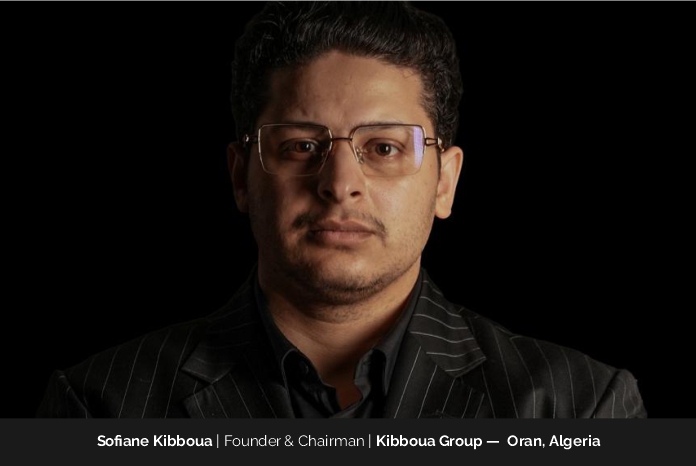
For Sofiane Kibboua, Founder & Chairman, Kibboua Group, scaling an enterprise is not a pursuit of growth for its own sake. It is the deliberate application of a single, uncompromising standard across reinforcing industries. Through a carefully aligned ecosystem spanning real estate, construction, media, e-commerce, and health sciences, Sofiane has established an organizational framework explicitly engineered to outlast its founder and elevate the region’s commercial benchmarks.
“And my success is only through God. In Him I trust, and to Him I turn.”
— Surah Hūd, 88
Early Foundations: From Local Commerce to Market Acceleration
The journey toward establishing Kibboua Group began long before formal corporate structures were put in place. Driven by an early instinct for trade, Sofiane Kibboua initiated his path in commerce as a child, selling sweets and games to master the fundamental mechanics of exchange. After completing his formal studies, he launched his first commercial enterprise, Neo Accessoires, a small retail shop in Oran built entirely without institutional capital.
The enterprise succeeded by focusing strictly on execution: product curation, precise presentation, and direct customer care. Building on this momentum, he partnered with his sister to open Mon Dessert, introducing the first bubble-waffle dining concept to Algeria and pioneer markets across Africa ahead of broader European adoption. As Sofiane reflects on that foundational era, “That venture taught me two things: being early is a strategy and putting your own name behind a door changes how seriously you hold your own standard.”
The critical shift in scale materialized with the launch of EcomLeader International, an e-commerce platform that rapidly accelerated during the COVID-19 pandemic to become the leading digital commerce player in Algeria. Managing operations through nationwide economic disruption established the core operational tenets that continue to govern the broader group today: speed, data transparency, cash-flow discipline, and an absolute reliance on daily customer feedback.
The Real Estate Awakening and Systemic Integration
A major pivot in Sofiane’s strategic vision occurred during an extended engagement in Dubai. Observing the rapid urban transformation of the city served as a practical demonstration of how long-term vision, when paired with disciplined execution, could transform landscape into international infrastructure within a single generation.
This experience led to a central conviction: Oran possesses the potential to rise among the world’s modern urban centers. Kibboua Group was established to serve as the vehicle for this ambition, bringing a unified standard across multiple sectors. The expansion across real estate, construction, media, e-commerce, and health is not an exercise in traditional corporate diversification, but a deliberate ecosystem designed for mutual reinforcement.
Construction and property divisions give the group direct vertical control over build quality and cost, protecting project margins and removing reliance on external contractor variances. The media division serves as the trust-building engine, generating brand equity and credibility that directly reduces client acquisition costs across all other arms. Meanwhile, e-commerce functions as a high-velocity cash-flow generator that maintains direct daily contact with consumer markets, and the health division extends the group’s overarching mission of elevation into personal vitality.
Sofiane conceptualizes this interconnected structure as an operational machine designed for permanence: “I think of the group as a set of connected machines: a cash-flow machine that funds patience, an asset machine that compounds value, a media machine that compounds trust. A company can be sold. A machine that feeds other machines is much harder to stop.”
“The most powerful reputation is not manufactured. It is earned — then revealed with taste.”
Strategic Growth: Governance, Red-Teaming, and Asymmetric Opportunity
Maintaining absolute alignment across disparate business units requires a rigid operating architecture rather than reliance on executive rhetoric. Kibboua Group operates on a single management system anchored by documented standards, measurable key performance indicators (KPIs), and a unified decision-making filter: every initiative must strengthen the broader ecosystem and maintain the group’s premium standard. If an opportunity fails in either condition, it is declined.
When evaluating expansion, Sofiane Kibboua targets asymmetric opportunities where downside risk is strictly bounded while upside potential compounds over time. Before committing capital, three strategic questions are answered in writing:
- Does the venture reinforce the existing ecosystem or merely enlarge it?
- Can a premium, uncompromised standard be held within this arena?
- Does the venture fit the group’s machine logic as a cash-flow engine, an asset builder, or a trust generator?
Following initial vetting, proposed initiatives undergo a mandatory red-teaming process where senior leaders are tasked with actively arguing against the investment before a single dinar is deployed. Concepts are proven through small-scale pilots, verified metrics, and early delivery milestones before capital is allocated for scale.
“We don’t compete. We dominate.”
Adaptive Leadership and Executive Architecture
Managing operations across heavy industrial construction, digital media production, and health technology requires an adaptive leadership model that separates executive oversight from domain-specific execution.
Explaining his core operational responsibility across these sectors, Sofiane notes, “My role is the same in every division: I am the architect and the operator of the whole, I set the vision and the standard, and I guard the culture. What changes is everything below that line.”
To maintain governance without creating operational bottlenecks, Sofiane relies on two central management practices: credibility-weighted decision making and executive restraint. Domain experts with proven track records carry the primary decision weight in their respective fields, even when challenging executive leadership. Furthermore, the Chairman intentionally speaks last in executive briefings to prevent setting pre-emptive bias and to ensure genuine operational feedback.
Executive recruitment across all divisions adheres to a strict four-part rubric focused on long-term organizational health: character, ownership, domain excellence, and the instinct to elevate surrounding teams.
Emphasizing the importance of executive selection discipline, Sofiane observes, “I would rather leave a seat empty for a year than fill it with a B-player. The cost of an empty chair is visible and temporary. The cost of the wrong leader is invisible and compounding.”
Operational Infrastructure and Enterprise Interdependence
Digital infrastructure across Kibboua Group is deployed to enforce operational precision at scale rather than to serve as decorative corporate modernization.
In construction, the implementation of industrialized and modern building systems aligns project speed with structural accuracy. In e-commerce and distribution, algorithmic data management tracks acquisition costs, inventory logistics, and customer service metrics on daily KPI dashboards. In media, modern production workflows, including AI integration, allow high-volume output while maintaining rigorous production quality. Digital tools are evaluated against a single metric: whether they deliver a measurable improvement to the end customer’s experience.
This operational discipline extends directly to internal commerce across the group’s divisions. Internal business units are required to treat sister divisions as demanding, independent clients. Internal orders must be earned on competitive terms rather than granted by default, preventing systemic inefficiencies from developing within the supply chain.
“Vision attracts opportunity. Execution attracts money.”
Culture, Stewardship, and Long-Term Legacy
Corporate culture within the group is maintained through strict operational rhythms and observable behavioral standards rather than abstract statements. The organization’s foundation rests on six core values: Excellence, Integrity, Long-Term Vision, Discretion, Discipline, and Elevation. These values are reinforced through weekly scorecards, standardized meeting cadences, and continuous performance reviews across every site, studio, and warehouse.
For Sofiane Kibboua, carrying the family name on the brand elevates culture from a corporate initiative to a personal accountability framework.
Reflecting on the central challenge of operating within developing markets, Sofiane emphasizes, “The hardest thing when you build to an international standard in an emerging market is to hold the line on quality when every incentive pushes you to cut it, to move faster, spend less, promise more. Choosing the long road over the quick win, again and again, is where most ambitions quietly die.”
By holding to these standards, the group aims to demonstrate that private enterprise can drive sustainable regional development. Well-executed real estate and infrastructure projects elevate surrounding communities, develop skilled local labor pools, and require regional suppliers to meet international specifications.
Ultimately, the vision for Kibboua Group is focused on building an institutional foundation capable of operating across generations, demonstrating within North Africa and the broader Arab world that regional enterprises can establish, maintain, and scale world-class operational standards through disciplined proof.
Strategic Guidance for Enterprise Builders
For founders and executives who aspire to build multi-divisional corporate groups within emerging markets, Sofiane Kibboua outlines a clear sequence of principles. Above all, leadership must earn the right to diversify. Establishing a group is not a shortcut around making a single business exceptional, but the reward for doing so. An enterprise must dominate its core arena and build one autonomous machine before allocating capital to a second.
When expansion occurs, it must follow strict ecosystem logic rather than a personal appetite for novelty. Every new division should actively reinforce existing operations by sharing audience trust, customer bases, or distribution capabilities. A collection of unrelated ventures is not a group; it is merely a gambler’s portfolio.
Furthermore, operational substances must always take precedence over public image. Branding can only amplify what already exists, it cannot invent quality out of thin air. Leaders must focus entirely on proof and execution, delivering completely on every promise before choosing to speak.
Finally, sustainable enterprise building requires constructing autonomous systems rather than personal dependencies. A group that functions only when the founder is in the room is not a business, but a job with subsidiaries. By protecting corporate reputation as the balance sheet’s most valuable asset, long-term success becomes a matter of continuous execution, repeated with relentless discipline over time.