
🇬🇧 Read in English | 🇩🇪 Auf Deutsch lesen
Most people don’t lose money because they earn too little. They lose it piece by piece, over the years – simply because they don’t know what is possible from a tax perspective. Nelson realized this early on. He grew up in modest circumstances and watched how hard his parents worked and how disciplined they were with money. Others did the same, yet had more.
He set out to understand how things work and how they can work better. The difference wasn’t effort. It was awareness. Leadership came later, influenced by a gradual shift toward building something that could run without him.
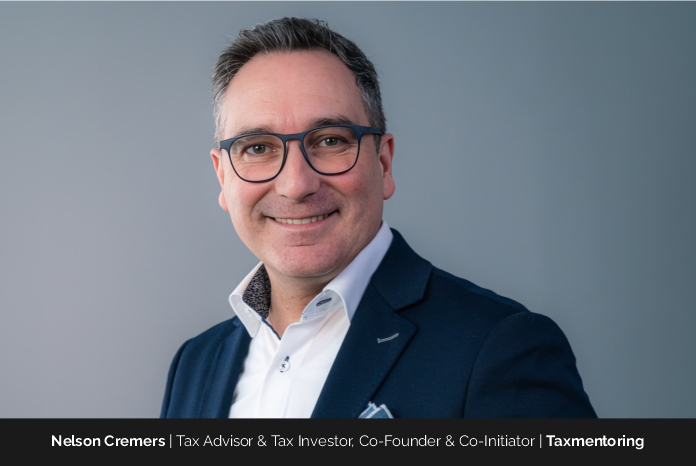
Today, Nelson is a tax investor, advisor, and entrepreneur who empowers self-employed professionals and mid-market companies to manage taxes and build lasting wealth strategically. Through his firms and programs, he combines deep technical knowledge with practical leadership, turning complex tax challenges into opportunities for growth.
As Managing Director of Tax Mentoring, Nelson oversees around 55 people across Tax Mentoring GmbH, the Tax Design tax structuring practice, and Kremers & Partner, his ongoing tax consulting firm. His approach challenges a common assumption.
He believes, “Technical competence has nothing to do with leadership competence.” And for him, real leadership begins when you stop being the center of everything and start building people who no longer need you at the center.
The Core of the Mission
He studied economics at the University of Wuppertal, specializing in taxation and auditing. In 2005, he founded Cremers & Partner Steuerberatungsgesellschaft mbH, laying the foundation for his career helping mid-market companies optimize corporate structures. He is also co-initiator of TaxMentoring and a shareholder of TaxDesign Steuerberatungsgesellschaft mbH.
Through TaxMentoring, Nelson helps entrepreneurs and self-employed professionals integrate tax strategies into corporate structuring, wealth creation, and asset protection. The program emphasizes the “TaxJourney,” a multi-stage model guiding participants from traditional taxpayers to strategic tax investors, combining theory with structured implementation support for long-term wealth development.
Learning to Question What Looks “Normal”
His perspective grew from small observations that eventually grew impossible to ignore. He noticed that many people followed established systems without a second thought. Decisions were often made and accepted as truth simply because they appeared standard on the surface. He realized how often this unquestioning acceptance came at a high cost. There were many instances where the final results failed to reflect the hard work involved. That gap between common belief and actual possibility became his primary focus. This evolved into a habit of asking whether a rule was truly unchangeable or merely accepted without thought.
This mindset dictated his professional path. Before building or structuring anything, he first identified what was being taken for granted. His leadership grew from this practice of creating clarity in places where most people were content to follow along.
The Cost of Not Knowing
Nelson’s drive stems from a childhood realization that professional neglect has real human consequences. His mother worked as a nurse, his father worked in a factory, and money was managed carefully. Each year, they received a small tax refund until they discovered another family in the same situation was getting back significantly more.
The reality came down to something simple. Deductions his parents never knew they could claim. Watching this unfold at home, at fourteen, Nelson recognized the blind spot. It created a direct disadvantage for the entire household. A few thousand Deutsche Marks more each year could have transformed their daily circumstances. This experience proved that information gaps eventually manifest in how a person lives.
Seeing the Same Pattern Again
The pattern repeats itself. He runs into it even now, where income gets mistaken for progress. Nelson has seen cases where someone earning €400,000 to €500,000 a year is left with less at the end than someone earning a fraction of that in a structured job. The issue, for him, is not how much comes in. It’s what happens after.
A large part of it also comes down to the kind of advice people follow. Many are told to accept higher taxes as a sign that things are going well. “You always wanted to have a Porsche, then buy the Porsche, then you have expenses, and then your tax goes down.” According to Nelson, such thinking doesn’t really solve anything. It just shifts the problem around.
Turning Insight into Practice
That initial clarity showed up in how he worked. Even at the start of his career, he focused on what he could control, making deliberate choices instead of default ones. As he moved into self-employment, he kept personal costs tight and started looking at decisions through a business lens.
Over time, a pattern formed. Nelson would try things on his own first to see what actually held up. When he wanted to invest in his first property, he used tax structuring to create the capital he lacked. A refund became the starting point. He admits there was some luck involved, but it got him in.
From there, it was step by step. Keep what works. Drop what doesn’t. The same thinking carried into how Nelson works with others. Nothing abstract, only what has been tested and can hold its ground.
Working Through People
His leadership style doesn’t sit in one box. There is structure, but he leans toward action and an awareness of what drives people or holds them back. For him, progress is not an individual effort. It depends on how the people around him grow within the company. He doesn’t see his role as just setting direction, but as aligning the company’s path with his employees’ personal ambitions. As Nelson puts it, “Only if I make the goals of my employees, as far as possible, also my own company goals, will the bond be maximally strong, and the engagement maximized.”
That alignment is where real momentum comes from. When people see their own progress in the work they do, the effort changes.
Operationalizing Care
In his industry, the workforce is often a 50–50 mix, and Nelson doesn’t treat the desire to start a family as a disruption. Working hours are adjusted, and returning part-time after maternity leave is supported. He is even establishing a company kindergarten, so those who want to return earlier have that option.
These are part of how the company functions. Nelson treats personal constraints the same way he looks at business problems. If someone lacks time for health or childcare, the solution is addressed within the structure. When the pressure to choose between work and life is removed, employees show up differently, creating a stronger, more loyal team.
At the same time, he emphasizes structured processes and daily learning as the backbone of the company. Onboarding is organized to ensure standards are met, and leaders are expected to actively help others. He also learns from his leaders, keeping growth mutual.
Employee well-being is built into the system. The company offers occupational health management, reimbursing up to €1,000 per year for health services and providing quick access to specialists. Regular training and team activities strengthen both health and team cohesion.
Difference between a Tax Practice and a Company
When asked about retention rates, Nelson admits he hasn’t tracked specific percentages. “What I can say is,” he explains, “at some point I made the decision to turn a tax practice into a real company.”
A typical tax practice is owner-dependent. The advisor sits at the top and handles technical work, HR, and every major decision. Because of that, growth stays limited. Nelson is building something substantial. In his words, “I want to make giants out of a kind of dwarf economy, so from employee dwarfs I want to make giants. And they should be able to achieve everything with me. And that becomes a place where everyone can grow as they want.”
His goal is to develop employees into capable leaders until he is no longer needed for day-to-day work. Whether an employee wants to climb the ladder or pursue self-employment, Nelson’s stance is precise: “Do that.” He even offers to partner with those who strike out on their own, providing the foundational base he lacked so they can earn from day one.
Growth with Intention, Not Just Numbers
The 55 employees he mentions are just the core team. Alongside them, there are freelancers and independent contractors, around eight to ten more, who aren’t part of that count. But for him, the number isn’t the point. What matters is that the company now has a structure that can support growth. That wasn’t always the case. Earlier, growth and pressure came together. Now, it’s more deliberate.
He doesn’t see development as something that should run constantly. For him, it happens in phases: build → pause and fix things → then grow again. Recruiting capable people is a major challenge that the company tackles through targeted campaigns and multi-stage qualification. Candidates start with a personality check, followed by a professional assessment. Nelson only gets involved at the final stage, usually for senior hires.
He is gradually stepping back from hiring decisions, often leaving the final choice to department heads or team leaders who understand the criteria. “Currently, I have two heads of departments,” he shares, “I am looking for a third.”
Biggest Challenge
The hardest part has been turning employees into real leaders, not just managers. Nelson feels that involves teaching them to take responsibility for outcomes and letting go of control.
This veteran knows mistakes are inevitable. He intentionally allows them. Even if it costs time or money, he knows that is the only way people actually grow.
Keeping the Ego in Check
Years of experience showed Nelson that his way of working wasn’t sustainable. He was stretched thin, and his own ego was getting in the way. The turning point came when he brought in an external leader. The message was direct. Things would only change if he stepped back and got his ego out of the way. It wasn’t easy to hear, but he took it in.
Around the same time, he was already worn out. Quitting had crossed his mind more than once. A coach then helped him see it differently. Walking away wouldn’t fix much if there was nothing clear on the other side. That’s when it clicked. Nelson didn’t actually want to stop working. He didn’t want to keep doing everything.
He changed the approach. Build people who can lead. Hand over what doesn’t need his involvement. This commitment to radical transparency and self-improvement is precisely why Nelson is recognized as one of Europe’s 10 Most Inspiring Business Leaders to Follow in 2026.
Four years in, what began as a way to ease the load has turned into a structured, well-oiled way of running the company.
From Operator to Mentor
What keeps Nelson going is progress. Even small steps forward are enough to keep his focus sharp. His main goal now is to step out of daily operations entirely. To make that happen, he’s bringing in or developing more leaders and building systems like HR to support growth. Over time, his own involvement is gradually shrinking.
Some leaders are still growing into their roles, so he steps in occasionally, but less and less.
Eventually, he sees himself as more of an idea generator, a support system, like a coach or mentor. Nelson no longer wants to be the conductor or CEO. His focus is on creating innovative ideas and content that move clients forward.
Focus Over Distraction
Nelson keeps his focus by deciding quickly what’s worth his attention and saying no to everything else. He constantly qualifies and disqualifies opportunities. Anything that doesn’t contribute to the core goals of his three companies is ignored.
Since 2023, he has stopped all real estate investments, even though good offers came in, to avoid distractions and stay fully committed to growing his businesses. His wife also supported this decision.
Respect as a Compass
When working with clients, Nelson puts appreciation first, then value creation. A client-advisor relationship has to be mutually respectful without appreciation; even a profitable client isn’t worth keeping. Conversely, small clients who show potential and respect can grow with the company.
During organizational changes, some employees and clients didn’t align with this philosophy and left the organization. The “A-players” and appreciative clients stayed. Nelson chooses to part ways when respect isn’t there, prioritizing a healthy environment over short-term revenue.
Staying Approachable
Nelson makes a conscious effort to remain approachable, even across a large office. The space includes a social area where employees gather and eat together. He joins these meals every Tuesday.
Once a month, they hold a Best Practice Day (BPD) where employees share effective practices and company updates. Tax Days happen three times a year, involving 60–70% of employees on-the-ground work. These structured activities help employees feel connected, reinforcing that leadership doesn’t create distance.
Building Structures and Embracing Replaceability
This seasoned executive advises entrepreneurs to build structures from the start. Define responsibilities, document processes, and create a scalable foundation. Nelson stresses pairing growth with periodic “stops” to systematize operations. Avoiding burnout is also crucial. He has consistently taken six weeks of vacation since day one.
Equally important is embracing replaceability. Nelson approaches work with the mindset that he can be replaced, allowing him to focus on tasks he truly enjoys. By trusting others and avoiding micromanagement, leaders can step back from tasks they dislike while returning to the parts of their work that bring the most satisfaction.
Designing Energy
Beyond saying no to distractions, Nelson actively builds environments that recharge him. He structures his life so that he does only what he truly wants, when he wants, and from where he wants.
Specifically, he spends about 10 weeks a year in Portugal, living in a large apartment by the Atlantic. The location gives him energy and helps him reset.
Nelson’s quest for clarity is built on meditation, a practice introduced to him by his business partner, Michael, who opened a new world of mindfulness. Influenced by figures like Dr. Joe Dispenza, Nelson’s commitment even led him to Switzerland for a retreat alongside Michael and several interested employees. He considers meditation to be a tool that helped him develop a different perspective on work and decision-making.
Personal Triumph
His proudest achievement is personal. Nelson guided his son, who has an intellectual disability, toward independence and confidence. Despite challenges such as divorce and legal guardianship, Nelson focused on helping his son find his own path, live in his own apartment, and make his own decisions. Watching him thrive and feel self-reliant is what matters most to him.
Legacy and Empowering Entrepreneurs
Nelson’s vision is to make tax mentoring the standard for tax structuring and wealth building in Germany. He advocates a shift in which a mid-sized entrepreneur manages taxes as a strategic asset. It directly benefits personal wealth rather than being a burden to be feared.
To illustrate this progression, Nelson points out, “How you pay less tax, those are the concepts A, B, C, D, E, F, G. You can use them to have more equity, to build your personal wealth, to become more independent from your own business. Then you have less fear of failing, you have two, three, four, five pillars.” He believes this path to independence belongs in university programs.