
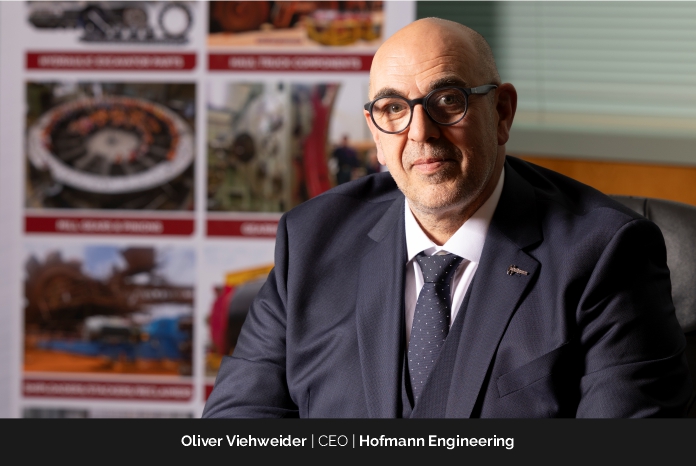
As CEO of Hofmann Engineering, Oliver Viehweider drives the company at full throttle, where the pressure is relentless and precision rules. Tight deadlines, split-second decisions to global stakes, are a few of the constant environments where he does his work best. He brings structure to chaos, moving with calm clarity while others scramble. Every decision is assessed. That’s how he continues to sharpen Hofmann’s global edge and transform it into an industrial force with staying power.
Decades before assuming the CEO role, Oliver was deeply involved in the work, solving production issues, testing designs, and shaping outcomes where it counted most. That grounding never faded. As he puts it, “Leadership in engineering must transcend technical expertise to deliver lasting business value through people, process, and purpose.” Backed by over 25 years in senior executive roles across global operations, he now leads Hofmann Engineering with the same accuracy he once brought to the floor. Every outcome reflects a systems thinker who builds performance through clear priorities, disciplined execution, and long-range vision.
How Technical Mastery Fuels Strategic Direction
Ranked among the ‘Top 10 Visionary Business Leaders Shaping the Future in 2026,’ Oliver embodies the rare blend of visionary thinking and hands-on grit. Years spent handling the whole arc of the engineering lifecycle gave him a visceral understanding of where breakdowns really occur. More often than not, the culprits weren’t technical flaws but misalignments in communication, accountability, or cohesion. Recognizing that, he didn’t merely fix systems but began shaping the culture that builds them.
His engineering background remains his most decisive advantage. It fine-tunes his ability to question assumptions, pressure-test ideas, and connect execution with enterprise goals. Whether leading Lean Six Sigma transformations, complex integrations, or global negotiations, Oliver’s approach blends logic, systems fluency, and grounded decision-making. He solves at the source and scales what works, guiding with a mindset that balances people, performance, and precision.
A defining chapter came as he led some of Europe’s most advanced engineering firms, managing intricate industrial portfolios across borders. These roles honed his ability to drive sustainable growth, adapt to shifting markets, and build trust across cultures. Each challenge strengthened his blueprint for leadership as analytical as it is adaptive, and always rooted in the realities of how great companies actually operate.
Operational Efficiency and Innovation: A Symbiotic Relationship
According to CEO Oliver, at Hofmann Engineering, performance and innovation move in sync. In industries like defense, aerospace, mining, and energy, he believes precision alone isn’t enough. Agility and repeatability must travel together. That’s why, he explains, Hofmann doesn’t treat efficiency as a side initiative. It lives in their culture. From tools to top brass, Lean, Six Sigma, and Total Productive Maintenance are practiced daily, tracked obsessively, and continuously improved through metrics that matter, including on-time delivery (OTD), non-conformance reports (NCRs), yield, productivity, and root-cause analysis.
“Our innovation isn’t an ivory tower R&D exercise,” Oliver clarifies, “it’s pragmatic and customer-focused. “Whether it involves AI-supported inspection technologies, smarter machining processes, and lightweight gearbox solutions, the company’s engineers deliver breakthroughs that directly address client demands. In sectors like defense, where conditions shift rapidly, this kind of responsive ingenuity gives Hofmann a competitive spine.
Oliver emphasizes that what truly sustains this balance is people. Hofmann is designing a next-generation apprenticeship journey that immerses rising technicians across design, machining, quality assurance, and digital integration. This initiative aims to go far beyond traditional training. Apprentices don’t shadow, they shape. They are embedded in real projects, contributing to a culture where improvement is everyone’s responsibility. Oliver shares, “Our vision is to empower them not only to learn but to contribute meaningfully to continuous improvement and innovation.”
He adds that this forward-looking talent pipeline is essential to sustaining Hofmann’s competitive edge and cultivating future leaders. As the company mentors the third generation of the Hofmann family for future ownership, succession is treated not as a timeline but as a craft. The legacy is passed forward with care, anchored in excellence, ownership, and purpose.
Oliver adds, “Operational excellence isn’t a destination—it’s a living system we maintain, evolve, and pass on.” Through structured execution, practical innovation, and intentional workforce growth, he believes Hofmann continues building an industrial legacy that adapts as strongly as it strives.
Leadership Precision in the Pressure Zone
Leadership is most visible when the stakes are high. Throughout his career, whether integrating multinational acquisitions, leading global restructures, or delivering critical defense programs, Oliver has tackled intense strain by leaning on a set of guiding principles.
He begins with clarity. He has observed that pressure tends to generate noise and indecision. Hence, the veteran encourages his teams to strip away the clutter and concentrate on what matters most: safety, quality, delivery, and cash flow. Oliver considers, “If a problem cannot be explained in two minutes, we haven’t fully grasped it.”
Second, integrity and accountability. Oliver asserts that crises test a leader’s integrity more than any routine challenge. He never shifts blame and expects the same of his team. Challenges are met head-on with transparency, composure, and a focus on resolution. In his view, trust becomes the most critical asset in times of turbulence.
Thirdly, he underscores the importance of calm. Oliver makes a conscious effort to project steady confidence, not bravado, but a grounded belief that, with the right people and process, any obstacle can be addressed. He acknowledges that manufacturing environments are unforgiving and that decisions must be made with precision to avoid widespread consequences.
The next key tenet is empowerment. Oliver resists the urge to micromanage under pressure. Instead, he listens intently, uses data to inform choices, and gives frontline teams the space to lead problem-solving efforts. He believes the best ideas often come from the floor, not the top.
Finally, Oliver always weighs short-term fixes against the long game. Even when under pressure, he remains focused on preserving customer trust, maintaining high-quality standards, and supporting team morale during uncertain times.
He describes these principles as his leadership philosophy, anchored in realism, respect, and resilience. For Oliver, it’s not high-pressure situations that build character, but they reveal it.
Holding the Line: The CEO’s Mantra for Strategic Balance
This adept CEO doesn’t see vision and execution as separate realms. He treats them as one integrated system. Strategy, in his view, must live in the routines, always clear, visible, and measurable from the ground floor up. At Hofmann Engineering, this means translating high-level plans into frontline priorities, encompassing design and machining, logistics, and quality assurance.
Oliver explains that alignment happens through structure. KPIs, Gemba walks, daily huddles, and customer reviews aren’t rituals for reporting. Rather, they’re mechanisms for momentum. But digits alone don’t drive cohesion. For Oliver, the fundamental transition happens when leaders engage directly with the teams doing the work. He listens, adjusts, and acts fast, staying nimble without compromising direction.
He recalls that one of his most demanding leadership tests was steering a global restructuring after a major acquisition. Two companies, with two distinct cultures and two separate systems, had to be united under a ticking clock. Hofmann launched a 90-day operational reset grounded in Lean, with fresh KPIs, redefined processes, and a deliberate focus on restoring trust. Within four months, performance surpassed expectations and morale rebounded.
“This experience,” he says, “underscored that transformation isn’t just about processes—it’s about engaging hearts and minds.”
Engineering for Change: How Hofmann Stays Ahead of Shifting Demands
Serving sectors such as aerospace, mining, and defense demand more than just technical expertise. It calls for constant recalibration. According to Oliver, each industry brings its own design and production pressures. Aerospace prioritizes weight and traceability. Mining demands torque and durability. Defense requires strict compliance and acoustic control.
He explains that Hofmann navigates this complexity through adaptable product platforms and cross-functional teams that stay tightly connected to field realities. Insights gathered on the ground are cycled directly back into engineering and manufacturing. He credits the company’s vertical integration as a critical advantage. By prototyping, testing, and scaling under one roof, Hofmann responds more quickly to changing requirements while maintaining the consistency that its clients count on.
Green Is a Given: Sustainability as Strategy
Today’s industrial customers expect more than performance. They expect responsibility. In such a scenario, sustainability is no longer a checkbox. It is a business-critical priority. At Hofmann Engineering, the drive to shrink environmental impact is embedded directly into product design and operations. From smarter energy use and closed-loop cooling to digitalization and waste recovery, the company is rethinking how industrial systems consume resources.
Oliver points out that their engineering focus goes beyond compliance. Products are designed to reduce lifecycle emissions and enhance durability, particularly in heavy-impact sectors such as mining and marine propulsion. Materials are responsibly sourced, and systems are designed to minimize waste from the outset.
He notes that sustainability has become a key factor in customer decisions. Environmental performance is now seen as a marker of operational excellence, and Hofmann intends to lead on both fronts.
Global Thinking, Local Precision: Why International Ties Matter
This adept C-suite executive credits Hofmann Engineering’s collaboration with international bodies, including the German Gear Association, as a key driver of growth and adaptability. These partnerships encourage cross-border innovation, harmonized standards, and a stronger talent ecosystem.
He believes the real value lies in the mindset. Engaging globally reinforces openness, learning, and speed, helping Hofmann respond proactively to regulatory changes and lead with confidence in international markets.
Word of Advice for Emerging Leaders
With an extensive background in the field, Oliver advises the next generation of industrial leaders to go beyond the machine. He urges them to pursue excellence in their technical domain, but not stop there. He believes that understanding business systems, from finance and supply chains to customer value, is what truly equips leaders to drive change.
“True leadership isn’t just about technical problem-solving,” Oliver clarifies, “it’s about managing people and systems in complex environments.” He inspires rising professionals to volunteer for difficult projects, listen attentively, ask questions, and seek feedback as a valuable resource for personal growth and development.
To Oliver, mentorship is invaluable. Great leaders elevate others. They create environments where people prosper, ideas flourish, and execution becomes culture.
Innovation with Intent: Where Bold Ideas Meet Commitment
Innovation is intentional, and it thrives where curiosity is rewarded. Oliver explains that Hofmann Engineering fosters this mindset through structured experimentation, cross-functional kaizen events, and a leadership model that encourages thoughtful risk. Failure? Instead of fearing, it is embraced as a learning step.
Continuous learning, from technical certifications to leadership development, in his view, is a standard, not a perk. Whether through strategic learning partnerships with universities or suppliers, growth is always in motion.
Future Forces: What Will Separate the Fast from the Forgotten
This prescient executive indicates that the real innovation over the next decade will come from the intersection of digital intelligence and physical precision. He points to AI inspections, sustainable materials, secure-by-design systems, and energy-smart manufacturing as transformative forces.
Not every firm is wired for this shift. Who will crack the code? Oliver expects that companies that master this convergence by combining traditional engineering rigor with digital sophistication will set the new pace for breakthroughs and competitiveness.
Legacy in Motion: Engineering for People, Not Just Products
Great leaders often set out to solve complex problems, but those who truly leave a mark also elevate others. That is the legacy Oliver hopes to shape at Hofmann Engineering. He aspires to be remembered as a leader who embodies faith, integrity, and has a tangible impact. “If I’ve helped others lead better, think sharper, and build with purpose, then my work here has truly mattered,” he articulates. For Oliver, real impact means building high-performing teams that transcend individual skill.
He believes, “True teams are not just groups of skilled individuals—they are built on trust, forged across differences.”
At Hofmann, where teams span continents, cultures, and disciplines, Oliver sees a shared mission as the common thread that weaves trust. Built through diversity, that trust becomes the glue that enables both collaboration and performance.