
“All Patients. Not Some. All.”
How Mercury Bio is Redefining Medicine to Treat Disease at Its Origin — Inside the Cell
October 28, 2019, was the day that changed Casey Perkins’s life forever.
Casey had been in pharmaceuticals for years by that point. She had built a career around serving patients, commercializing drug products, working with physicians, removing access barriers, building out patient and product pathways to make sure families received the medications they needed. She loved that work. It gave her purpose. But she had always served from the professional side of the equation. She had never been the one sitting in the hospital chair, helping a loved one through those battles.
This was different. This was deeply personal. Her husband, Mark, had fallen ill at their home in Santa Fe, New Mexico. He was rushed to the hospital, where doctors delivered a diagnosis that would reshape their lives: Acute Myeloid Leukemia. Casey immediately contacted their physician, Dr. Michael Hovan, at Mayo Clinic Arizona. Without hesitation, Dr. Hovan took care of everything. Mark was transported by plane to Mayo Clinic Hospital in Arizona, where Dr. Hovan and the Mayo Clinic team saved his life. In that moment, Casey became a full-time caregiver. She would be walking in the shoes that so many of the patients she’d served had walked. This would change her life forever.
That experience changed how Casey viewed patients and the caregiver relationship. It solidified a belief that had always been there: all patients deserve access to great healthcare. All patients deserve support and people advocating on their behalf. All patients, not some. All her leadership philosophy was shaped from when she started in pharmaceuticals in New Mexico many years earlier and deepened in the hours between hope and uncertainty, and in the fierce determination that Mark’s fight, and every patient’s fight, deserves more than the status quo.
WHERE SERVICE LEADERSHIP BEGAN
Casey’s commitment to service-oriented leadership began more than twenty-five years ago in New Mexico, the Land of Enchantment, where she started her pharmaceutical career with Lederle Labs. Based in New Mexico, she called on physicians, hospitals, and pharmacies across the state.
Over the years, she saw a lot of progress in drug therapies and development. She saw great innovation. She saw survival extended by weeks, months, and sometimes years. But she also saw barriers, prior authorizations, insurance denials, affordability issues, and coverage gaps that dictated whether a patient could begin treatment, forced to use a less-effective medication, or denied all together. Those experiences defined everything that followed.
“Patients benefit from pharmaceutical innovation, but also someone willing to fight for their access to it.” — Casey Perkins
From those early days with Lederle Labs, Casey’s career grew purposefully to include: hospital sales, pharmaceutical sales leadership, managed care/access, commercialization, strategy, contracting, channel/distribution, and patient services, spanning neurology, oncology, immunology, cardiometabolic, infectious disease, rare disease, and advanced cell and gene therapies. Every role, every promotion, every move pointed toward the same mission. She created infrastructure where none existed. She helped architect patient-product models for high-complexity treatments that the healthcare system had never encountered. The hours were 24/7/365. And through all of it, the guiding principle never changed: put the needs of the patient and their caregivers first. Always.
Her twenty-five years across the full spectrum of biopharma have given Casey something rare in today’s rapidly evolving biotech landscape: the ability to see the larger picture and strategy not as an abstraction, but as a chain of decisions that ultimately reaches a patient. Through her work at Solvay Pharmaceuticals, Ferring, Depomed, Syneos Health Consulting, and now Mercury Bio, her knowledge in developing strategy and direction comes from understanding the critical levers in the preclinical to launch phase that will impact a successful product’s entry into the market. These include selecting the right strategic partners, mapping out the milestones, and being able to work within the market/policy-dynamics that impact how patients are able to even access the therapy. This breadth of experience allows her to approach corporate strategy with a patient-centric lens that some may never experience, the lived experience of being on both sides of the coin—the business side of pharmaceutical development, and the patient side where your whole world can be compressed into the holding of a loved one’s hand during chemo treatments and bone marrow transplant.
On October 28, 2019, her professional mission became deeply, irrevocably personal.
WHEN LEADERSHIP BECOMES PERSONAL
On October 28, 2019, Mark, her husband of twenty-eight years, was diagnosed with Acute Myeloid Leukemia in Santa Fe, New Mexico. Casey called Dr. Michael Hovan at Mayo Clinic, and he took care of everything. Mark was flown to Mayo Clinic Hospital in Arizona, where Dr. Hovan and his team saved Mark’s life. Casey became a full-time caregiver that day, and she never left his side.
Thanks to the world-class care at Mayo Clinic Arizona, Mark fought his cancer for over three years, with Casey by his side at every moment. She learned what it meant to be a caregiver—not in a professional capacity, but in the most intimate, exhausting, and sacred sense of the word. Every appointment, every lab result, every treatment decision was shared. She was not an executive observing the healthcare system, she was a wife living inside it.
But the disease returned with devastating force. After cycles of treatments, remission attempts, and relentless hope, Mark passed away in 2022. A year earlier, Casey’s mother had passed suddenly following a ruptured colon and internal bleeding. In the span of months, she lost two of the people who had shaped her life most profoundly.
Those experiences reshaped her leadership perspective in a meaningful way. Every late night she had spent solving a patient’s insurance issue, every weekend she had worked to ensure a therapy shipped on time, every holiday she had given to someone else’s family, those hours suddenly had a face. Mark’s face. She understood, with a clarity that only caregivers know, that behind every case number is a family holding its breath and living for hope.
“You can understand healthcare access and policy intellectually. When you’re sitting in that chair waiting for results, you can fully understand the emotional weight families carry.” — Casey Perkins
When asked which challenge in her career most significantly strengthened her strategic and operational insight, Casey does not point to a deal or a product launch. She points to those three years with Mark.
Caregiving taught her that urgency is not a business concept, it is a human one. It taught her that systems built without empathy will fail the people they are meant to serve. And it taught her that leadership, at its highest form, is service.
Today, Casey volunteers in the Mayo Clinic Hospital Cancer Ambulatory Infusion Center, serving patients and caregivers and supporting the Mayo clinical team. She walks the same hallways she once walked with Mark.
“The needs of the patient must always come first. Everything else is secondary.” — Casey Perkins
She offers presence and support. Her empathy is not theoretical; it was earned through every infusion appointment, every physician’s visit, and every night she spent at Mark’s side.
How does she maintain balance while overseeing partnerships, investor engagement, and corporate strategy? She doesn’t see it as balance. She sees it as integration. Her work at Mercury Bio and her volunteer work at Mayo are not separate lives, they are the same mission expressed in different ways. Mark taught her that life does not wait for convenient timing.
THE GENE THERAPY INFLECTION POINT
Before joining Mercury Bio, Casey helped launch Zolgensma, the first gene replacement therapy for patients with Spinal Muscular Atrophy. As Executive Director of Market Access, Distribution, and Patient Services at AveXis (later Novartis Gene Therapies), she, along with the Zolgensma team, helped enable treatment for more than 1,500 children whose families lived for the hope the product would provide their child.
Each patient journey and experience was different. Some families were navigating their first encounter with rare-disease diagnosis. Others had spent years searching for answers. Some children were newborns; others were slightly older. Casey and the Zolgensma team approached each case with the same principle: the needs of the patient and their caregivers come first. There were never enough hours for all the work; she fielded phone calls at midnight, coordinated logistics on weekends, and problem-solved on holidays, because families waiting for a life-saving therapy do not operate on a business schedule.
The therapy had cost $2.1 million per dose. Industry systems were simply not built for that scale. At one point, legacy-reimbursement infrastructure could not process claims above $999,999.99. Casey worked closely with the National Council for Prescription Drug Programs (NCPDP), commercial compendia, specialty distributors, and pharmacies who would create the technical and policy solutions that allowed high-dollar therapies to be adjudicated; not just for Zolgensma, but for every gene therapy that would follow.
During much of this work, Casey was living her own patient journey with Mark. She was creating the product and patient journey with the Zolgensma commercial team to save other families while fighting to save her own. That duality gave her an understanding of urgency.
“Breakthrough science requires breakthrough execution. If the system can’t support the therapy, patients won’t receive it.” — Casey Perkins
The single more important aspect was: watching a child receive Zolgensma and knowing that the infrastructure she, the Zolgensma team, and strategic partners created made it possible. Each patient case, every system designed, every policy created, every 2 a.m. phone call, all led to a moment where a family received hope.
During the Zolgensma launch, Casey worked closely with Bruce McCormick and Dana Barnard of SAVSU Technologies, whose precision cryogenic transport systems ensured the safe handling of life-saving gene therapy products. The partnership was forged under extraordinary pressure: families were waiting, and the margin for errors in cryogenic logistics is zero. Bruce and Dana operated with the same patient-first urgency that defined Casey’s own approach. Trust was built in the shared understanding that every shipment carried a family’s hope.
Years later, that trust would lead to an entirely new chapter.
A NEW CATEGORY: INTRACELLULAR IMMUNOTHERAPEUTICS
In the summer of 2025, Bruce McCormick reached out. A Santa Fe-based startup he co-fouunded called Mercury Bio had significantly evolved its science in just a few short years. The company had developed into an intracellular immunotherapeutic biotech company focusing on neurodegenerative diseases and was seeking her support with corporate strategy, partnerships, and business development.
Many neurodegenerative diseases, including Parkinson’s disease and Alzheimer’s disease, begin inside the cell. Protein aggregation, mitochondrial dysfunction, and intracellular pathology have their origins within the cell, yet most pharmaceutical therapies operate outside the cell—managing symptoms rather than engaging the disease at its genesis.
Mercury Bio’s approach is fundamentally different. Under the leadership of Bruce McCormick, Dana Barnard, Dr. Richard Sayre, and Casey Perkins, Mercury Bio developed a groundbreaking technology called MB-TIP (Targeting Intracellular Pathologies), which is designed to cross the blood-brain barrier, enter cell membranes, avoid endosomal entrapment, and engage intracellular targets directly.
“When I understood the science, it was clear. This is how you truly transform medicine from within and creating therapies that can possibly modify diseases.” — Casey Perkins
Casey’s transition to Mercury Bio was full of inspiration and excitement. It was not a career move, it was a calling. The science was transformative, the promise to patients was real, and the people leading the company were the same people she’d trusted with the lives of children during the Zolgensma launch. Bruce McCormick and Dana Barnard were the reason Casey came to Mercury Bio. She had seen how they operated under pressure. She had watched them build systems and solve problems at the intersection of precision and compassion. She knew that a company led by Bruce and Dana would never lose sight of patients.
And there was something else: her journey had started in New Mexico, the Land of Enchantment, for Lederle Labs. Now, decades later, Mercury Bio brought her mission full circle, back to the high deserts of New Mexico, and back to the place where her career and her conviction were born. The symmetry was not lost on her.
“Mercury Bio is an intracellular immunotherapeutics biotechnology company whose science is designed to modify disease at its origin — inside the cell.” — Casey Perkins
COMPANY SPOTLIGHT: MERCURY BIO
MB-TIP™ TARGETING INTRACELLULAR PATHOLOGIES
Mercury Bio’s proprietary MB-TIP™ (Targeting Intracellular Pathologies) represents a paradigm shift in therapeutic design. Rather than addressing disease extracellularly, Mercury Bio’s patented technology is engineered to cross the blood brain barrier, cell membrane, avoid endosomal entrapment, and engage pathological targets where disease begins, inside the cell. This intracellular approach opens an entirely new therapeutic frontier for neurodegenerative diseases and beyond.
THE FOCUS: PARKINSON’S & ALZHEIMER’S DISEASE
Mercury Bio’s lead program targets Parkinson’s disease, a condition impacting over 1.1 million Americans, with a broader vision that extends to Alzheimer’s disease and other neurodegenerative conditions. Current therapies for these diseases manage symptoms but do not modify the underlying disease. Mercury Bio’s science aims to change that equation, developing therapeutics designed to engage the intracellular mechanisms that drive disease progression, with the goal of true disease modification. For patients and families living with these devastating diagnoses, the promise of a therapy that addresses the root cause rather than masking symptoms represents a fundamentally different kind of hope.
THE VISION AND THE NEED:
Mercury Bio is located in Santa Fe, New Mexico, proving that category-defining science can emerge beyond traditional coastal biotech corridors. The company’s presence represents a broader movement: life-changing innovation is not bound by geography.
Mercury Bio is currently working on its Series A capital raise of $26.5M to bring these much needed intracellular immunotherapies for Parkinson’s Disease into the clinic, bringing hope to patients needing disease-modifying therapies.
THE LEADERSHIP TEAM BEHIND THE MISSION
Bruce McCormick, Co-Founder & CEO —Bruce McCormick, Co-Founder and CEO of Mercury Bio, brings decades of successful executive leadership, entrepreneurship, and business building—combining strategy, capital formation, and hands-on innovation to turn bold ideas into real-world solutions. Across his career he has built and scaled companies, led complex commercialization efforts, and helped finance growth through disciplined planning and relentless execution. An inventor with more than 43 patents, Bruce is known for “questioning the question”—starting with deep problem identification to unlock efficient, elegant breakthroughs. During his time as President and CTO of SAVSU Technologies, he invented the SAVSU EVO system that enabled the ultra-cold transport of advanced therapies, including supporting the delivery needs of Zolgensma—work that also forged a strong connection with Casey Perkins during the Zolgensma launch. Today, he applies that same leadership mindset at Mercury Bio, guiding strategic vision and operational execution with patient-first urgency.
Bruce began his career developing housing for underserved communities in New York. In the early 1990s, his first invention evolved into a collaboration with NASA’s EVA group, including an Antarctica mission where he supported scientists daily via early internet connectivity. That work helped catalyze the development and FDA clearance of a medical device for cardiac and pulmonary indications.
Over the years, Bruce has conceived and built diverse technologies—from real‑time motion analysis systems and precision garment measurement tools to insulated insoles, solar ice‑making, and cryogenic phase‑change materials. More recently, his work has focused on equipment and software used in vaccine and advanced‑therapy delivery, with innovations featured in outlets such as Popular Science and The New York Times.
Before Mercury Bio, Bruce served as President and CTO of SAVSU Technologies and later as Senior Vice President of Cold Chain Technologies at BioLife Solutions, helping build the infrastructure that enabled safe, reliable delivery of cell and gene therapies worldwide. As CEO of Mercury Bio, he leads the company’s strategic vision and operational execution with a patient‑first urgency—working alongside an exceptional scientific team to advance intracellular immunotherapeutics designed to reach disease at its biological origin—inside the cell.
Dana Barnard, Co-Founder & Chairman — Dana Barnard is a seasoned business executive and entrepreneur with a long track record of building, scaling, and successfully exiting companies—bringing disciplined leadership, capital stewardship, and an operator’s mindset to Mercury Bio, which he cofounded with Bruce McCormick.
After earning his MBA from Northwestern University’s Kellogg School of Management (Finance and Strategy), Dana began his career at PepsiCo before moving into entrepreneurial leadership—running industrial and aerospace businesses that earned contracts supporting major programs including work associated with the Space Shuttle Solid Rocket Motors (post-Challenger), Titan, and Pegasus. He later became CFO and then CEO of Barson, guiding its evolution into an investment and strategic consulting organization focused on early-stage ventures and lifescience innovation, including the growth and successful sale of SAVSU to NASDAQ listed BioLife Solutions.
Dana is deeply invested in Mercury Bio’s mission because he believes patients living with neurodegenerative diseases deserve disease modifying medicines—not incremental advances. At Mercury Bio, he helps pair breakthrough science with execution excellence alongside CEO Bruce McCormick, CSO Dr. Richard Sayre, and VP of Corporate Strategy & Business Development Casey Perkins—an experienced leadership team committed to translating innovation into meaningful options for patients and families.
Dr. Richard Sayre, Chief Science Officer & Co-Founder — Richard Sayre, Ph.D. brings decades of molecular biology leadership and translational innovation to advance the company’s intracellular targeting capabilities. He and his scientific team are driven by a shared urgency: to reach the biology that conventional therapies often can’t—and to deliver meaningful, disease-modifying options sooner for people and families living with neurodegenerative disease.
Dr. Sayre joined Los Alamos National Laboratory in 2011 as a Senior Research Scientist–6, one of the laboratory’s highest research ranks, where he helped establish the Entrada Biolabs Research Center and directed multiple U.S. Department of Energy research consortia. Across academic, national-lab, and entrepreneurial roles, he has built a rare track record of moving complex science into real-world applications. He has authored more than 150 scientific publications (H-index 57) and is an inventor on over 65 patents, reflecting both deep scientific rigor and sustained innovation.
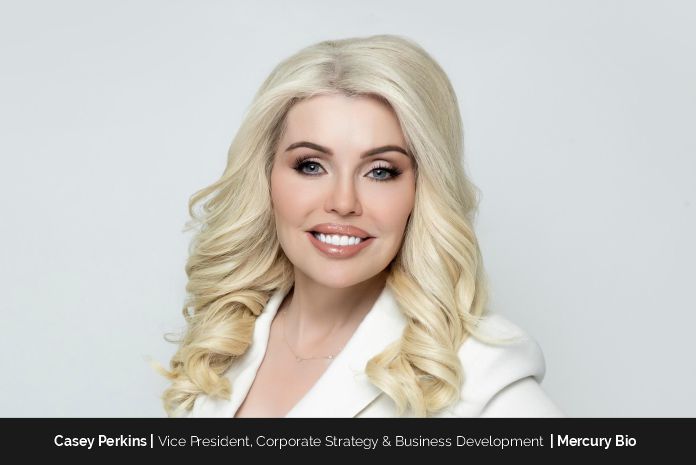
Casey Perkins, VP of Corporate Strategy & Business Development—
Casey is Vice President of Corporate Strategy and Business Development at Mercury Bio, where she leads Series A venture financing efforts, pharmaceutical partnerships, and licensing strategy to advance the company’s Parkinson’s and broader neurodegenerative disease candidates into the clinic. She works closely with CEO Bruce McCormick, CSO Dr. Richard Sayre, and co-founder Dana Barnard to translate Mercury Bio’s science into a focused corporate strategy—aligning capital planning, partner pathways, and execution to accelerate clinical entry.
Casey brings deep experience across biotech, gene therapy, and global pharmaceuticals, with leadership roles spanning Syneos Health Consulting, AveXis/Novartis Gene Therapies, Depomed, Solvay Pharmaceuticals, and Ferring. Her time at AveXis—joining at a formative stage and contributing to the build-out that culminated in the landmark Zolgensma launch. Mercury Bio experiencing a similar moment: high-potential innovation, expanding stakeholder and investor interest, and the and partnership strategy to reach the clinic.
Today, Casey engages institutional investors, biotech venture firms, and global pharmaceutical leaders with a narrative that is as clear as it is urgent: symptom management is not enough—patients need disease modification. Guided by her personal journey as caregiver to her husband, Mark, her mission is singular: to work with partners, investors, and key research institutions to bring patients the most advanced therapies possible—especially for those living with neurodegenerative diseases such as Parkinson’s and Alzheimer’s.
Together, this team represents the convergence of scientific innovation, business leadership, operational excellence, biotech clinical and commercial expertise, and patient-centered purpose. It is a leadership composition designed not just to build a company, but to build a new category in medicine… intracellular immunotherapies to transform medicine from within.
BUILDING TOWARD DISEASE MODIFICATION
“Creating therapies that improve both the quality and quantity of life isn’t just a business objective. It’s my life’s mission.” — Casey Perkins
Her broader goal is to establish Mercury Bio as a leading biotechnology company in the American Southwest. But growth is never divorced from purpose. In every investor discussion, every negotiation, and every partnership, she carries a quiet internal compass.
Does this move us closer to patients?
If the answer is yes, she moves forward. If it isn’t, she recalibrates. It is a discipline that separates strategic leaders from truly transformative ones.
SUPPORTING THE NEXT GENERATION
Casey is deeply committed to supporting those who want to build impactful careers in biopharma and advanced therapies. Her advice is grounded in experience: seek the roles that allow you to see the needs of patients. Understand the disease. Learn how the pharmaceutical drug development process works. Understand the mechanics of reimbursement and payer policy. Learn how decisions are made by physicians, payors, and all of the levers that impact the patient. Finally, as to the patient and product journey: what happens? How the product distributed and reimbursed? How do those mechanics impact patients and their care?
The leaders who change medicine are the ones who understand the entire journey from drug discover to patient treatment.
She also encourages leaders to find their mission and protect it fiercely. Careers in biotech are long, and the landscape shifts constantly. What endures is purpose. If your purpose is clear, you will make better decisions in every role you hold.
“Find your mission early. Protect it fiercely. If your purpose is clear, you will make better decisions in every role you hold.” — Casey Perkins
She envisions her work shaping opportunities for future generations by proving that patient-centered leadership is not a soft skill, it is a competitive advantage. Companies built around patients outperform companies built around products. She wants the next generation to enter biotech knowing that compassion and commercial success are not opposing forces, they are the same force, properly directed.
LEADERSHIP ROOTED IN SERVICE
Casey served seven years on the Cave Creek Unified School District Governing Board, an experience that reinforced the principles of servant leadership that define her approach. Public service taught her that leadership is not about authority. It is about service and stewardship.
“Leadership is stewardship. You are entrusted with resources, people, and futures.” — Casey Perkins
What leadership habit keeps her grounded during high-pressure growth periods? Service. By simply pausing before a major decision to ask whether it serves people, service is the practice that keeps her centered.
In biotech, that responsibility is magnified. Capital represents time. Time creates options. Options create hope. And hope is what turns possibility into progress—for patients who can’t afford to wait.
THE STANDARD
Mercury Bio’s mission, transforming medicine from within, is scientific. It is intracellular. It is about disease-modifying therapies. For Casey Perkins, it is also deeply personal.
She has lived the weight that families carry. She has decided that the rest of her career will be spent ensuring that science reaches the people who need it most, that no family waits for a breakthrough that the system is not built to deliver.
Working alongside Bruce McCormick, Dana Barnard, and Dr. Richard Sayre; Mercury Bio is not simply developing therapeutics. It is building a new standard for what biotechnology companies can be, organizations where breakthrough science and human compassion are not competing priorities, but one and the same.
Her advice to aspiring leaders who want to contribute meaningfully to patient-focused biotech innovation is simple: never forget why you started. The science will evolve. The markets will shift. But the patient waiting for a therapy that could change their life, that person is the constant. Build your career around them, and you will never lose your way.
“Every strategic decision I make is filtered through one question: Will this improve a patient’s life?” — Casey Perkins
Mercury Bio | Intracellular Immunotherapeutics
Targeting Intracellular Pathologies | MB-TIP™
Parkinson’s Disease | Alzheimer’s Disease | Neurodegenerative Diseases
Transforming Medicine From Within