
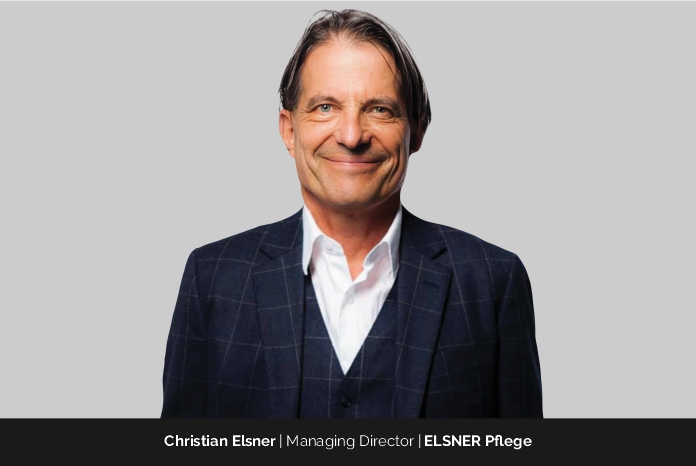
Christian Elsner, Managing Director of ELSNER Pflege, is our headline inspiration this time. Today, ELSNER Pflege is one of Austria’s top-rated 24-hour care agencies. When we ask Christian, the actual motivation behind building this company, he shares that it is ‘deeply personal.’
About 15 years ago, his sister had a serious moped accident. Overnight, his family had to arrange 24-hour care. What followed was stressful and frustrating. Finding a reliable agency was tough, and the options available did not meet their expectations.
That experience pushed Christian to stop searching and start building something better. That’s how ELSNER Pflege began. At its core, the objective is clear-cut. Make care more reliable, more transparent, and easier for families so they don’t go through what his family did. He is one of those people-first leaders who sees influence as something you leave behind in people, not something you claim for yourself. It should show how people feel when they walk away. Trusted. Supported. Capable. He believes if that is the mark he leaves, the rest will take care of itself.
“Care is not about keeping people alive – it’s about making life worth living.”
Leading from Lived Experience
His leadership comes from lived experience. He knows what it feels like to be on the other side, as a family member depending on care. That perspective informs how he works every day. Christian keeps it simple. He notes, “The principles that guide me are empathy, reliability, and responsibility.“ Empathy, because care is about people. Reliability, because families need stability. Responsibility, because people are at their most vulnerable.
He regards leadership as service in its most practical form. Whether it is simplifying a process for a client, clarifying something for a colleague, or easing the load for a team member, he believes every day offers a chance to make things a little better for someone. That, for him, is what gives leadership its meaning.
Global Exposure, Human Core
Christian’s international experience has influenced how he sees care systems. Last year, he spoke in New York about the gap between the US and European home care models. One thing stood out. Systems decide who gets access and how easily.
In the US, care is largely privatized and expensive, which puts pressure on families. In Austria, there is more structure and government support, so access is easier. Alongside this, his role as Honorary Consul of Peru in Austria keeps him connected to global networks. It brings exposure to different cultures, systems, and challenges in social care. It also shows how leadership, culture, and structure all come together in this space. But across all these differences, one thing stays constant for Christian. “People want dignity, stability, and to feel cared for,” he underlines. That belief guides him. Systems may change, but care has to stay human at its core.
“We make old people happy – and that changes everything.”
Built on Fairness and Respect
What makes ELSNER Pflege stand out starts with how caregivers are treated. In Austria, there are usually two models. In one, clients pay the full amount to the agency. Yet, only a portion reaches the caregiver. Often, the people doing the actual care earn far less than what is being paid.
Christian unequivocally sees a problem here. When caregivers are not paid fairly, it becomes hard to keep good people. And when that happens, the quality of care quietly drops. So, they chose to do it differently. In their model, the full agreed-upon daily rate is paid directly to the caregiver. It keeps things transparent and fair. Plus, it builds trust and motivation. The reason is fundamental. Good caregivers stay where they feel valued.
For Christian, this goes beyond business. It is about basic respect for the people who carry the heart of care.
From Emotion to Endurance
One of the biggest challenges was turning something emotionally driven into something sustainable. Christian has witnessed, “When you start with a strong emotional motivation, there is always the risk of being overwhelmed.” He had to learn how to step back and shape that drive into structure, processes, and something that could actually last. It was not an easy transition. It meant balancing heart with discipline, and learning when to pause, not just push.
What it taught him is simple. Resilience is not about forcing your way through. It is about holding on to your values while building something steady enough to grow with time.
Trust, Built in the Small Moments
For him, trust always begins with honesty. It’s a no-fuss, no muss approach. Saying things clearly, not overpromising, and showing up when it matters. But real trust is not built in big statements. It grows through assiduous attention to the small, consistent actions. Day by day, call by call, situation by situation.
As we know by now, Christian also carries the perspective of someone who has been on the other side, as a family member. He knows how much it means to rely on someone during difficult times. That is why, for him, trust is not just a value. It is something you earn, quietly and consistently.
Where Care Is Headed Next
This visionary trailblazer anticipates that the future of caregiving will not be shaped solely by innovation. It will depend on how we deal with the structural challenges already present in the system. In Austria, the market has changed a lot. When Christian started around 15 years ago, there were about 60 agencies, including large organizations like the Red Cross, Johanniter, and Caritas. Today, there are more than 900. This growth has brought pressure, especially for smaller providers.
Finding qualified caregivers is becoming harder. Wage gaps between Austria and Eastern European countries are narrowing, and many caregivers now prefer Germany or Switzerland for better pay. This shift is creating a real shortage. And it affects the entire system.
At the same time, affordability remains a concern. The cost of 24-hour care is around €3,400 per month. Even with government support, many families still carry a heavy financial burden. In some cases, after paying for care, there is very little left for daily living.
Christian also stays closely connected to emerging technology. Through robotics conferences and trade fairs, he follows developments in humanoid caregiving support. While he is clear that technology cannot replace human care, he sees potential in using it to ease pressure on caregivers and bolster the system in areas where needed.
According to him, the path forward is about balance. More transparency, fairer conditions, and stronger standards across the market are essential. Digital tools can improve coordination. Nonetheless, they are not the solution on their own. “In the end, the future of caregiving,” Christian explains, “depends on how well we balance economic reality with dignity, quality of life, and human connection.”
“The future of care is not technology replacing humans – it’s technology supporting humanity.”
Staying Grounded While Staying Committed
Balance in this field is not something you achieve once and keep forever. It keeps moving. There are phases when the work needs his full attention. But for Christian, balance has never meant a rigid split between work and life. Instead, it is a matter of alignment between what he does, why it matters, and who he is outside the room. Over time, he has come to understand that leading well also means jettisoning the accumulated stress of the day to protect his own energy.
Christian finds that balance in easy, grounding ways. Yoga, hiking in the mountains, and surfing, often with his partner, Rebecca. These moments help him step back and reset. When possible, he also travels and attends convivial international home care conferences. They bring a fresh perspective and keep him connected to global developments.
For him, it is about staying present in both spaces. Showing up for the work, but also making space to recharge so he can keep doing it well.
Holding Focus When It Matters Most
In a business like this, no two days are the same. There are emotional moments, and there are constant operational demands. What keeps Christian imperturbable is staying close to his purpose. He often reminds himself why he started, especially on the more demanding days.
On a practical level, he leans on clear priorities and structured routines. They bring a sense of order when things get intense. At the same time, he makes space to pause and reflect. It helps to prevent burnout. Because in the end, being calm and focused isn’t just for himself. It’s for everyone he’s responsible for.
A Name You Stand Behind
Not labels or laurels. For Christian, the most meaningful achievement is the trust they have built. When families say they feel safe and supported, it stays with him. In a crowded market, many agencies operate under brand-style names like Pflege Engel, Homecare 24, Leben in Würde, Senecura, Bestcare, or ClarePlus. He chose a different path. He put his own name on it, ELSNER Pflege. As Christian shares, “Because in my view, only when you put your own name on something are you truly accountable for your actions.”
For him, that choice is deeply held, guiding every decision they make and reinforcing the faith families place in them.
Fairness That Builds Dignity
To him, dignity begins with fairness. He keeps things clear from the start. Agreements are transparent, communication stays open, and there are no hidden layers in how things are structured. The equity of his model is incontrovertible. One of the core principles is straightforward. Caregivers receive their full compensation directly, without deductions.
“When people clearly understand what they give and what they receive, trust builds naturally,” Christian states. That clarity works both ways. Caregivers feel respected, and clients know exactly what they are paying for.
Advice for Emerging Leaders
For those who are just starting out, Christian’s advice is precise. He doesn’t talk about credentials or climbing ladders. Instead, he speaks about intent, character, and care. He encourages young professionals to respect the process and to let their values guide them, not just their ambition. He urges them to start by truly understanding the people they want to serve. Not just at the surface level, but by becoming perspicacious about what they actually need in difficult, everyday situations. That understanding shapes better decisions over time.
This industry veteran is aware of the nuances and complexities of the field. So, he urges the aspirants to master the virtue of patience. Rome wasn’t built in a day. So is earning credibility in service-driven industries. In his words, “trust, quality, and reputation take time to build.” They take shape slowly, through consistency and care.
“A nursing home can replace a bed – but it can never replace a home.”
The Legacy He Hopes to Leave
Some leaders pursue outcomes. Christian builds environments. For him, legacy is not about position or transaction. It’s about what lasts, how people are treated, what they carry forward, and what they choose to create. Thus, his contributions extend beyond the deal tables and decisions made. It goes beyond building a company. He hopes to be part of a system where care feels more human, more transparent, and more valued. A setup where caregiving is not seen as just another service. But it is essential work that carries real meaning. “If we can help raise standards and inspire others to approach this work with responsibility and empathy,” Christian shares, “that is a legacy worth leaving.” That, for him, would be enough.
For visionaries like Christian, success is less about peaks and more about inexorable progression. It includes nurturing future leaders, sharpening expertise, and protecting space beyond the office. Maintaining that alignment is demanding. Yet, there is no two-way about it. Without it, everything else loses its weight.
“If you want quality care, you must treat caregivers with fairness and respect.”