
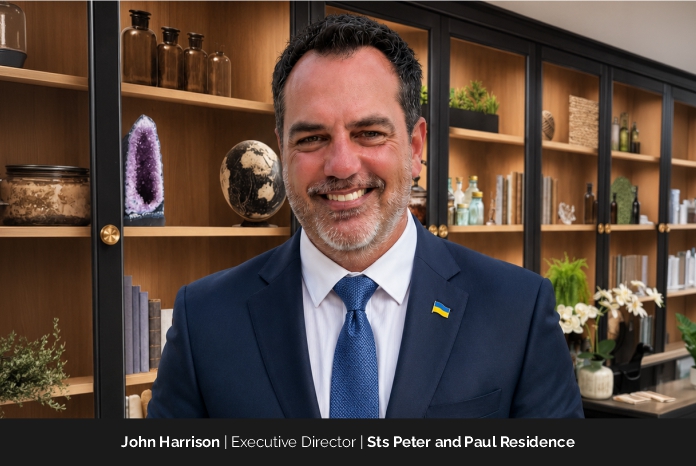
Some leaders frame healthcare as operations: compliance, budgets, staffing, risk, strategy, and performance. John Harrison knows that language. Twenty years in seniors’ care taught him that an organization must be managed, financially responsible, clinically accountable, and scrutiny-ready. His background spans long-term care, retirement, assisted living, memory care, non-profit housing, Ministry-regulated environments, turnaround, Board reporting, dementia, and palliative training.
Across those settings, one lesson remains: compassion is strongest when supported by discipline, and management protects dignity. But when John speaks about seniors care, it becomes personal – about families trusting a Home, residents carrying memories into a new chapter, and staff needing structure and purpose.
As Executive Director at Saints Peter and Paul, a non-profit, Board-governed Ukrainian community Home committed to seniors, families, and the community, John guides daily operations, turning vision into action, and keeping excellence visible in resident experience, while the Board oversees strategy.
Its Purpose Statement – Our Home Is Your Home – is not a slogan, but a standard. Residents should feel known, families heard, and staff supported. The Home must evolve while staying connected to its Ukrainian roots, community mission, and resident-centered values.
“In seniors care, compassion without structure can become inconsistent. Structure without compassion can become cold. The work of leadership is to bring both together.”
Where Quiet Strength First Took Root
John’s values were shaped first by family. He understood responsibility before governance, compliance, or executive operations. “How you treat people matters most when they’re vulnerable, tired, afraid, or depending on you,” he reflects. “It taught me respect, resilience, and humility – that strength is often quiet – showing up consistently, doing the right thing, and standing by your values when circumstances are difficult.”
That foundation carried him through every career stage. “Leadership is never only about managing a building or meeting a target,” John explains. “It’s about a resident who deserves choice and dignity; a family carrying worry and guilt; staff in demanding roles; and earning a Board’s confidence.”
Healthcare leadership tested his judgment, patience, and stamina. Leading through regulatory scrutiny, a pandemic, staffing crises, and operational change, he learned that leadership isn’t proven when all is calm, but when you “create calm, make decisions under pressure, and help others believe improvement is possible.”
John credits his partner, who works in the hospital sector, and his senior mother for helping him stay grounded and connected to the human side of leadership. Time with his mother is a constant reminder that every senior is someone’s mother, father, spouse, friend, or neighbour, and that care must always be delivered with dignity and respect. His leadership philosophy is rooted in accountability with compassion, high standards supported by strong teams, and effective systems that never lose sight of the people they are meant to serve.
Protecting Dignity & Community Legacy
John entered seniors’ care not as a career ladder, but because the work mattered. Early exposure to families in crisis taught him to listen before judging. “People are never defined by one diagnosis or one difficult moment,” he says. “Senior care touches every part of a person’s life. When you support a senior, you’re supporting a life story.”
For nearly 20 years, John has worked across long-term care, retirement, assisted living, memory care, and non-profit housing. “Good care never happens by accident,” he notes. “It requires trained staff, regulatory knowledge, financial stewardship, and a culture that refuses complacency.”
What inspires him is the belief that seniors deserve to be known, respected, and protected. “That’s what makes Saints Peter and Paul meaningful – a Ukrainian Home that carries history, culture, faith, family, and memory,” he says. “Leading there is a privilege – protecting a community legacy while preparing for the future of seniors’ care.”
Balancing Leadership & Personal Life
Executive leadership in seniors’ care doesn’t end at the office door. For John, balance begins with purpose. “When I remember why the work matters, the demands become more meaningful,” he says. “You can’t lead well from exhaustion.” At home, he reconnects with what grounds him – time with his senior mother, his dogs Roxy and Buttons, and tinkering with his sports cars and motorcycles. “It quiets the noise of the day,” he notes.
Caitlyn, who works in a hospital, helps him turn work off when possible. Weekend getaways, even short ones, create needed distance. “Balance isn’t pretending responsibility disappears,” John says. “It’s protecting the relationships and joys that allow me to lead with compassion and resilience.”
A Home First, Healthcare Second
Leading a retirement residence is unique because it’s both a healthcare environment and a home. Responsibilities include care, safety, compliance, belonging, meals, and dignity.
“A retirement residence must be clinically responsible without becoming cold. In a hospital, care focuses on an acute episode. Here, we’re part of a resident’s daily life,” John says. “Safe and regulated, but still personal. Policies and documentation, but warmth in the hallways.”
At Saints Peter and Paul, a Board provides governance while John guides daily operations. The model requires clarity and respect for the difference between governance and operations. The Home includes assisted living, memory care, market rent, and Rent-Geared-to-Income housing.
Leadership must balance healthcare, housing, rights, finance, and culture with fairness and transparency. For John, the core responsibility is to keep the Home clinically strong, financially responsible, culturally respectful, and deeply human.
Strong Board, Stronger Home
A strong Board protects the mission, oversees risk, and ensures accountability. “At Saints Peter and Paul, leadership is not about one person making decisions in isolation,” John explains. “It’s a respectful partnership between governance and operations.”
He provides clear, decision-ready reporting on quality, finances, compliance, staffing, and resident experience, translating complex issues into clear reporting so governance can be strong and informed.
When the Board and Executive Director share a commitment to dignity and sustainability, the Home grows stronger. That alignment drives initiatives like Memory Care and palliative care that require vision, planning, discipline, and long-term stewardship.
Accountability Balanced With Compassion
John’s greatest challenge has been leading through pressure without letting it define the culture. A defining moment came under Ministry scrutiny where he rebuilt systems, restored accountability, and helped people believe improvement was possible. His solution was based on three principles – clarity, accountability, and people.
“Leadership isn’t pretending challenges are smaller,” he explains. “It’s looking at them directly and keeping people aligned.” That experience deepened his respect for the staff and reinforced that compassion and empathy must be paired with accountability. “In seniors care, compassion is not optional,” John says. “Residents face loss, loneliness, or fear. Families struggle. Staff carry heavy demands. A leader who doesn’t understand that human reality cannot lead effectively.”
Empathy helps him pause and ask: What is this resident experiencing? What does this family fear? What support does this staff member need? Those questions strengthen leadership. But compassion doesn’t mean lowering standards. “Compassion without accountability creates inconsistency. Accountability without compassion creates fear. The balance of both creates trust,” he explains.
That balance is essential at Saints Peter and Paul – a Ukrainian Home with a universal mission of dignity, connection, and personal care. “Compassion is not a soft value,” John insists. “It’s a leadership responsibility.”
A True Sense Of Home
John’s proudest achievement is the Memory Care program, opened in October 2025. “It began as a vision: could we create memory care that felt less like a clinical unit and more like a true home?” he recalls. The Board embraced the idea. The floor was built around belonging: scenic murals as windows, a nursing station designed like an old pharmacy – familiar, not clinical.
“Thoughtful design supports dignity,” John explains. “It’s not just a specialized floor, but the care philosophy behind it. When a Board and Executive Director share a commitment to dignity, an idea becomes a real improvement in people’s lives.”
Looking ahead, a planned 2026 Palliative Care initiative will strengthen comfort-focused support. “Together, Memory Care and Palliative Care represent a commitment to supporting residents through the most vulnerable stages of aging,” he reflects. “That’s what ‘Our Home Is Your Home’ should mean.”
John is also excited by broader trends: integrated, person-centred care that keeps residents connected to community, identity, and home. “The future of seniors care will require organizations to move beyond traditional models,” he predicts.
He sees promise in interdisciplinary care, healthcare partnerships, data-driven quality improvement, and staff development – trends that help retirement residences become more clinically capable without losing warmth.
At Saints Peter and Paul, adaptation means honouring Ukrainian roots while building modern seniors’ care. “The future should not require residents to choose between strong healthcare and a true sense of home,” John insists. “They deserve both.”
Success Is Trust
John admits that while financial stability and operational performance matter, in seniors care, those metrics are not the full definition of success. Success is trust. A resident who feels safe. A family member who feels heard. A staff member who feels supported. A Board with confidence in the direction. A community that sees the Home as a place of care, belonging, and integrity.
Success is also a culture. Are people kind in the hallways? Are concerns addressed before they become crises? Are residents treated as individuals, not tasks? “Those questions matter as much as any dashboard,” John notes. At Saints Peter and Paul, success also means protecting Ukrainian identity and legacy while preparing for the future. Memory Care and planned Palliative Care show the Home is listening to residents and responding with purpose.
Practical Innovation, Real Dignity
John’s approach to innovation is practical. “It doesn’t have to be dramatic to be meaningful,” he says. In seniors’ care, innovation can mean clearer systems, better communication, earlier risk identification, and services that match resident needs.
The Memory Care program is a key example. “The intention was not simply to add another service,” John explains. “It was to create a living environment where residents could feel they still belonged.” Scenic murals, memory boxes outside every room, and a nursing station designed as an old pharmacy create comfort and recognition. For residents living with dementia, those cues reduce the feeling of being in a clinical space.
A vision must translate into planning, budgeting, Board communication, staffing, and training. The success of Memory Care is not only how it looks, but how it functions as part of a commitment to safety, dignity, and person-centered care. The planned 2026 Palliative Care initiative is about comfort, dignity, family support, and quality of life. “Some of the most important healthcare moments happen quietly,” John reflects.
He has also focused on fundamentals: accountability, documentation, risk reviews, staff coaching, and regulatory readiness. “If systems are weak, compassion becomes inconsistent,” he observes. “If systems are strong, compassion becomes dependable.”
Seniors Care Deserves the Best
John hopes his work shows future leaders that seniors care deserves their ambition, intelligence, and heart. “Seniors’ care is not a lesser part of healthcare. It’s one of the most complex and meaningful areas of the system,” he insists. “The future will need leaders who can hold two truths at once: care must be compassionate and well-managed. One without the other is not enough. The best leaders bring warmth and structure together.”
John also wants future leaders to value non-profit, Board-governed care. “A strong Board protects the mission,” he explains. “An Executive Director respects governance while providing operational leadership to make the vision real.” At Saints Peter and Paul, Memory Care, palliative care, and cultural belonging send a broader message that Community-based Homes can lead. They can innovate. They can be clinically responsible and deeply personal – preserving tradition while preparing for the future.
Never Forget Who the Work Is For
John’s advice to aspiring leaders in seniors care is to never forget who the work is for. “Seniors care leadership is not about title or authority. It’s about responsibility,” he says. “Every decision affects residents, families, staff, and the Board.”
He recommends spending time on the front line, listening to residents, families, and staff, understanding morning care, medication passes, family meetings, behavioral expressions, palliative conversations, and regulatory inspections. “You can’t lead seniors care from a distance,” he notes.
Aspiring leaders must become students of the sector, understanding legislation, quality improvement, governance, finance, staffing, and culture. “Compassion is essential, but it must be supported by competence,” John insists.
His advice is to stay resilient. “There’ll be days when your decisions are challenged. Return to your values. If decisions are grounded in resident safety, dignity, fairness, and integrity, you can stand behind them. Seniors care needs leaders willing to do hard things for the right reasons,” he declares.
Purpose Visible Every Day
John notes that a team stays motivated when people understand the mission, feel respected, and see consistency from leadership. “Every role shapes the resident experience,” he says. “Nursing, personal support, dietary, recreation, housekeeping, maintenance, administration – all matter.”
John connects his daily work to purpose. At Saints Peter and Paul, the mission is visible in memory care, Ukrainian culture, family communication, and palliative care. “Staff are not simply completing tasks. They’re protecting dignity,” he explains.
Motivation also requires clear expectations. Alignment comes from strong systems: defined roles, communication, training, and accountability. “People need support, but they also need structure,” John notes. “A healthy culture is built through fairness, clarity, follow-through, and trust. Excellence cannot be a word used only in meetings. It has to be how the Home operates.”
When staff see leadership and the Board share the same commitment, purpose strengthens. “People want to be part of something that matters,” John reflects. “My responsibility is to help them see that their work does matter.”
A Cookbook of Memory, Heritage, and Welcome
Another initiative of Saints Peter and Paul is a cookbook titled “Recipes, Memories, and Legacy” that honors residents’ lives, shaped by migration, faith, and family, through their cherished recipes and stories.
Residents and families are invited to share recipes with its story and photos, to create a portrait of heritage. The cookbook also offers space for donors to purchase pages.
Conclusion
John Harrison’s leadership is not defined by a title, but by a journey, from Ministry-regulated environments to non-profit seniors’ housing, from operational turnaround to community innovation. His work has been shaped by pressure, family values, discipline, and a belief that seniors’ care requires leaders with both competence and compassion.
At Saints Peter and Paul, governance, culture, and care come together with a shared purpose. The Board provides oversight and support, John leads the organization’s vision and operations, staff deliver compassionate care, and residents and families bring meaning to the work every day.
The 2025 Memory Care opening and the planned 2026 Palliative Care initiative reflect that vision being transformed into action. The Memory Care project has become a key step forward in expanding specialized care for residents. Its murals, old-pharmacy station, and warm, familiar design reflect John’s belief that quality care is shaped not only by policies, but by how residents feel in the spaces they call home.
For John, “Our Home Is Your Home” is more than a promise. It represents what leadership in seniors care should protect – dignity, trust, belonging, and the belief that every senior deserves care that honors the life they have lived.